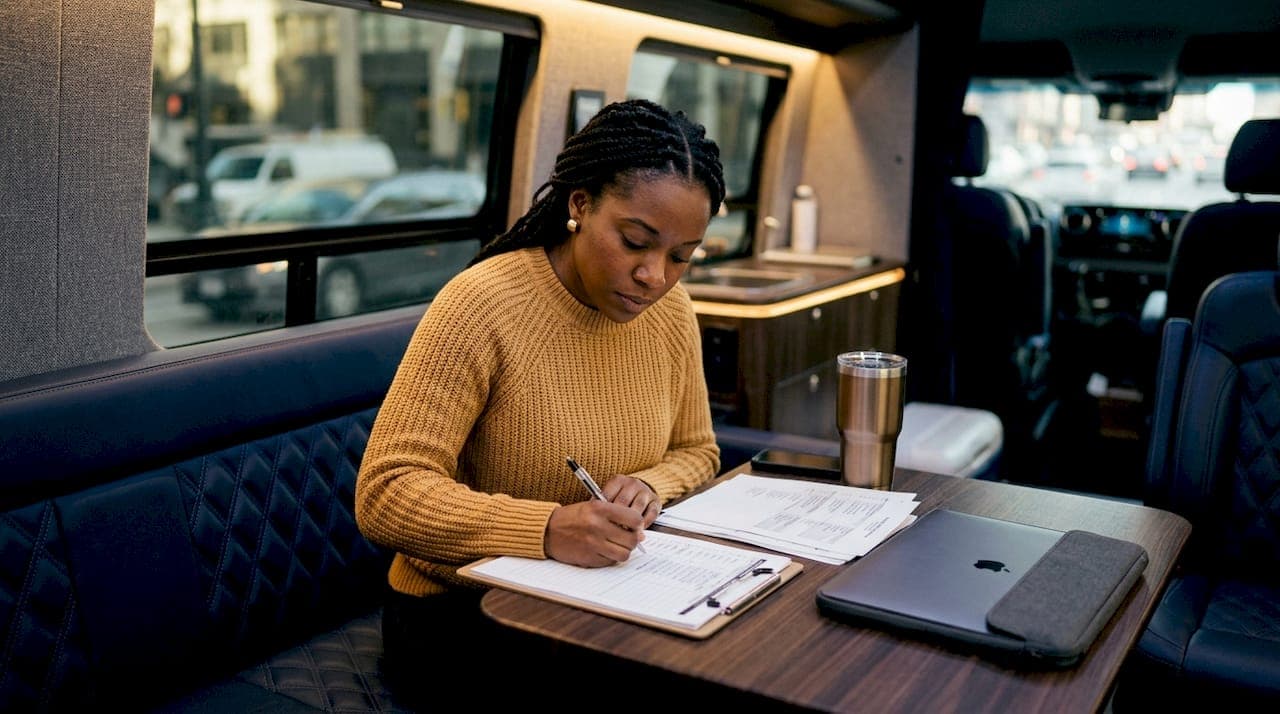
Luxury vans in productions are specialized ground transport assets that serve as mobile workspaces, talent sanctuaries, and crew shuttles on active film and TV sets. Production transportation, known in the industry as "base camp logistics," depends on these vehicles to keep talent rested, crew moving, and schedules intact. A single failed shuttle can halt an entire production day, making vehicle reliability a direct financial concern. For production managers and event planners, understanding how luxury vans function within this system is not optional. It is the foundation of every call sheet that actually runs on time.
What operational functions do luxury vans fulfill on production sets?
The role of luxury van in productions extends well beyond driving talent from point A to point B. These vehicles handle at least four distinct functions simultaneously, and each one affects the production schedule directly.
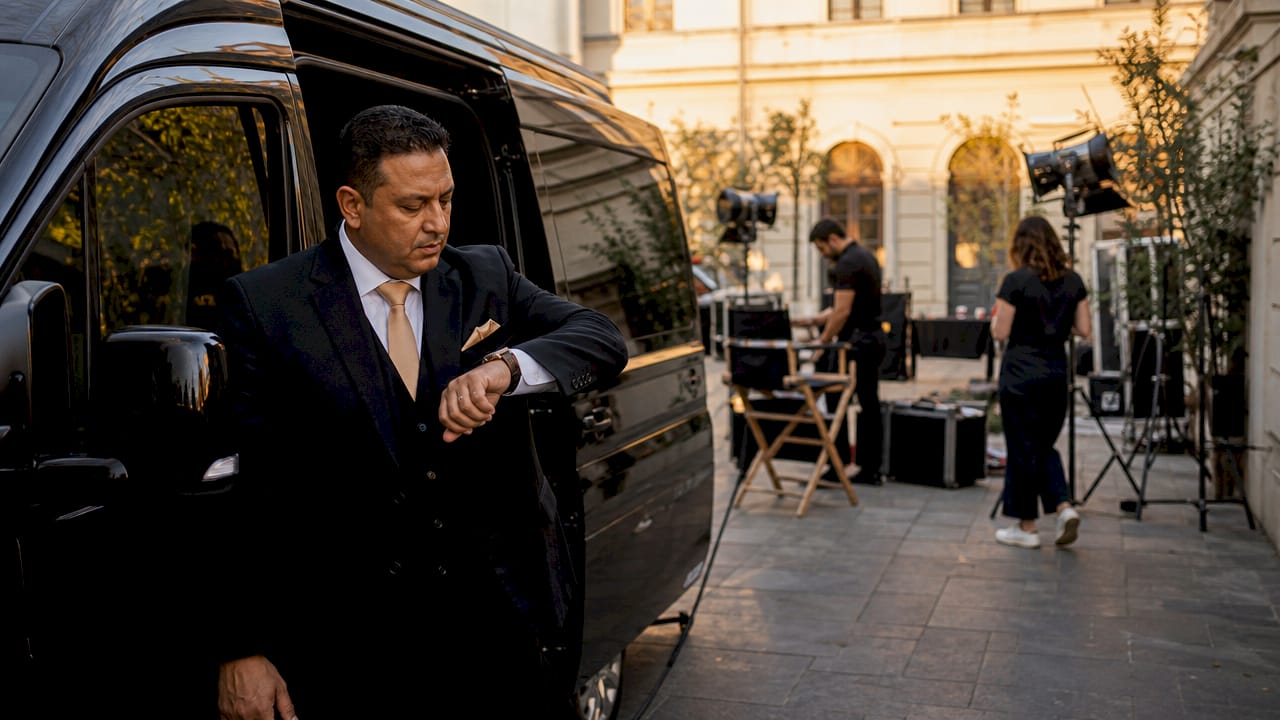
- Talent shuttling. Luxury vans move principal cast between hotels, location sets, and studio lots on tight call times. A delay of even 15 minutes ripples through every department waiting on set.
- Mobile prep suite. Hair, makeup, and wardrobe teams use the van's interior for touch-ups between scenes. Bespoke interiors with executive captain's chairs, worktables, and smart lighting make this practical rather than improvised.
- Private meeting space. Directors, producers, and senior talent use the van for script reviews, phone calls, and confidential conversations. The acoustic insulation in premium builds blocks ambient set noise effectively.
- Crew shuttle coordination. Department heads and key crew members rotate between base camp and set. Reliable broadcast crew shuttle service keeps these rotations predictable and documented.
Timing is the most underrated function. Productions run on union clock rules, and a van that arrives late triggers overtime charges across multiple departments. The vehicle is not a perk. It is a scheduling instrument.
Pro Tip: Assign a dedicated production coordinator to each luxury van run. That person owns the manifest, the route, and the communication chain. Drivers should never be the ones managing schedule changes in real time.
How do luxury vans compare to other production transport options?
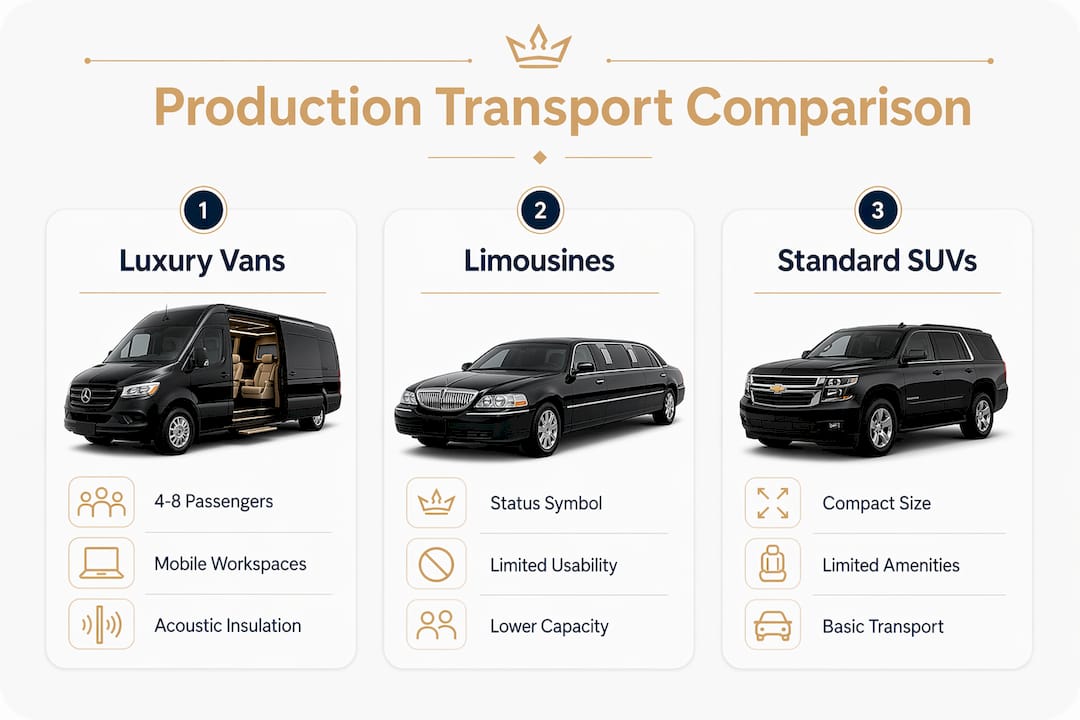
Production managers regularly choose between luxury vans, limousines, and standard SUVs. Each vehicle type serves a different operational profile.
Executive van conversions prioritize usable interior space for three or more passengers with mobile work and privacy capabilities. That design philosophy makes them the most versatile option on a working set.
| Feature | Luxury van | Limousine | Standard SUV |
|---|---|---|---|
| Passenger capacity (working) | 4–8 with workspace | 4–6, limited workspace | 3–5, minimal workspace |
| Standing interior height | Yes (most builds) | No | No |
| Mobile work surface | Built-in worktable | Rarely included | Not available |
| Acoustic privacy | High (custom insulation) | Moderate | Low |
| Equipment storage | Large rear cargo area | Minimal | Moderate |
| Cost per day (relative) | High, justified by function | High, limited utility | Lower, less capable |
Limousines project status but sacrifice usability. A talent principal cannot hold a script review or take a private call comfortably in a stretch limo with a glass partition. Standard SUVs offer flexibility for smaller crews but lack the workspace and privacy that senior talent require. The luxury van occupies the middle ground where comfort, capacity, and function converge. That is why white-glove studio transport standards consistently specify vans over other vehicle categories for principal cast.
What should production managers know when selecting luxury vans?
Selecting the wrong vehicle or the wrong builder creates financial exposure that far exceeds any upfront savings. Poor engineering and unreliable finishes cause costly downtime on production schedules where every hour carries a dollar figure.
Key criteria for evaluating luxury van builds and providers:
- Builder credentials. Reputable builders provide structural reinforcements and crash safety upgrades to accommodate heavy custom furniture and integrated technology. Ask for documentation.
- Interior finish quality. Stitching, cabinetry, and electrical systems in lower-quality builds fail under daily production use. Premium upfits hold up across multi-week shoots.
- Telematics integration. Real-time telematics monitoring of location, idle time, and maintenance intervals keeps vans reliable and on schedule. This is not optional for productions running more than five vehicles.
- Union compliance. Four or more production vehicles trigger specific union labor agreements affecting driver and mechanic assignments. Production managers must account for this in their logistics plans before the first day of principal photography.
- Maintenance scheduling. Vehicles on a six-day shoot week need pre-scheduled service windows. A van that goes down mid-production has no easy replacement path without advance planning.
TV production ground transportation in major markets like New York requires providers who already understand these union rules and build compliance into their service agreements. Vetting a provider on this point alone eliminates a significant category of scheduling risk.
Pro Tip: Request a full vehicle inspection report and telematics access before signing any production transport contract. A provider unwilling to share that data is a provider whose reliability you cannot verify.
Luxury van builds for executive production use typically start around $200,000 and often exceed $500,000 for fully custom configurations. That price range reflects the engineering, safety, and technology investment required to make these vehicles function as genuine production assets rather than upgraded passenger transport.
How does a luxury van enhance talent experience and productivity?
Senior talent on long-duration shoots face a specific challenge: maintaining performance across 12-hour days in chaotic, high-stimulus environments. The luxury van solves this by providing a controlled space between the set and the outside world.
"Luxury vans serve as sanctuaries, helping high-profile talent maintain calm and performance amidst the chaos of production sets. The vehicle becomes the one consistent, quiet space in a day full of variables."
Insight from production transport analysis, Autoweek
The modern approach to luxury van design follows what the industry calls "discreet opulence." The exterior reads as professional transport. The interior functions as a private office, prep suite, or rest space depending on what the talent needs at that moment. This philosophy prioritizes internal productivity and privacy over visible status signals.
Practically, this means a lead actor can run lines, take a call with their agent, or simply decompress between takes without leaving the production footprint. A director can review dailies on a worktable with a producer while the van moves to the next location. Celebrity and talent transportation at this level requires vehicles that support work, not just transit.
The productivity benefit extends to production managers as well. When talent arrives at set rested and prepared rather than stressed from a chaotic commute, the first setup of the day runs faster. That time savings compounds across a full production schedule.
Key Takeaways
Luxury vans are the most operationally versatile production transport asset available, combining talent comfort, mobile workspace capability, and scheduling reliability in a single vehicle.
| Point | Details |
|---|---|
| Operational versatility | Luxury vans serve as shuttles, prep suites, and meeting spaces simultaneously on active sets. |
| Scheduling reliability | A single failed shuttle can halt a full production day, making vehicle uptime a financial priority. |
| Builder quality matters | Poor engineering causes costly downtime that exceeds any savings from lower-quality builds. |
| Union compliance | Four or more production vehicles trigger labor agreements that must be planned before principal photography begins. |
| Talent productivity | A controlled, private vehicle environment helps senior talent maintain performance across long shoot days. |
What I've learned about luxury vans that most production guides miss
I've watched production managers treat vehicle selection as a procurement checkbox rather than a logistics decision. That mistake shows up on day three of a shoot when the van is down, the talent is waiting in a parking lot, and the AD is burning through contingency time.
The most common error is separating the vehicle budget from the scheduling budget. A cheaper van that breaks down twice during a four-week shoot costs more than a premium build that runs clean. The math is straightforward once you factor in crew overtime, talent holding fees, and the reputational cost of a disorganized set.
The second mistake is ignoring telematics until something goes wrong. Productions that integrate real-time vehicle monitoring from day one catch maintenance issues before they become schedule problems. That is not a technology preference. It is basic risk management.
The trend I find most significant for 2026 is the shift toward treating luxury vans as mobile production infrastructure rather than transport perks. The best productions I've observed budget for the van the same way they budget for a camera package. It is a tool that enables the work, not a line item to minimize.
My recommendation: hire a provider with documented union compliance experience, telematics access, and a proven fleet maintenance record. The vehicle itself matters less than the operational system behind it.
— Sammy
Rigaglobaltravel's production transport services
Production managers working in major markets need a transport partner who already knows the rules before the first call sheet drops.
Rigaglobaltravel provides luxury talent transportation for film and TV productions across New York, Los Angeles, Miami, and Connecticut. Every vehicle in the fleet is chauffeur-driven by professionals who understand production schedules, union protocols, and the privacy requirements of high-profile talent. Rigaglobaltravel's New York limousine service and production-specific ground transport options are built for the pace and precision that entertainment productions demand. Contact Rigaglobaltravel to discuss a transport plan for your next production.
FAQ
What is the primary role of a luxury van on a film set?
A luxury van functions as a mobile workspace, talent shuttle, and private meeting space on active production sets. Its reliability directly affects the daily schedule and crew efficiency.
How do luxury vans differ from standard production SUVs?
Luxury vans offer standing interior height, built-in worktables, acoustic insulation, and larger passenger capacity than standard SUVs. These features make them the preferred choice for principal cast and senior production staff.
What triggers union labor rules for production vehicles?
Four or more production vehicles on a unionized set trigger specific labor agreements affecting driver and mechanic assignments. Production managers must account for this before principal photography begins.
How much does a production-grade luxury van cost?
Executive luxury van builds start around $200,000 and frequently exceed $500,000 for fully custom configurations designed for production use.
Why is telematics important for production van fleets?
Telematics systems monitor location, idle time, and maintenance intervals in real time. This data prevents unexpected breakdowns that would otherwise halt production schedules.