
Limousine services in talent contracts are defined as contractual transportation provisions that guarantee secure, reliable, and coordinated movement of talent across production, event, and touring environments. The role of limousine in talent contracts extends far beyond vehicle provision. It functions as a privacy and security layer that directly influences production schedules, talent safety, and operational accountability. Companies like Noble Black Car and platforms using GPS dispatch technology have demonstrated that transportation clauses, when written correctly, prevent costly production delays and protect talent from unplanned public exposure. For talent agents and entertainment professionals, understanding how these clauses work is not optional. It is a core competency.
What contractual terms govern limousine services in talent transportation
Transportation clauses in talent contracts function as service-level agreements, not simple vendor bookings. The contract scope must emphasize service reliability, security integration, and performance accountability above all else. When these clauses are vague, productions absorb the cost of vendor failures directly.
The standard terms you will encounter in well-drafted limousine clauses include:
- Pricing model: Hourly versus point-to-point rates, with clear overtime thresholds and billing increments
- Cancellation and no-show policies: Defined windows for penalty-free cancellation and financial consequences for missed pickups
- Insurance requirements: Coverage for both the vehicle and all passengers, with minimum liability limits specified
- Driver qualifications: Background check requirements, licensing standards, and professional conduct expectations
- Vehicle standards: Age, condition, and maintenance certification requirements for all contracted vehicles
- GPS dispatch technology: Mandatory real-time tracking and live ETA sharing for all active runs
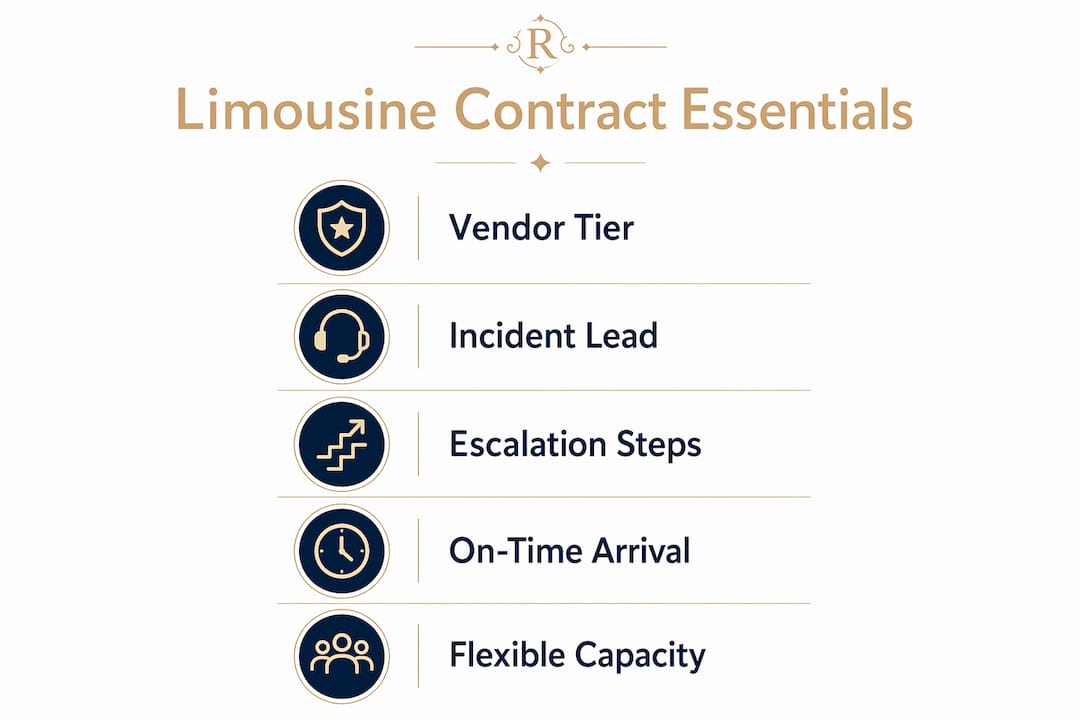
The vendor tier structure is one of the most underused protections in talent transportation contracts. Pre-tiered vendors with primary, secondary, and emergency categories reduce the risk of a single provider failure cascading into a production delay. Each tier should have pre-negotiated rates and confirmed availability windows.
Pro Tip: Insist on naming an Incident Lead in every limousine contract. This individual holds explicit authority to rebook, reroute, or escalate to a backup vendor without requiring production approval. That single clause has saved more shoots than any other provision.

Escalation procedures must be written into the contract with a clear authority hierarchy. Without them, a missed pickup at 5:00 a.m. becomes a 45-minute phone chain instead of a two-minute fix.
How limousine services coordinate with production security and scheduling
The operational integration of limousine transportation with talent security teams is what separates professional entertainment transport from standard car service. Limousine vehicles use dark tinting, private cabins, and trained discreet drivers to maintain a protected bubble around talent from the moment they leave their hotel or residence.
The coordination process follows a structured sequence:
- Pre-production route planning: Drivers receive call sheets and production schedules 24 to 48 hours in advance to map routes that avoid high-traffic public areas and known paparazzi positions.
- Back-of-house pickup coordination: Security teams designate private entry and exit points at venues, hotels, and studios. Drivers are briefed on these locations before departure.
- Real-time GPS and dispatch management: Integrated GPS dispatch platforms allow Incident Leads to monitor all active vehicles and push rerouting instructions instantly when conditions change.
- Live ETA sharing: Production coordinators and personal security receive live ETAs so they can adjust green room timing, security positioning, and stage calls accordingly.
- Wrap coordination: Drivers are staged and ready before wrap is called, not summoned after. This eliminates the gap between talent leaving set and entering a secure vehicle.
Delayed or missed pickups negatively impact production schedules and cause costly overruns that compound across the day. A single 20-minute delay at the first pickup of the day can push every subsequent call time, affecting crew overtime, venue access windows, and catering logistics simultaneously.
Luxury transport vehicles in entertainment are also equipped as mobile green rooms with customized rider preferences, allowing talent to prepare, rest, or conduct calls in transit. This is not a comfort upgrade. It is a productivity tool that keeps talent performance-ready between locations.
Pro Tip: Ask your limousine provider for a talent tour transportation protocol document before signing. If they cannot produce one, they are not equipped for entertainment-grade logistics.
How do limousine contract roles differ across touring, event, and production contexts?
The contractual requirements for limousine services shift significantly depending on whether you are managing a touring cast, a single-night event, or an ongoing production shoot. Each context carries distinct operational demands and failure modes.
| Context | Contract focus | Vehicle requirements | Key risk |
|---|---|---|---|
| Touring cast | Layered vendor tiers, incident escalation, city-by-city provider networks | Multiple vehicle classes, ADA compliance where required | Vendor gaps between markets |
| Single event | Multi-venue coordination, tight scheduling windows, same-day rebooking | Consistent vehicle class, high availability during peak hours | Timing failures across venue transitions |
| Production shoot | Punctual set arrivals, wrap timing support, location-specific routing | Reliable sedans and SUVs, driver familiarity with studio lots | Cascading delays from first pickup |
Touring contracts carry the highest operational complexity. Touring contracts emphasize layered vendors and incident escalation because each city introduces a new provider network with different reliability profiles. Agents negotiating touring transportation clauses should require that the primary vendor certify local partner relationships in every market before the contract is signed.
Event contracts prioritize speed and coordination. When talent moves between a press junket, a red carpet, and an after-party in a single evening, limousine services provide seamless coordination for multiple location transitions with active rebooking built into the service model. The contract must define response time for schedule changes in minutes, not hours.
Production contracts focus on one metric above all others: on-time arrival at set. A talent arrival that is 15 minutes late can push a full crew of 50 or more people into overtime. The financial exposure from a single missed pickup on a union production is significant. Production limousine clauses should include on-time guarantees with financial penalties and pre-approved backup vehicle provisions.
For a deeper look at how streaming companies structure these logistics at scale, the limo fleet strategies used by major platforms offer a useful operational benchmark.
Best practices for negotiating and managing limousine clauses in talent contracts
Effective limousine clause negotiation requires treating transportation as a critical production dependency, not a line-item afterthought. The following practices reflect what actually works in entertainment contracts, not what sounds good in a template.
- Assign a named Incident Lead: Every contract should identify a single individual with authority to make transportation decisions in real time. This person can rebook, reroute, or escalate without waiting for approval chains.
- Build a vendor tier list before signing: Identify primary, secondary, and emergency providers in advance. Confirm their availability windows, vehicle inventory, and pricing. A vendor tier list with no confirmed capacity is not a contingency plan.
- Write service-level commitments into the contract: On-time guarantees, maximum response times for schedule changes, and escalation timelines should all carry defined consequences. Vague language like "best efforts" is not enforceable.
- Align billing with production accounting: Invoicing cycles, purchase order requirements, and expense coding should be agreed upon before the first run. Billing disputes after production wraps create unnecessary friction.
- Include spare vehicle provisions during peak periods: Award ceremonies, festival days, and multi-venue events create demand spikes. Contracts should require the vendor to hold at least one spare vehicle on standby during these windows.
Pro Tip: Secure flexible vehicle capacity clauses that allow you to scale up or down within 24 hours without penalty. Productions change. Your transportation contract should change with them.
Cancellation scenarios deserve specific attention. Define what constitutes a force majeure event, what notice period triggers a penalty-free cancellation, and what the financial exposure is for same-day cancellations. These terms are negotiable before signing and nearly impossible to change after a dispute begins.
The entertainment industry limo benefits that professionals consistently cite are not about vehicle class. They are about reliability, accountability, and the confidence that transportation will not become a production problem.
Key takeaways
The role of limousine in talent contracts is defined by operational reliability, security integration, and contractual accountability, not vehicle luxury.
| Point | Details |
|---|---|
| Limousines as service-level agreements | Treat transportation clauses as performance contracts with defined guarantees and escalation procedures. |
| Incident Lead authority | Naming a single decision-maker in the contract prevents delays from becoming cascading production failures. |
| Vendor tier structure | Primary, secondary, and emergency providers must be pre-confirmed before the contract is signed. |
| Context-specific terms | Touring, event, and production contracts each require distinct clauses, vehicle standards, and risk mitigation approaches. |
| Security and privacy integration | Back-of-house pickups, GPS dispatch, and discreet drivers are contractual requirements, not optional upgrades. |
Why transportation contracts are where productions actually win or lose
After years of working in entertainment logistics, the pattern I keep seeing is the same. Productions invest enormous resources in talent, crew, and locations, then treat transportation as a commodity purchase. That is where things go wrong.
The contracts that hold up under real-world pressure are the ones that were built around failure scenarios, not ideal conditions. What happens when the primary vendor has a breakdown at 4:00 a.m.? Who makes the call? How fast can a backup vehicle be confirmed? If your contract does not answer those questions in writing, you are relying on goodwill instead of accountability.
I have also watched the privacy dimension get underestimated repeatedly. A talent arriving at a public entrance because the back-of-house protocol was not written into the contract is not just an inconvenience. It is a security exposure and a reputation management problem. The coordination with personal security has to be baked into the transportation clause from day one, not added as an afterthought when something goes wrong.
The providers worth working with are the ones who understand production schedules, speak the language of call sheets and wrap times, and have technology that gives you real-time visibility into every vehicle. That combination of industry knowledge and operational infrastructure is what separates entertainment-grade transport from a standard car service account.
— Sammy
How Rigaglobaltravel supports talent contract transportation needs
Rigaglobaltravel specializes in limousine and concierge services built specifically for the entertainment industry. The team understands production schedules, call sheets, and the security protocols that talent contracts require. Every run is backed by GPS dispatch technology, a scalable fleet, and drivers trained for the discretion and reliability that entertainment logistics demand.
For talent agents and production coordinators who need transportation that performs under contract-grade pressure, Rigaglobaltravel delivers concierge-level transport with the operational depth to support touring casts, single-night events, and ongoing production shoots. When transportation reliability is non-negotiable, the right provider makes that clause easy to fulfill.
FAQ
What is the role of limousine in talent contracts?
The role of limousine in talent contracts is to provide contractually guaranteed, secure, and reliable transportation that protects talent privacy, supports production schedules, and defines vendor accountability through service-level terms.
Why do talent contracts specify limousine services instead of general car service?
Limousine contracts include specific provisions for driver qualifications, vehicle standards, GPS tracking, and escalation procedures that standard car service agreements do not cover. These terms are necessary to meet the security and reliability demands of entertainment production.
What is a vendor tier system in limousine contracts?
A vendor tier system designates primary, secondary, and emergency transportation providers in advance, so that if one vendor fails, a pre-confirmed backup is activated immediately without requiring new negotiations during a live production.
How does an Incident Lead improve limousine contract performance?
An Incident Lead is a named individual with authority to rebook, reroute, or escalate to a backup vendor in real time. This role eliminates approval delays and is one of the most effective protections against transportation-related production disruptions.
How do limousine contracts differ for touring versus single-event productions?
Touring contracts require layered vendor networks across multiple markets with city-by-city provider confirmation. Single-event contracts prioritize tight scheduling windows and same-day rebooking capacity for multiple venue transitions within a single day.