
A post-production travel service is a specialized logistics solution that manages all travel needs for film and television productions during the editing, sound mixing, color grading, and delivery phases. Unlike standard corporate travel, these services are built around production schedules, call sheets, and wrap days. They coordinate crew movement, equipment transport, and last-minute itinerary changes with the same urgency the production floor demands. Rigaglobaltravel provides exactly this kind of production-focused travel management, combining 24/7 specialist support with deep knowledge of how entertainment projects actually run.
What is a post-production travel service and how does it work?
A post-production travel service manages the full scope of travel logistics that arise after principal photography ends. This includes transporting editors, colorists, sound designers, visual effects supervisors, and producers between studios, facilities, and remote locations as the project moves toward final delivery.
The service integrates directly with the production timeline rather than operating as a separate administrative function. Production travel must be integrated with the production process itself, because this integration transforms travel into a stabilizing force within a fluid schedule. When a colorist needs to be on-site in New York one day and in Los Angeles two days later, a post-production travel service handles the booking, ground transportation, and contingency options without pulling the production coordinator away from other tasks.
Three core functions define these services:
- Schedule alignment: Travel plans are built around call sheets, recce schedules, and unit moves, not standard business hours.
- Consolidated invoicing: All travel expenses are tracked and billed by project code, giving production accounting a clean, auditable record.
- 24/7 emergency support: Flight cancellations, last-minute reshoots, and schedule shifts are handled in real time, with backup routes and alternative accommodations prepared in advance.
Production travel specialists understand production language. Specialists read call sheets and recce schedules to ensure travel aligns perfectly with unit moves and wrap days. That expertise is what separates a production travel service from a generic corporate travel agent.
How do these services handle complex scheduling and logistics?
Post-production scheduling is rarely linear. A director may need to return to set for reshoots while the editor is still cutting. A sound mixer may need to fly to a remote facility for a final mix session with 48 hours' notice. These demands require a travel partner that treats disruption as a routine operational variable, not an exception.

Dedicated production travel specialists manage early call times, night shoots, and quick turnarounds, helping productions avoid last-minute booking premiums and budget overruns. A specialist who knows that a "martini shot" signals the end of the day can pre-position ground transportation accordingly. That level of contextual knowledge prevents the kind of miscommunication that costs productions real money.
Pro Tip: Build a travel brief at the start of post-production that lists all key personnel, their home cities, and anticipated travel windows. Share it with your travel specialist so they can pre-negotiate rates and hold inventory before schedules firm up.
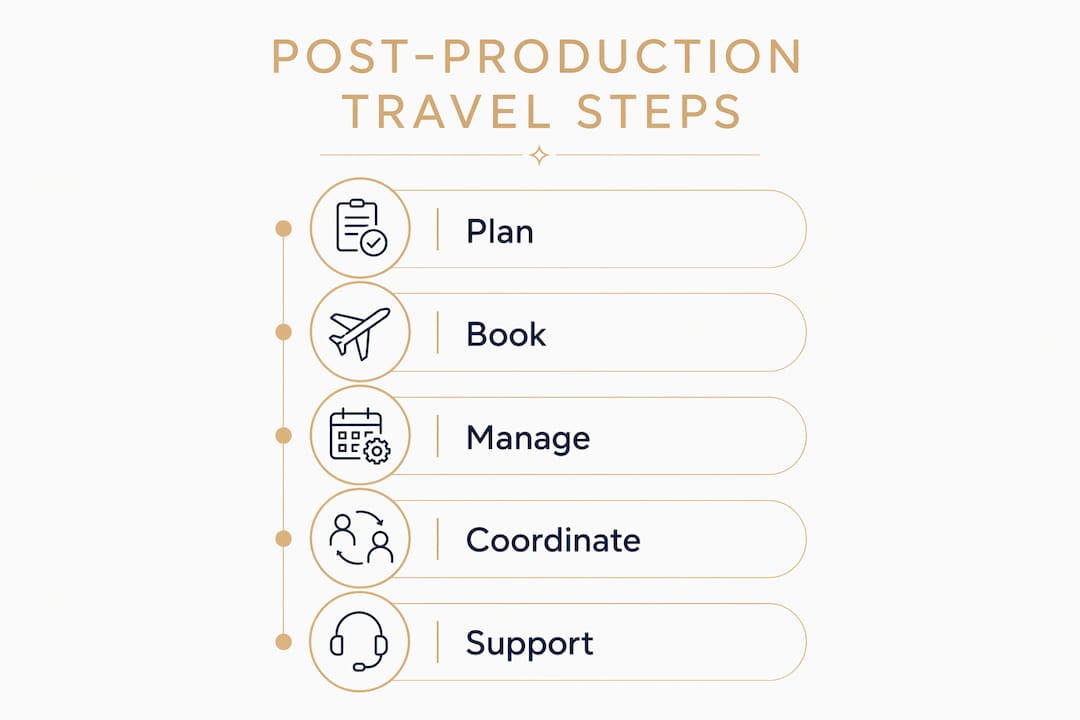
Multi-city itineraries are another area where these services prove their value. A single post-production phase may involve facilities in Atlanta, New York, and London. Structured travel coordination turns travel disruptions from production-breaking problems into background operational processes. The production team stays focused on the creative work. The travel specialist handles the logistics behind the scenes.
Ground transportation is a critical and often underestimated component. Productions managing TV production ground transportation in major markets like New York know that a missed pickup for a key editor can cascade into a delayed session and a missed delivery deadline.
What are the financial benefits of specialized post-production travel?
Budget control is one of the strongest arguments for using a dedicated post-production travel service. Production travel services include policy alignment, negotiated media baggage rates, and real-time re-routing of cast and crew, all consolidated by project code. That structure gives production accountants a single, clean view of travel spend rather than a pile of individual expense reports.
Negotiated rates for media baggage and equipment transport represent a direct cost saving that generic travel agents cannot match. A colorist traveling with a calibrated monitor or a sound editor moving with a portable rig faces baggage fees that standard booking platforms do not account for. A production travel specialist negotiates these rates in advance.
| Financial benefit | How it works |
|---|---|
| Consolidated invoicing | All travel billed by project code for clean accounting |
| Negotiated media baggage rates | Pre-arranged fees for equipment and oversized gear |
| Loyalty program consolidation | Points pooled under the production entity to offset costs |
| Avoidance of last-minute premiums | Pre-held inventory and contingency bookings reduce surge pricing |
| Real-time budget visibility | Live spend tracking tied to production finance systems |
Centralizing loyalty programs under the production entity allows for pooling rewards and points from multiple crew members' travel, significantly lowering overall costs for multi-location projects. This strategy is frequently overlooked by productions that treat travel as an individual expense rather than a collective one. On a project with 20 traveling crew members, the accumulated points can cover multiple additional flights or hotel nights.
Handling travel logistics internally without specialists raises opportunity costs significantly as project scope scales. The time a production coordinator spends chasing flight changes is time not spent managing the schedule, the vendors, or the budget.
How do post-production travel services support remote workflows?
Remote post-production has become a standard working model. Editors cut from home studios. Colorists grade remotely using cloud-based review tools. VFX teams collaborate across time zones. This shift does not eliminate the need for travel. It changes the nature of that travel and makes coordination more complex.
AI-assisted tools and remote-first workflows can reduce editing hours by up to 40%, and optimized travel logistics contribute to net margins 18% higher than industry averages on comparable projects. Those gains depend on travel and digital workflows operating in sync, not independently.
Here is how production teams can align travel with remote post-production workflows:
- Map the digital delivery windows. Know when cloud proxies are ingested and when remote editors need to be on-site for critical review sessions. Build travel around those dates.
- Coordinate travel with asset delivery. Cloud proxy ingestion over high-speed connections enables simultaneous remote editing. Travel arrangements should synchronize with these windows to prevent finalization delays.
- Plan for post-mortem travel. Vendor performance reviews and wrap meetings often require in-person attendance. Include these in the travel brief from the start.
- Account for complex footage demands. Drone, GoPro, and multi-camera footage creates longer editing hours and requires targeted editor support through coordinated travel logistics.
- Use travel to support, not replace, digital tools. Remote workflows reduce travel volume. A post-production travel service ensures the travel that does happen is timed correctly and executed without friction.
Pro Tip: Ask your travel specialist to flag any travel dates that conflict with major digital delivery milestones. A flight delay on the day a final cut is due can push the entire delivery schedule.
What steps help production teams get the most from these services?
Getting full value from a post-production travel service requires treating it as an integrated part of production management, not a booking tool you call when you need a flight.
- Assign a single point of contact. One production coordinator should own the relationship with the travel specialist. Fragmented communication leads to duplicate bookings and missed updates.
- Share the production schedule early. The more lead time a travel specialist has, the better the rates and the stronger the contingency planning. Contingency planning and stability despite shifting filming schedules are the core value of a dedicated specialist.
- Consolidate all loyalty accounts under the production entity. Do not let individual crew members book on personal accounts. Pool the points.
- Review travel spend weekly against the production budget. Real-time visibility prevents surprises at wrap.
- Brief the travel specialist on production terminology. Share the call sheet format, explain what a unit move means, and clarify how wrap days are structured. A specialist who already knows this language, as production travel experts do, will deliver better results from day one.
White-glove studio transport practices reinforce these principles at the ground transportation level, where precision timing and crew comfort directly affect on-set performance.
Key Takeaways
A post-production travel service is not a luxury. It is an operational requirement for any production that moves people, equipment, and schedules across multiple locations during finalization.
| Point | Details |
|---|---|
| Core definition | A post-production travel service manages crew and equipment logistics during editing, mixing, and delivery phases. |
| Schedule integration | Travel plans must align with call sheets, wrap days, and digital delivery windows to prevent costly delays. |
| Financial control | Consolidated invoicing by project code and negotiated media baggage rates deliver measurable budget savings. |
| Remote workflow sync | Travel logistics must coordinate with cloud proxy ingestion and remote editing schedules to protect delivery timelines. |
| Specialist expertise | Production travel specialists who read call sheets and understand production language outperform generic travel agents on every metric. |
Why production travel deserves more respect than it gets
Productions spend months obsessing over every line in the budget. They negotiate vendor rates, track equipment costs to the dollar, and review every VFX invoice. Then they hand travel to whoever has a moment to book flights on a consumer site. I have watched that approach cost productions far more than the fee for a dedicated travel specialist would have.
The productions that run well treat travel as a production department, not an afterthought. When a specialist knows that a "check the gate" call means travel needs to move within the hour, that knowledge is worth real money. When loyalty points are pooled correctly, a multi-city project can recover meaningful budget. When contingency bookings are in place before a reshoot is confirmed, the production does not lose a day waiting for seats.
The future of post-production travel will involve tighter integration with digital workflow platforms. Travel specialists will eventually sync directly with production management software to flag conflicts before they happen. Productions that build that relationship now will be ahead of the curve when the tools catch up.
Treat travel as a production element. Staff it accordingly. The savings and the reduced stress will show up in every phase of post.
— Sammy
Rigaglobaltravel's production travel services
Film and television productions operating across New York, Los Angeles, Miami, and Connecticut need a travel partner that understands the difference between a call sheet and a boarding pass.

Rigaglobaltravel provides limousine and chauffeur services built specifically for the entertainment industry, with 24/7 availability, production-aware scheduling, and ground transportation that moves with your crew, not against your timeline. From celebrity and talent transportation to multi-location crew logistics, Rigaglobaltravel handles the complexity so your production team stays focused on the work. Contact Rigaglobaltravel to discuss your post-production travel requirements.
FAQ
What is a post-production travel service?
A post-production travel service is a specialized logistics solution that manages crew, talent, and equipment travel during the editing, sound, color, and delivery phases of a film or television project. It integrates with production schedules and provides 24/7 support for last-minute changes.
How does post-production travel differ from standard corporate travel?
Production travel specialists read call sheets, understand unit moves, and manage media baggage rates. Standard corporate travel agents do not have this production-specific knowledge, which leads to miscommunication and costly booking errors.
What financial benefits do these services provide?
Consolidated invoicing by project code, negotiated media baggage rates, and pooled loyalty programs reduce overall travel spend. Avoiding last-minute booking premiums alone can represent significant savings on a multi-location production.
How do post-production travel services support remote editing teams?
Travel logistics are coordinated with cloud proxy ingestion schedules and digital delivery windows, ensuring editors are on-site when needed and remote when the workflow allows. This synchronization prevents delays in final delivery.
When should a production engage a post-production travel specialist?
Productions should engage a specialist at the start of post-production, not when the first flight needs booking. Early engagement allows for pre-negotiated rates, contingency planning, and loyalty program consolidation before schedules firm up.