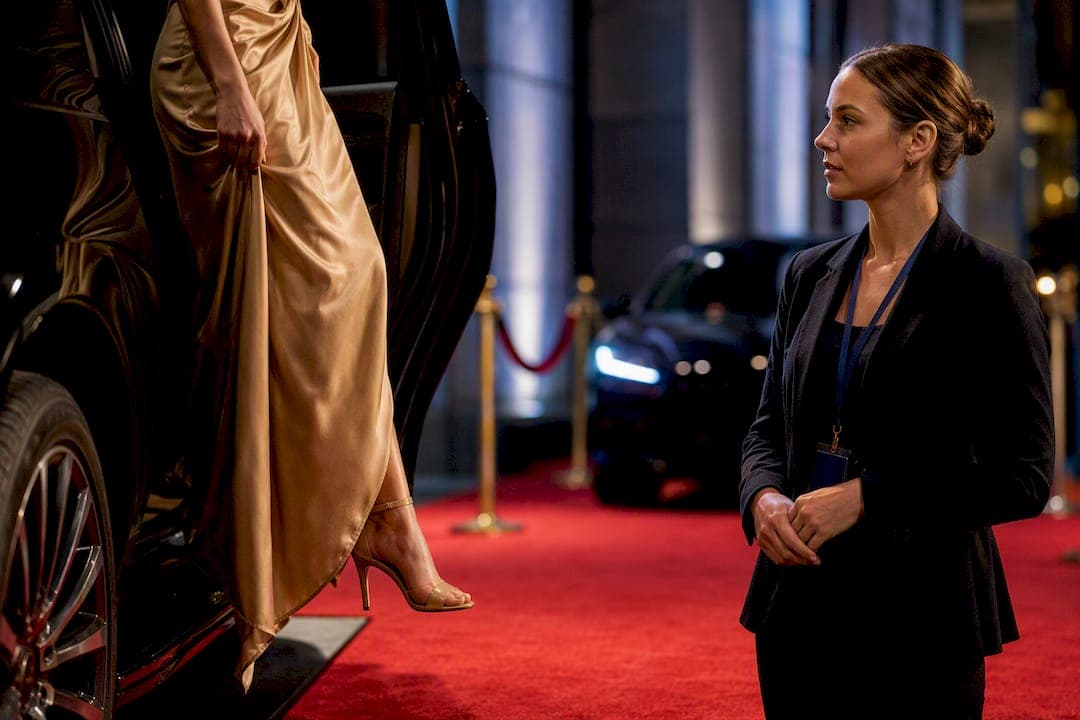
Red carpet logistics means coordinating secure, on-time VIP arrivals and departures through chauffeured transport, staged handoffs, and a single command structure that can adapt in real time. The outcome that matters is discreet, punctual movement with backup vehicles and routes ready if anything slips. The first move for any production team: centralize the guest manifest and name one transport coordinator with the authority to make changes on the spot.
TL;DR:
- Building flexible movement windows around real variables like delays and traffic reduces late arrivals more effectively than fixed pickup times.
- Assigning vehicles based on guest wardrobe and equipment volume improves practicality and presentation, especially when choosing between SUVs, EV sedans, or vans.
- Having a single transport coordinator with authority over the manifest and changes prevents miscommunication and keeps a tight command structure.
- Cooperating with security and venue staff beforehand, and staging standby resources, minimizes risks during arrivals and departures.
- Constant live vehicle tracking, redundant communication channels, and immediate contingency plans are essential for smooth event execution and safety.
Table of Contents
- What Belongs on Your Red Carpet Logistics Checklist
- Which Vehicles Actually Work for Red Carpet Arrivals
- How Do You Sequence Timing and Routing for a Red Carpet Arrival?
- Security Coordination and Chauffeur Protocols You Should Expect
- Connecting Flights to the Red Carpet Timeline
- On-Site Handoff and Departure: The Part Most Plans Get Wrong
- Who's In Charge? Command Structure and Manifest Control
- What Riga Global Travel's Playbooks Reveal About White-Glove Arrivals
- A Coordinator's Honest Priority List for Event Week
- How Riga Global Travel Handles Red Carpet Logistics
- Sources
What Belongs on Your Red Carpet Logistics Checklist
Every arrival plan starts with a manifest that answers questions before anyone has to ask them. Skip a field now, and you'll be fielding a panicked phone call from a chauffeur two minutes before a nominee's car is supposed to hit the carpet.
The manifest needs, at minimum:
- Full name (and alias, if the guest is traveling under one), role, and direct contact number with country code
- Flight or train number, airline, and expected deplaning time
- Luggage and equipment count, plus any wardrobe or stylist gear traveling separately
- Access credentials and accreditation level for venue entry
- Assigned vehicle, chauffeur name, and mobile number
Beyond the manifest, four operational habits separate smooth arrivals from chaotic ones:
- Build movement windows instead of fixed pickup times, and sequence convoys so vehicles don't bottleneck at the same access point.
- Assign vehicles by guest profile: nominees get dedicated cars, entourages get vans, stylist teams get cargo space.
- Name a security liaison who owns accreditation checks and on-site radio traffic.
- Stage standby resources: a spare vehicle, an extra chauffeur, and an alternate access point that nobody has to improvise under pressure.
This structure mirrors what event transport specialists recommend for high-profile events: segment by role and centralize control rather than treating transport as a numbers problem.
Which Vehicles Actually Work for Red Carpet Arrivals
Fleet choice isn't about luxury for its own sake. It's about matching the vehicle to the guest's role, the wardrobe involved, and how the car reads on camera pulling up to the carpet.
Large SUVs like the Cadillac Escalade remain a default for solo talent and executives because they photograph well at the curb and give security teams a clean sightline during the handoff. Premium EV sedans, including Lucid models, have gained ground for guests or studios that want a quieter, lower-emission arrival without sacrificing presentation. For groups traveling with a stylist, a Mercedes Sprinter van solves a real problem: high ceilings and low step-out heights make it far easier for someone in a floor-length gown to exit without an awkward shuffle in front of a hundred cameras.
Vehicle assignment should account for:
- Guest role: nominee, presenter, entourage, or crew
- Wardrobe and equipment volume, not just headcount
- Onboard provisioning: water, snacks, phone chargers, and privacy screening if an NDA is in play
- Whether the studio has mandated electric vehicles for sustainability reasons, which is increasingly common
Riga Global Travel breaks down these categories further in its guide to red carpet arrival vehicle options.
Pro Tip: Assign vehicles by the guest's wardrobe, not just their billing order. A supporting actor in a structured gown needs the Sprinter's step-out height more than a lead in a tailored suit does.
How Do You Sequence Timing and Routing for a Red Carpet Arrival?
Optimistic pickup times are the single most common cause of a late arrival. The fix is to build movement windows around specific, identifiable risks rather than guessing at a clean departure time.
- Set movement windows around real variables: flight delay probability, immigration processing time at the arrival airport, and historical traffic patterns for that venue and time slot.
- Draft primary, secondary, and tertiary routes for every vehicle, and keep the actual routing confidential until departure if the event calls for it.
- Coordinate directly with venue security and municipal traffic authorities early. Road closures for major events can start as much as two weeks out, and you need to know the plan before you lock convoy sequencing.
- Track every vehicle live and keep a redundant communications channel open so dispatch can reroute a car mid-transit without waiting for a dropped call to reconnect.
Award-show operators running hundreds of vehicles lean on command centers precisely because manual coordination breaks down at scale. Your event may involve a fraction of that volume, but the same principle holds: a bottlenecked procession isn't just a scheduling annoyance, it's a safety exposure.
Security Coordination and Chauffeur Protocols You Should Expect
Arrival points concentrate risk. Everyone with access to a guest is standing in one place, on a fixed timeline, in front of a crowd. That's exactly why security planners treat the curb as a critical transition zone, not a formality.
Standard chauffeur protocol for high-profile arrivals includes:
- Staying inside the vehicle during the handoff so security controls the pace of the exit
- Carrying verified accreditation and knowing the exact drop point before departure, not on arrival
- Understanding emergency extraction procedures if a situation escalates
- Communicating directly with the security liaison, not improvising a route change alone
Transport teams and close-protection details typically split responsibility this way: chauffeurs own the vehicle and the drive, security owns the perimeter and the exit. Riga Global Travel's approach to chauffeur vetting, covered in its piece on why celebrities need private chauffeurs, reflects this same division: drivers are trained for discretion and situational awareness, not for playing security.
Pro Tip: Brief chauffeurs on the extraction plan before the event, not over the radio in the moment. A driver who already knows the alternate exit reacts in seconds instead of asking questions.
Connecting Flights to the Red Carpet Timeline
Airport arrivals aren't a separate task from the event. They're the first link in the same movement chain, and treating them that way prevents most late arrivals before they happen.
The manifest should list flight numbers, terminals, expected deplaning times, and a realistic baggage assumption for each guest. For time-critical talent, a dedicated transfer almost always beats a consolidated shuttle. Waiting to fill a van costs minutes you don't have on show day.
- Monitor flights in real time and set escalation rules in advance: who gets notified at a 15-minute delay, who gets notified at 45
- Flag private aviation passengers separately. FBO transfers involve different security screening and often a different staging area entirely
- Confirm baggage handling responsibility before the flight lands, not after the guest is standing at the curb
On-Site Handoff and Departure: The Part Most Plans Get Wrong
Chauffeurs generally stay in the vehicle at the red carpet handoff, and the reason is straightforward safety logic: a driver stepping out to open a door creates a second person for security to track and a longer exposure window for the guest.
- Predefine the exact handoff point with venue staff and security before the event, not as guests start arriving.
- Assign clear roles at that point: the chauffeur controls the vehicle, venue staff directs the guest, security manages the perimeter.
- Stage departure vehicles ahead of the release window so nobody is circling the block when a guest is ready to leave early.
- Build a fast extraction plan for early departures. Talent leaving before the scheduled window is common enough that "no plan" isn't an option.
Who's In Charge? Command Structure and Manifest Control
Most transportation failures on event day trace back to a communication failure, not a mechanical one. A single named transport coordinator with authority to reassign vehicles or adjust timing solves the majority of these before they escalate.
- Transport coordinator: owns the master manifest and approves any change
- Dispatcher: manages live vehicle assignments and relays updates to chauffeurs
- Chauffeur lead: fields driver questions and enforces protocol on the ground
- Venue liaison and security lead: control access points and handoff timing
Live dispatch depends on redundant tools: GPS tracking as the baseline, a backup comms channel, and satellite or Wi-Fi fallback for venues with dead zones. Escalation rules should be written down in advance, and access to the manifest itself should be limited to people who actually need to edit it.
What Riga Global Travel's Playbooks Reveal About White-Glove Arrivals
Years of studio transport work surface the same lesson repeatedly: the plans that hold up under pressure are the ones built with slack already in them, not the ones that look perfect on paper. Riga Global Travel's guide to white-glove studio transport practices covers eight recurring habits, and the two that matter most are vehicle redundancy and pre-briefed chauffeurs.
One recurring scenario: a nominee's flight lands late, immigration runs long, and the original pickup window is already gone by the time the guest clears customs. A coordinator working from a live-updated manifest reroutes the assigned chauffeur to a secondary pickup point and swaps the primary route for the tertiary one to dodge a traffic incident flagged on the dispatch channel. The guest arrives four minutes behind the original schedule instead of missing the window entirely, because the contingency plan existed before it was needed.
- Riga Global Travel provides manifest and chauffeur brief templates on request for production teams building their first red carpet operation.
- Award-show operators running hundreds of vehicles rely on command centers and redundant communications to keep that many moving parts on schedule, a scaled-down version of the same discipline smaller events need.
A Coordinator's Honest Priority List for Event Week
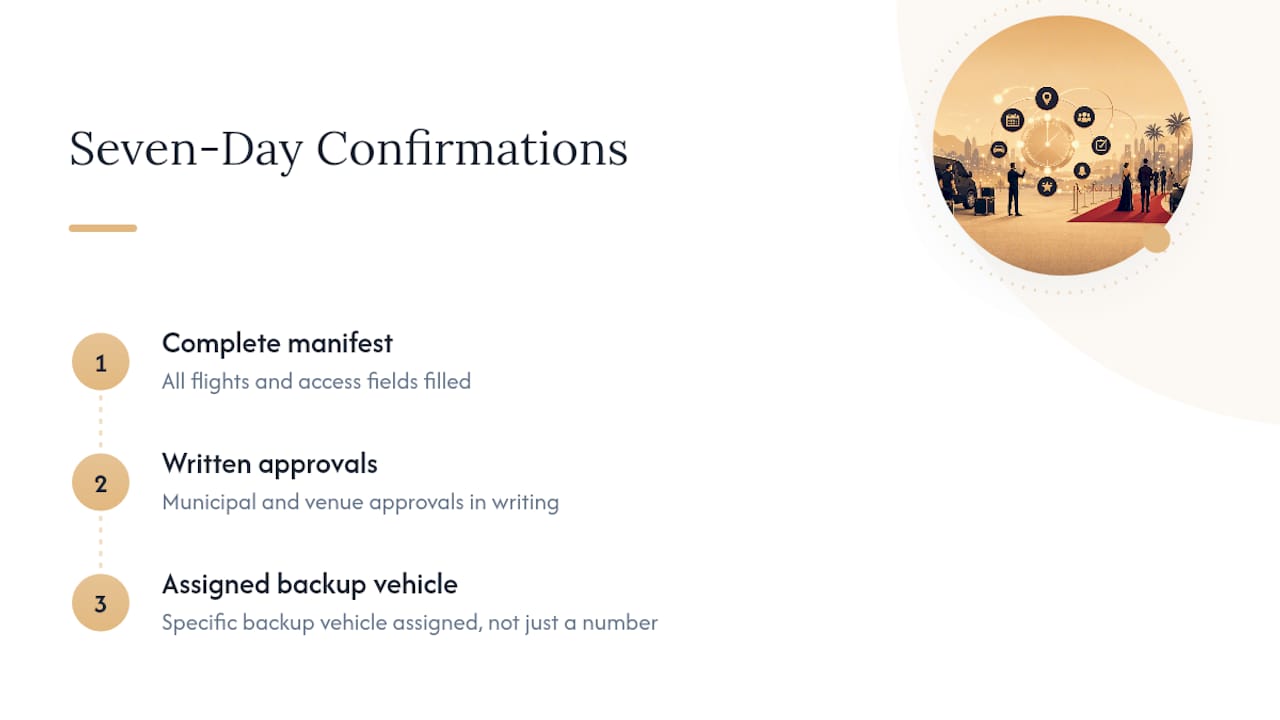
The plan that matters is the one you can actually execute under a compressed timeline. Seven days out, three things need confirming: the manifest is complete with every flight and access field filled in, municipal and venue access approvals are in writing, and there's an actual backup vehicle assigned, not just a phone number for a backup company.
On event day, before the first vehicle moves, confirm live tracking links are working for every car, the security brief has actually happened (not just been scheduled), and the chauffeur roster matches the manifest exactly, with no last-minute swaps nobody flagged.
Contingency routing gets activated the moment a flight delay, traffic incident, or access change threatens a movement window, not after the guest is already running late. The same goes for swapping a vehicle: if a car shows a mechanical flag or a chauffeur calls in sick, the backup deploys immediately rather than waiting to see if the problem resolves itself.
— Sammy
How Riga Global Travel Handles Red Carpet Logistics
Riga Global Travel runs the fleet classes, chauffeur teams, and live dispatch that this kind of operation actually requires: luxury sedans, SUVs, EV premium options, and Sprinter vans, all paired with drivers trained specifically for red carpet handoffs and security-coordinated arrivals.
Booking works around how productions actually operate. Hourly and day-rate pricing covers one-off premieres and award shows, while corporate retainers suit talent agencies and production companies running multiple events a year with invoiced direct billing. A proposal should spell out fleet assignments, chauffeur briefing procedures, and the command structure before you sign anything.
For events in the Los Angeles market, Riga's limousine service in Los Angeles covers studio lots, LAX transfers, and Beverly Hills venues in one coordinated operation. Productions building out talent transport specifically can request details through Riga's celebrity and talent transportation page, where the next step is simple: request an operations brief that lays out fleet options, chauffeur assignments, and contingency routing before your next red carpet date.
Sources
- Stars' arrival fleets and the choreography behind Oscar night
- How to Manage Event Transportation Well | MLR Worldwide Service
- Red carpet security planning for executives
- Major-Event Ground Transportation Planning Guide | MCR EXEC