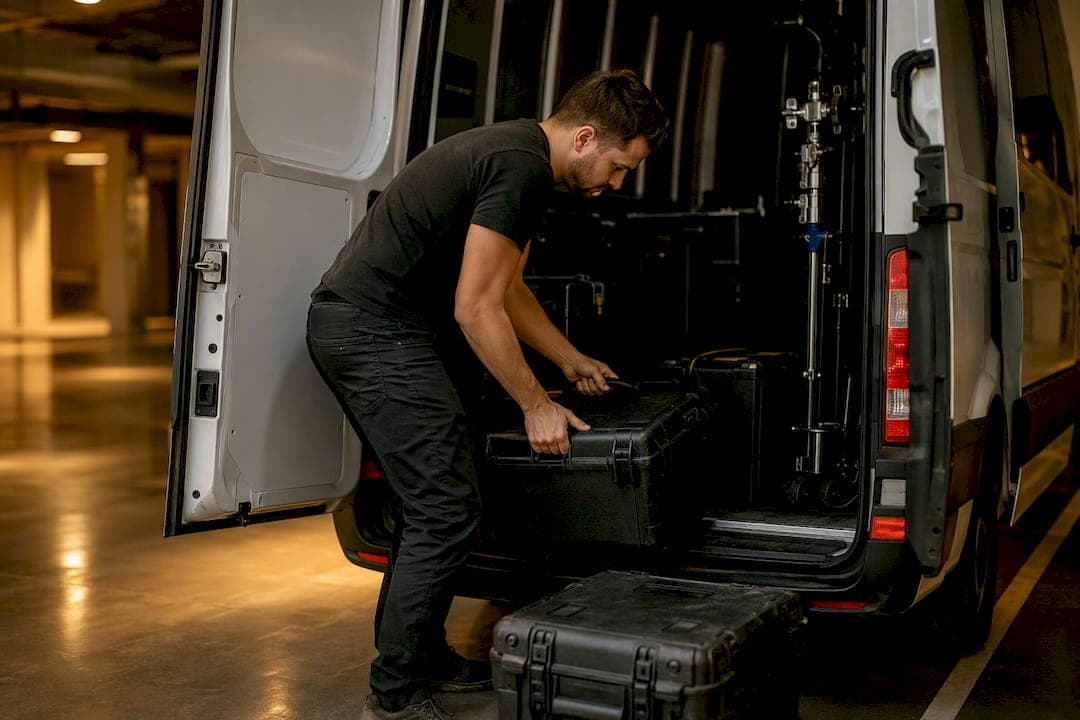
The right call for most production teams moving crew and gear together is a purpose-upfitted crew van for anything recurring, a chauffeured crew-van service for one-off or security-sensitive jobs, and luggage-shipping for gear that isn't time-critical. That's the whole decision in one sentence. The rest is picking the right version of each.
Before you call a dealer or an upfitter, confirm you need:
- A stationary metal or high-impact partition between crew and cargo
- Tie-down tracks or a SmartFloor system rated for your heaviest cases
- A payload rating that covers people plus gear, not just gear
- Seating for 3 to 6 depending on crew size
- Verified insurance coverage and qualified drivers if you're hiring out
If you're moving on a deadline, the fastest next step is either requesting an upfit quote from a Sprinter, Transit, or ProMaster dealer, or booking a chauffeured crew van for the specific dates you need coverage.
Key Takeaways
Matching crew size, gear type, and trip frequency to the right van model, upfit spec, or chauffeured service is what actually prevents production transport failures.
| Point | Details |
|---|---|
| Match model to load | Sprinter for tall/heavy cargo, Transit for modular mixed loads, ProMaster for high payload on a budget. |
| Partition is non-negotiable | Require FMVSS 201U-tested stationary partitions to keep cargo from shifting into crew space. |
| Buy only for daily use | Reserve ownership for continuous routes; rent or hire for one-off or intermittent jobs. |
| Ship gear that isn't urgent | Services starting around $25 per bag beat driver-hours and airline fees for one-way moves. |
| Hire out for security-sensitive moves | Rigaglobaltravel's chauffeured crew vans remove fleet management for talent moves and tight timelines. |
Table of Contents
- What Are the Best Luggage Vans for Crews Right Now?
- What Upfit and Safety Features Does a Crew Van Actually Need?
- Should You Buy, Lease, Rent, or Hire a Crew Van?
- How Do the Main Crew-Van Options Compare on Specs?
- When Should You Ship Gear Instead of Driving It?
- What Should You Ask Before Booking a Van or Chauffeured Service?
- When a Chauffeured Crew-Van Service Beats Managing Your Own Fleet
- Sources
What Are the Best Luggage Vans for Crews Right Now?
Three platforms dominate production fleets, and each one solves a slightly different problem.
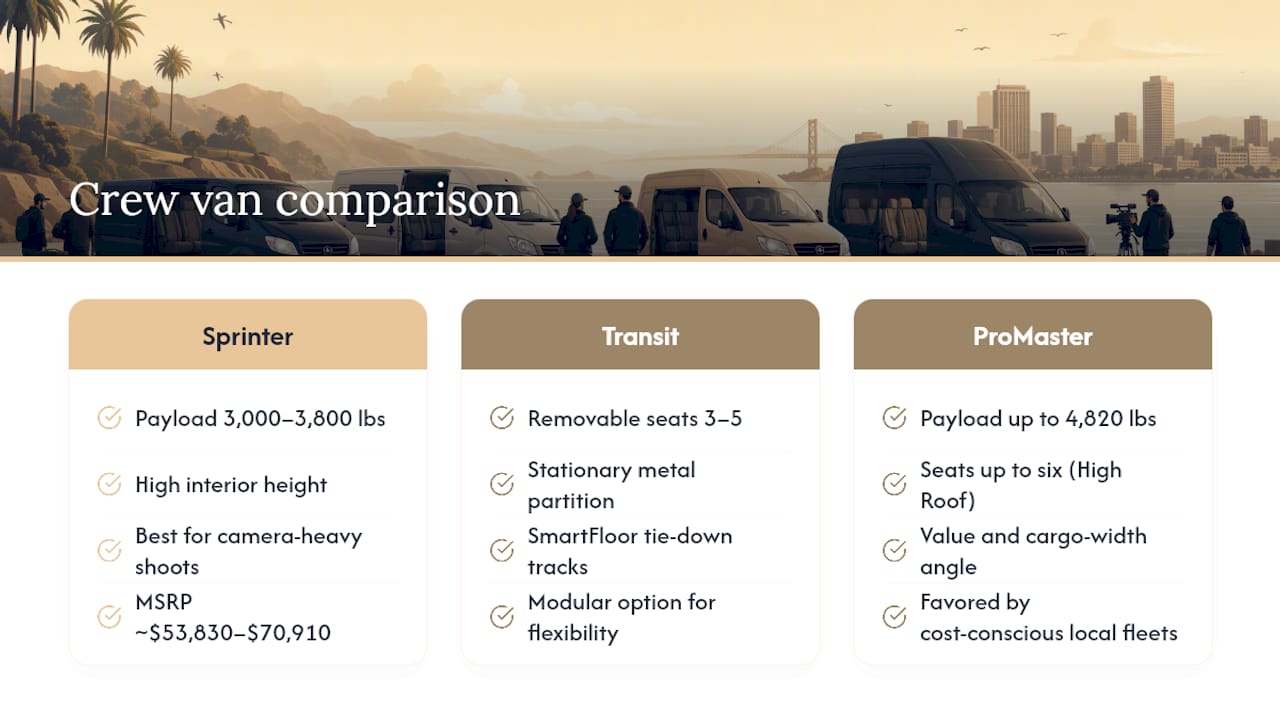
The Mercedes-Benz Sprinter Crew Van wins on payload and interior height. The 2026 Sprinter Crew Van lineup lists payload figures around 3,000 to 3,800 lbs depending on configuration, with MSRPs running roughly $53,830 to $70,910. That range makes it the default pick for long hauls with heavy camera packages, lighting rigs, or multi-day location moves where crew needs to stand up inside the cargo area.
The Ford Transit Crew Van is the modular option. Driverge's Transit Crew Van upfit seats 3 to 5 with removable seating, a stationary metal partition, SmartFloor tie-down tracks, and LED cargo lighting. It's the van most upfitters reach for when a production needs flexibility between camera-heavy days and lighting-heavy days without swapping vehicles.
The Ram ProMaster Crew Van takes the value and cargo-width angle. The 2026 ProMaster lineup cites payload figures up to 4,820 lbs on some configurations, with a Crew Van package that seats up to six in the High Roof body. Cost-conscious fleets running frequent local moves tend to land here.
Camera-heavy shoots favor the Sprinter's height. Lighting-dominant loads and mixed crews favor the Transit's modularity. High-volume local production with tight budgets favors the ProMaster's payload-per-dollar.
What Upfit and Safety Features Does a Crew Van Actually Need?
A van with seats and a cargo area isn't a crew van until it's upfitted correctly, and skipping this step is where most transport managers get burned.
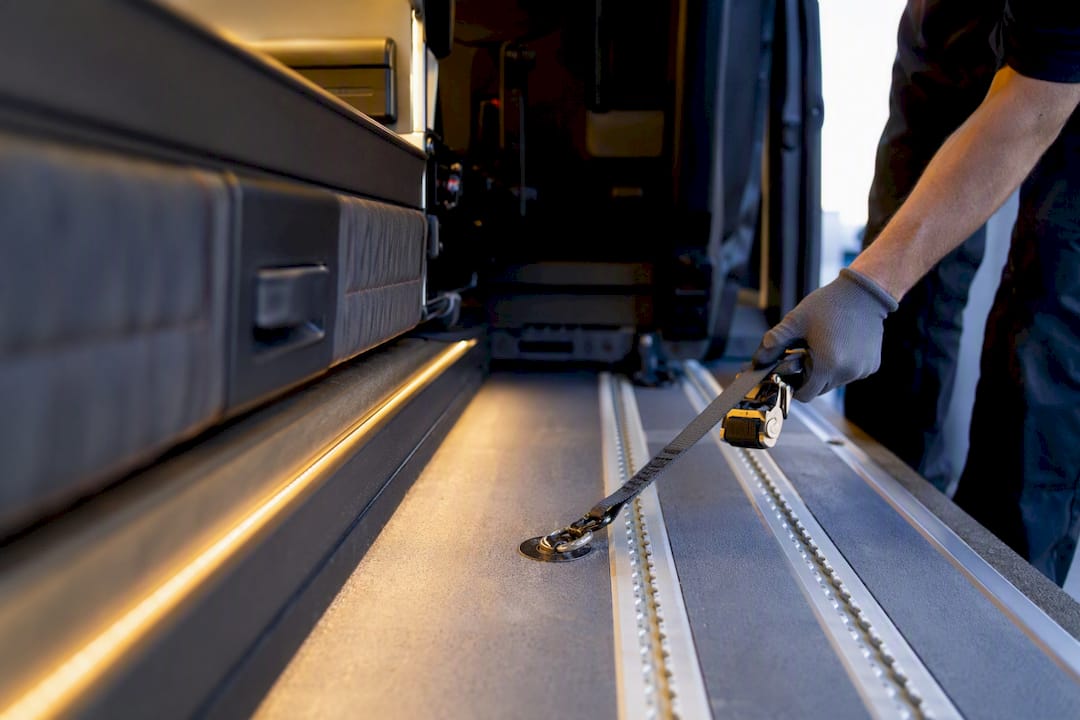
The partition matters more than people assume. TCI Mobility points out that a properly installed stationary metal or high-impact bulkhead keeps heavy cargo from sliding into the passenger compartment during a hard stop, which is exactly the scenario that turns a fender bender into an injury. Look for partitions tested to FMVSS 201U head-impact standards, the same benchmark Driverge builds its Transit upfits around.
Beyond the partition, require:
- SmartFloor-style tie-down tracks or recessed anchor points rated for your heaviest case
- Industrial-grade flooring, diamond plate or plywood-over-steel, to prevent gouging and cargo shift
- LED cargo lighting for early-call and late-wrap load-outs
- Removable seating to flex between passenger and cargo configurations
- HVAC zoning that keeps sensitive electronics and crew comfortable on the same trip
Pro Tip: Specify partition mounting points and floor tie-down layout before the upfit starts, not after. Retrofitting anchor points into a finished floor almost always means drilling through structural bracing, and that's a fix nobody wants to pay for twice.
Should You Buy, Lease, Rent, or Hire a Crew Van?
The right acquisition model depends less on budget than on how often the vehicle actually gets used.
- Buy when you run daily or near-daily crew moves and have in-house maintenance capacity. Ownership makes sense once utilization is high enough that per-mile cost beats rental rates.
- Lease when your production slate is multiyear and predictable, but you don't want the maintenance or depreciation exposure of ownership.
- Rent for project-based work, festival seasons, or a single feature shoot where the van only needs to exist for a few weeks.
- Hire a chauffeured crew-van service when the job is one-off, security-sensitive, or when you have zero appetite for managing drivers, insurance claims, and fleet logistics yourself.
Before committing, run the numbers on total cost of ownership against day-rate rental and chauffeured hourly rates. Include insurance, driver payroll, fuel, and downtime in that math, not just the sticker price. And book early: production calendars fill vehicle inventory fast, so lock in rentals or chauffeured service at least two to three weeks out for anything tied to a hard shoot date.
How Do the Main Crew-Van Options Compare on Specs?
Here's what to check before you sign anything, based on the numbers manufacturers actually publish.
- Best for: Sprinter suits heavy, tall cargo and long hauls; Transit suits mixed camera and lighting crews needing modularity; ProMaster suits high-volume local moves on a budget.
- Seating capacity: Typically 3 to 5 in upfitted Transit configurations, up to 6 in ProMaster's Crew Van High Roof package.
- Payload: Sprinter payloads run roughly 3,000 to 3,800 lbs; ProMaster payload tops out near 4,820 lbs on certain configurations.
- Upfit-friendliness: Transit leads on documented modular upfit packages; all three platforms support SmartFloor-style tie-down systems.
- Safety features: Look for stationary partitions tested to FMVSS 201U and industrial flooring rated for repeated equipment loading.
- Approximate cost: Sprinter MSRPs land around $53,830 to $70,910; ProMaster and Transit pricing varies more by trim and upfit package, so get a written quote rather than relying on base MSRP.
Once a van is upfitted, measure the internal width at tie-down rail height, not at the floor. Wheel wells and partition brackets eat into usable cargo space, and that number is what actually determines whether your road cases fit.
When Should You Ship Gear Instead of Driving It?
Shipping beats driving when the move is one-way, the crew is small, or the drive time isn't worth the driver-hours and fuel.
LugLess prices domestic shipping starting around $25 per bag, with no overweight surcharges up to 100 lbs, routed through FedEx or UPS with full tracking. Compare that to airline oversize and overweight fees, or the cost of an extra driver day, and shipping frequently wins for gear that isn't needed the moment the crew lands. Send My Bag offers a similar model for international moves, with doorstep collection that many film crews and contractors already use for relocating equipment safely between jobs.
The limits matter, though:
- Hazardous materials and high-value items are typically excluded or require declared-value coverage
- Delivery windows aren't instant, so this doesn't work for same-day, on-set-needed gear
- Fragile production equipment may need extra packing beyond what standard shipping covers
What Should You Ask Before Booking a Van or Chauffeured Service?
Vet any upfitter, rental company, or chauffeured provider with the same short list every time.
- Ask for proof of FMVSS 201U compliance on partitions, not just a verbal assurance
- Confirm exact tie-down and SmartFloor specs, plus warranty terms on the upfit itself
- Verify driver qualifications, background checks, and cargo insurance limits
- Request maintenance records if you're renting or leasing a used fleet vehicle
- Get contract terms in writing: cancellation policy, damage liability for your equipment, invoicing structure, and whether a backup vehicle is guaranteed if one breaks down
A vendor who hesitates on any of these is telling you something.
When a Chauffeured Crew-Van Service Beats Managing Your Own Fleet
Buying and upfitting a van makes sense when you're running the same route every week. It makes a lot less sense for a single high-profile shoot, a talent move that needs discretion, or a production window too tight to spend on vehicle procurement.
That's the gap Rigaglobaltravel fills. Instead of sourcing a van, vetting an upfitter, hiring a driver, and hoping the insurance paperwork clears in time, you book a chauffeured crew van and let someone else own the logistics. Rigaglobaltravel runs chauffeured vans and executive vehicles for studios, talent agencies, and event productions, with drivers who already know how set calls and load-out timing actually work. Corporate accounts get direct billing instead of per-trip paperwork, which matters when a production is running multiple vehicles across a shoot schedule. For moves involving talent or sensitive equipment, the celebrity and talent transportation service handles the security side that a rented van and a stranger behind the wheel can't.
If your next shoot is in Los Angeles, request a quote for chauffeured van service and get a vehicle assigned to your production dates before your window closes.
A Note From the Road
I've watched productions burn a full shoot day sourcing a rental van because nobody booked ahead. The lesson that stuck: decide your van strategy before the call sheet goes out, not after the gear is sitting in a hallway.
Sources
- Cost of shipping luggage | LugLess
- Work Crew Vans & Employee Transport Vehicles | TCI Mobility PA & FL
- Ford Transit Crew Van - Driverge Vehicle Innovations
- 2026 Ram ProMaster® Cargo Van | Ram Work Van
- 2026 Crew Van | Sprinter | Mercedes-Benz Vans