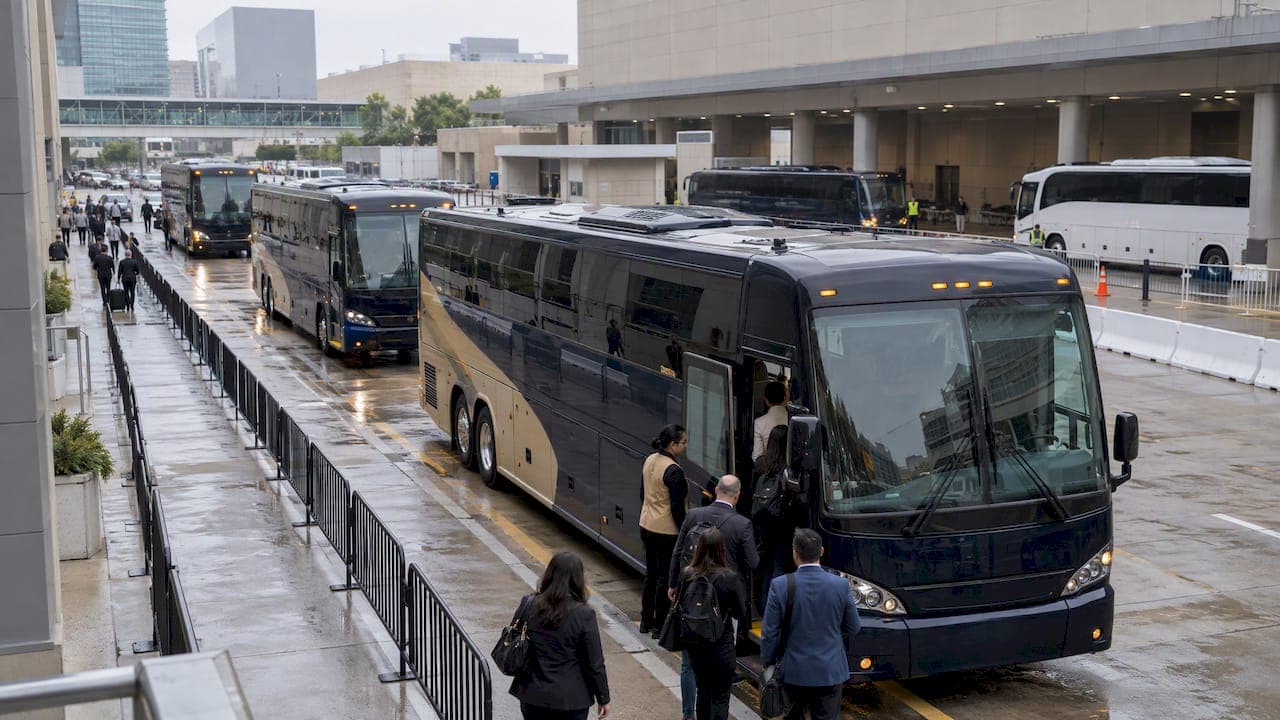
A usable shuttle staging plan delivers continuous, rapid loading and unloading through three defined zones: active loading, reserve holding, and satellite staging, backed by a ready reserve fleet that can fill gaps without creating new ones. Below, you'll find a copyable checklist, venue exhibit prompts, and the operational detail that turns a diagram into a working day-of plan.
TL;DR:
- Size shuttle waves from ticketing and session times, and measure a full loading cycle during a walkthrough, including staging, boarding, and passenger movement.
- Get venue and municipal approval for pickup points, drop off locations, and permit windows in writing; begin coordination weeks before the event.
- Assign accessible boarding support, provide a dedicated marked space with tested ramps or lifts, and match accessible vehicles to rider demand.
- Set a specific queue length or wait time for automatic backfill, and give dispatch current vehicle counts through radio updates and disciplined manifests.
Table of Contents
- Designing the Three Staging Zones for Continuous Loading
- Mapping Demand and Scheduling Shuttle Waves
- Securing Venue Permits and Traffic Control Coordination
- Running Passenger Flow, Signage, and Accessibility On-Site
- Structuring Command, Staffing, and Communication
- Planning for Delays, Reroutes, and Reserve Fleet Deployment
- Your Operational Checklist and Venue Exhibit Essentials
- What Years of Production Shuttle Work Taught Us
- How We Help You Execute the Staging Plan On-Day
- FAQ
- Sources
Designing the Three Staging Zones for Continuous Loading
Your active loading zone is the busiest piece of real estate on the property, so it needs curb access wide enough for buses to pull in and out without blocking each other, marked boarding points tied to specific routes, queue fencing that keeps lines orderly, and shelter so waiting riders aren't exposed to weather or vehicle exhaust. The FHWA handbook is direct about this: stations must support rapid loading and unloading, give riders a defined waiting area, and shield them from adjacent vehicular and pedestrian traffic.
Reserve holding sits apart from that curb, close enough to redeploy fast but positioned so idle buses never spill into pedestrian paths or block through traffic. When dispatch calls for backfill, a reserve vehicle should be able to merge directly into the active loading queue with one clear maneuver, not a three-point turn through a crowd.
Satellite staging lots handle overflow parking and act as a buffer when demand spikes beyond what the active zone can absorb. Express corridors, fenced walking paths with clear signage, move riders from satellite lots to the venue without crossing active traffic lanes.
- Active loading needs curb width, marked boarding points, queue fencing, and shelter.
- Reserve holding stays close to the active lane but outside pedestrian flow.
- Satellite lots need a dedicated express corridor into the venue, not a shared road.
A detailed breakdown of how to structure these three zones is worth bookmarking for your own exhibit drafting.
Mapping Demand and Scheduling Shuttle Waves
Your demand map starts with the event timeline itself. Pull session start times, gate opening windows, and ticketing data to estimate when riders will arrive in clusters rather than trickle in evenly. Cross-reference that against transport origin data, parking lots, hotel blocks, transit drop-offs, so you know which staging points need the heaviest early waves.
Cycle time is where most plans go wrong. It's not just drive time; it includes staging, boarding, and the walk from the curb to the seat. Underestimating this by even a few minutes per loop compounds into a backlog within the first hour.
- Build the demand map from ticketing and session data.
- Estimate full cycle time, including staging and boarding, not just driving.
- Size your fleet waves to match peak arrival and departure windows.
- Stagger dispatch so buses don't all return to the yard at once.
- Set a dynamic call-for-backfill rule tied to queue length, not a fixed clock.
Pro Tip: Measure one full loading cycle during a pre-event walkthrough and use that real number, not a theoretical one to size your waves.
Securing Venue Permits and Traffic Control Coordination
Every staging plan lives or dies on the permissions behind it. Before you finalize layouts, confirm your pickup and drop-off points with the venue and with municipal traffic control, including the exact permit windows those points are approved for. A city or venue transportation management plan example shows how exhibit-ready staging diagrams, stacking capacities, queue routing, and accessible boarding points, speed up sign-off from traffic engineers.
- Confirm pickup/drop-off points and permit windows in writing with venue and city traffic authorities.
- Name a single liaison contact for each agency involved and document a sign-off sequence.
- Lock in any temporary lane closures, traffic control staff, or police assistance your staging plan requires.
Multi-agency sign-off takes longer than planners expect, so start this process weeks ahead of the event, not days.
Running Passenger Flow, Signage, and Accessibility On-Site
Station design only works if riders can read it instantly. Visible signage at every decision point, which lane, which route, where the line starts, cuts confusion before it turns into crowding. Printed route markers and boarding banners from a vendor like Print Cafe USA can cover this need quickly when you're staging a one-time or recurring event.
Staff presence matters as much as signage. Greeters at the queue entrance, load marshals at the curb who confirm headcounts, and dedicated accessible support staff keep the flow moving without relying on riders to self-sort correctly.
- Post visible, route-specific signage at every queue decision point.
- Staff the curb with greeters, load marshals, and accessible support.
- Scale accessible vehicle deployment to match the share of riders who need it, not a flat minimum.
Accessible boarding needs its own lane or clearly marked space within the active zone, with ramps or lifts tested before doors open, not during the first rush.
Pro Tip: Run one accessible boarding cycle during your walkthrough so the attendant and driver both know the sequence before a real rider is waiting.

Structuring Command, Staffing, and Communication
A staging plan needs a command structure as much as it needs buses. Define roles clearly: a staging manager who owns the physical layout, a dispatcher who tracks fleet position and timing, a traffic liaison who talks to the agencies on-site, and an ADA attendant assigned to accessible boarding.
- Assign a staging manager, dispatcher, traffic liaison, and ADA attendant by name before event day.
- Set a radio protocol and manifest update cadence so dispatch always knows vehicle counts.
- Establish rider-facing messaging, text, app, or signage, for delay updates.
- Run everything through a single command post with one clear escalation path.
Manifest discipline prevents the two most common failures: double-loading a vehicle and leaving a group behind. Each vehicle ties to a numbered pickup point and one point of contact who verifies counts before departure.
Planning for Delays, Reroutes, and Reserve Fleet Deployment
Even a well-designed plan needs a backup. Set a clear call-forward threshold, a specific queue length or wait time, that triggers reserve vehicles to move into active loading automatically rather than waiting for a judgment call under pressure.
- Define the exact queue length or wait time that triggers a backfill call.
- Pre-identify alternate routes and emergency access lanes in case the primary lane is blocked.
- Keep reserve vehicles staged where they can merge into active loading in one move, not trapped in ambient traffic.
- Give your operations lead a short rapid-decision list: reroute, call backfill, or hold, with no fourth option during peak load.
A reserve fleet that's accessible but isolated from pedestrian-heavy areas lets you redeploy fast without creating a second bottleneck.
Your Operational Checklist and Venue Exhibit Essentials
A staging plan is only as good as the documents behind it. Build one packet with a rider manifest template, a radio communication plan, a staging map showing all three zones, a staffing table with named roles, and a signage list tied to each decision point.
- Manifest template tied to numbered pickup points and vehicle IDs.
- Radio plan listing channels, callouts, and escalation steps.
- Staging map showing active loading, reserve holding, and satellite lots.
- Staffing table naming every role from staging manager to ADA attendant.
- Signage list mapped to each queue decision point.
The FHWA handbook recommends designing shuttle service to expand and contract with patron arrival and departure rates, which means your exhibit should show wave sizing, not just a static bus count. APTA's mega-event playbook guidance adds two pillars worth building into your exhibit: early partnerships with transit and law enforcement, and a customer information strategy that treats the shuttle wait as part of the visitor experience.
Run a full walkthrough 24 hours out to catch blocked loading bays, missing signage, or diverted pedestrian routes before they become day-of problems.
What Years of Production Shuttle Work Taught Us

Three lessons stick with us after years of running production and VIP shuttles. First, manifest discipline beats fleet size: a smaller, well-tracked fleet outperforms a larger one running on guesswork. Second, a dedicated VIP lane, separated early and clearly marked, prevents more delays than any amount of extra staffing. Third, a single point of contact who can make a call without routing through three people saves more time than any app.
Test these on your next event: tighten your manifest process, designate the VIP lane before the layout meeting, and make sure someone with real authority is reachable by phone, not just by app, the whole day.
— Sammy
How We Help You Execute the Staging Plan On-Day
Drafting the plan is one job. Running it with chauffeurs who show up on time, vehicles that are inspected and ready, and a point of contact who answers the phone directly, not an app, is another. We have extensive experience working with production companies and studios on ground logistics, providing screened chauffeurs and a rapid response team behind every booking.
Whether you need a full fleet for a multi-day shoot or a dedicated lane for talent and executives, our corporate and production transportation services are built to plug directly into a staging plan like the one above. Reach out for a quote on your next event, or ask about our celebrity transportation services if VIP handling is part of your brief.
FAQ
What is an event shuttle staging plan?
An event shuttle staging plan is the layout and schedule that governs how buses load, wait, and redeploy around a venue during an event. It typically defines active loading zones, reserve holding areas, and satellite staging lots, along with the staffing and communication structure that keeps them running.
How many staging zones does a venue typically need?
Most venue plans use three zones: active loading for continuous boarding, reserve holding for backfill vehicles, and satellite staging for overflow parking and express corridors. This structure follows the design pattern described in the FHWA planned special events handbook.
How do you calculate shuttle cycle time for an event?
Cycle time includes driving time plus staging, boarding, and passenger flow from the curb to the seat, not just the drive itself. Measuring one full loading cycle during a pre-event walkthrough gives you a realistic number to size your fleet waves against.
What permits are needed for event shuttle staging?
You typically need sign-off from the venue and municipal traffic control on your pickup and drop-off points, plus approval for any temporary lane closures or traffic control staff. Multi-agency coordination takes time, so start the permit process weeks before the event rather than days.
Does Riga Global Travel provide staging plan support for events?
Riga Global Travel provides chauffeured fleet and concierge services, including corporate transportation and celebrity transportation, that can be built directly into a venue's staging plan. Services are quoted individually, so contact the team directly for pricing on a specific event.
Sources
- Managing Travel for Planned Special Events handbook — Chapter 3
- A playbook to managing mega events — Passenger Transport
- Transportation Management Plan (city/venue example) — Ryan Field exhibits (2026)