Book a mixed fleet of chauffeured sedans, Sprinters, and standby SUVs from a vendor who hands over a signed COI naming your production, an NDA, and a single dispatch contact before day one. Ground transportation qualifies as a covered expense under Georgia's 30% transferable film tax credit, so invoice structure matters as much as vehicle count. Build in traffic buffers and file street permits early. Everything else is detail.
TL;DR:
- Vendors should provide a sample certificate of insurance naming your production and the city of Atlanta before signing the contract.
- Early permit filing and city guidance on parking and staging are crucial to avoid delays and extra costs during filming in Atlanta.
- Booking transportation three to six weeks ahead for Sprinters, buses, and standby vehicles helps prevent last-minute failures and ensures fleet availability.
- Invoice line-itemization is necessary for Georgia's 30% transferable film tax credit, separating hourly, transfer, and day rates for faster processing.
- Having all vendor paperwork, including COI, NDA, driver vetting, and contingency plans, ready before signing expedites approval and reduces risks.
Table of Contents
- What Should Be On Your Atlanta Studio Transportation Checklist?
- How Do Atlanta Film Permits and Street Staging Actually Work?
- Which Vehicles Should You Book for Each Role on the Call Sheet?
- What Do Studio Transportation Pricing Models Actually Look Like?
- What Insurance and Vetting Documents Should You Require?
- How Does Atlanta's Geography Affect Studio Transport Planning?
- When Should You Book, and What Day-of Practices Actually Prevent Failures?
- What Riga Global Travel Looks for in a Production Brief
- Book Production-Grade Ground Transport With Riga Global Travel
- Where to Verify Permit and Tax-Credit Details
- Sources
What Should Be On Your Atlanta Studio Transportation Checklist?
Before you sign anything, get the paperwork and the fleet plan in writing. A vendor who hesitates on any of these items is telling you something about how they'll perform on day 12 of principal photography.
- Sample COI on file. Ask for a certificate naming your production entity and, where required, the City of Atlanta as additional insured.
- NDA template ready to sign. Confidentiality shouldn't be negotiated mid shoot.
- Driver vetting statement. Background checks, set-protocol training, and studio gate familiarity, documented, not just promised.
- Fleet match by role. Confirm minimum counts for principal sedans, crew Sprinters, and any background-move coaches before the call sheet locks.
- Permit assistance scope. Know exactly what the vendor helps file versus what your locations department must submit directly.
- Single point of contact. One dispatcher, one phone number, live during all call times.
- Contingency vehicle language. A standby unit should be written into the agreement, not assumed.
- Tax-credit-friendly invoicing. Line-itemized billing that separates hourly holds, transfers, and day rates for production accounting.
Pro Tip: Ask for the sample COI and NDA during the first vendor call, not after you've signed a deposit. A vendor who can produce both within the hour usually has the back-office discipline to match.
How Do Atlanta Film Permits and Street Staging Actually Work?
Street-use permits in Atlanta run through the Mayor's Office of Film, Music & Entertainment, and the lead times are tighter than most out-of-state productions expect.
- Submit early. Full street closures typically need several business days' notice; lane closures require a shorter notice period. Rush requests are possible but cost more and aren't guaranteed.
- Budget for right-of-way fees. Expect approximately one hundred dollars per location per day, typically capped at a few hundred dollars daily, though rush or extra services can push costs higher.
- Attach the full packet. Complete applications generally include a COI, a traffic control plan, and location maps. Incomplete submissions are the single biggest cause of delayed approvals.
- Coordinate parking before crew arrives. City-level guidance on film crew parking and loading permits makes clear that enforcement isn't theoretical: fines, towing, and stop-work orders all happen when staging isn't reserved in advance.
- Loop in transportation before locations finalizes the plan. Your driver team needs the same map the locations manager is working from, not a version relayed secondhand.
Treat permitting as a transportation problem, not just a locations problem. The vendor who knows where the reserved loading zone actually is on day one saves you an hour of circling before the first shot.
Which Vehicles Should You Book for Each Role on the Call Sheet?
Fleet mismatches waste money in both directions. Overbook sedans and you're paying hold time on idle cars. Underbook Sprinters and your crew is late to set.
- Sedans: one to three principals per vehicle, with the same driver assigned for the run of the shoot whenever possible. Continuity matters more for talent than for anyone else on the call sheet.
- SUVs or V-Class vans: small executive or talent groups, publicists, or a director traveling with an assistant.
- Sprinters: department heads and crew moving with light gear. "Light production gear" generally means bags, cases, and monitors, not lighting rigs or grip trucks.
- Coaches: background moves and large crew transfers between hotel and set, especially on days with early or late calls.
For mixed-day moves, size the fleet to the busiest single call time, not the daily average. And decide upfront whether a leg needs hold-and-wait service, where the driver stays on standby for an unpredictable schedule, or a scheduled point-to-point transfer, which is cheaper but leaves no room for a forced call running long. Most Atlanta productions use both models on the same day for different roles.
What Do Studio Transportation Pricing Models Actually Look Like?
Three pricing structures cover almost every studio transport booking: hourly or hold rates for talent and unpredictable schedules, flat transfer pricing for airport runs and fixed point-to-point legs, and negotiated day rates for multi-day or multi-week shoots.
Hidden costs tend to show up in the same four places:
- Overtime past a driver's contracted hours, usually billed in set increments.
- Staging and parking fees passed through when a vendor has to pay for reserved space.
- Traffic-delay allowances, which some vendors bake into the rate and others bill separately.
- Rush booking fees for last-minute additions to the call sheet.
For tax-credit filing, ask vendors to itemize invoices by vehicle, date, and service type rather than issuing a single lump sum. Georgia's 30% transferable film tax credit treats ground transportation as a qualified expenditure, but production accounting moves faster with structured line items. Before signing, confirm the contract includes a COI attachment clause, an NDA, clear cancellation and rescheduling terms, and defined overtime rules. Georgia's charter bus planning guidance also flags driver rest-rule compliance as a contract item worth confirming for any coach booking.
What Insurance and Vetting Documents Should You Require?
Risk and legal teams generally want four categories of proof before signing off on a vendor, and skipping any one of them slows down studio approval.
- COI naming your production, and the City of Atlanta as additional insured where a permit requires it.
- Signed NDAs and a written confidentiality policy covering no-posting rules and itinerary control for talent moves.
- Driver vetting documentation, including background checks and evidence of set-protocol training.
- A complete vendor file bundling all of the above for studio risk sign-off, not scattered across separate emails.
A production-aware driver who has signed an NDA and knows studio gate procedures isn't a luxury add-on. It's often the deciding factor between vendors that otherwise look identical on price.
Pro Tip: Request the vendor's confidentiality policy in writing, not a verbal assurance. If a vendor can't produce one document covering NDAs and no-posting rules, assume you'll be writing it yourself mid-production.
How Does Atlanta's Geography Affect Studio Transport Planning?
Atlanta's studio geography spreads wide, and that shapes almost every transport decision from hotel selection to call-time math.
- I-285 and the Downtown Connector inflate transit times unpredictably during peak hours; build in buffers of 30 to 45 minutes for any cross-town move during rush periods, based on general Atlanta traffic pattern data.
- Studio location relative to Hartsfield-Jackson matters for airport runs. Southern studio campuses sit closer to the airport, while northern in-town lots mean longer airport-to-set legs.
- Hotel hubs near your primary studio cut daily commute time significantly; a hotel chosen for room rate over proximity can quietly cost hours of transport time across a shoot.
- Summer heat demands climate-controlled holding for talent between takes and scheduled cooling breaks, not just air conditioning running in the car.
Map contingency routes for each leg of a multi-location day, and pre-position at least one alternate vehicle for principals. It's a small cost against the chaos of a forced call with no backup car available.
When Should You Book, and What Day-of Practices Actually Prevent Failures?
Book earlier than instinct suggests, especially during Atlanta's busy production seasons.
- Sprinters and charter buses: reserve three to six weeks ahead, longer if your background moves involve more than one coach.
- Set up a production account before your first call. Establish a master contact, billing terms, and recurring invoicing structure so day-of bookings don't stall on paperwork.
- Confirm live dispatch and a standby vehicle for every shoot day, not just for principal moves.
- Build direct AD-to-dispatch communication into your workflow. The call sheet functions as the operational source of truth, and transportation needs to move in step with it, especially through forced calls and turnarounds.
- Negotiate a day rate for extended productions. Locking predictable pricing across multiple weeks tends to secure vehicle availability better than booking week to week.
What Riga Global Travel Looks for in a Production Brief
A vendor's paperwork tells you more than their sales pitch. When we review a production brief, we're checking for the same three signals every time: a COI ready to name the production, an NDA signed before the first driver touches a call sheet, and a standby vehicle pre-positioned rather than promised.
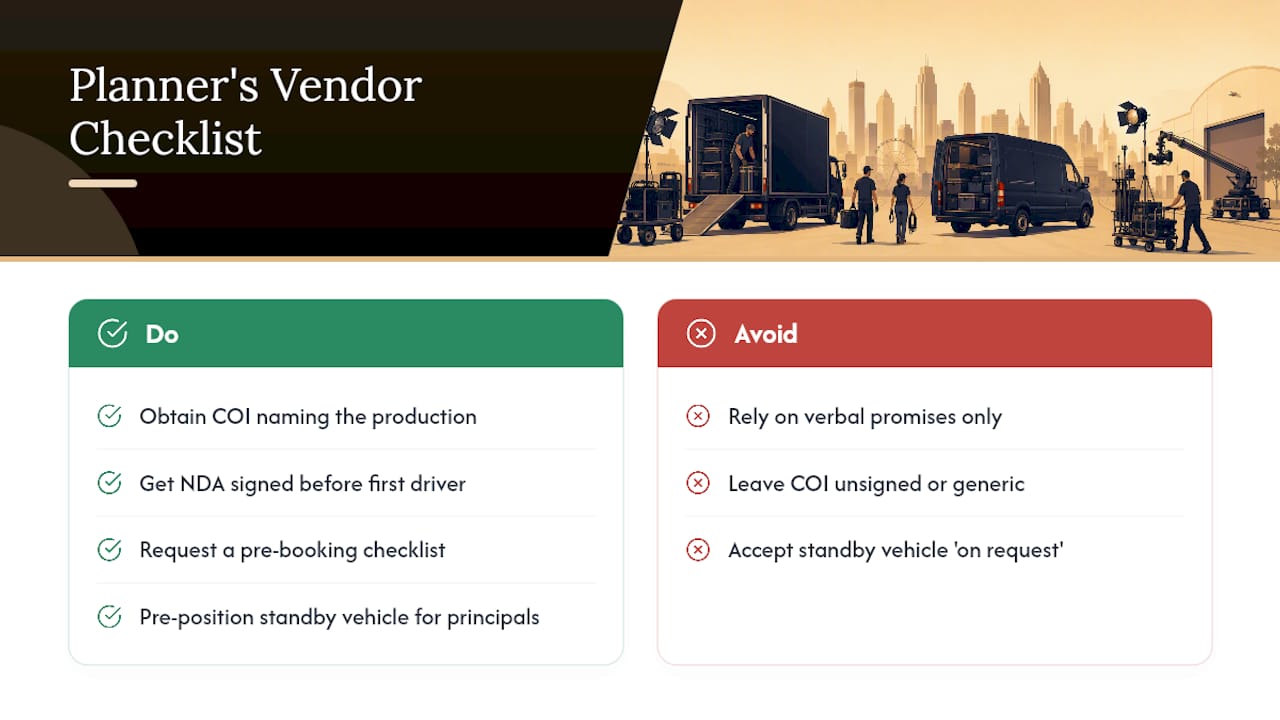
Most transportation failures on Atlanta shoots trace back to one of those three gaps, not to traffic or weather. A production that shows up with a clean brief, fleet needs mapped to roles, and permit requests already filed tends to get faster, more accurate quotes. That's not favoritism. It's just easier to plan around specifics than around guesses.
If you're building a vendor file for studio risk sign-off, ask for the sample COI, the sample NDA, and a pre-booking checklist before you finalize any contract. Some vendors provide all three, along with pre-positioned standby vehicles for principal moves, on request.
— Sammy
Book Production-Grade Ground Transport With Riga Global Travel
Some vendors provide chauffeured sedans and SUVs for principals, Sprinters for crew, shuttles for background moves, and COI and NDA paperwork before account confirmation. Dispatch may run around the clock to handle forced calls at any hour.
To request a production proposal, send over your call sheet, your fleet needs by role, and any permit requests already in motion with locations. That's enough for a same-day quote in most cases. Riga Global Travel also supports best-practice production transport standards across multiple entertainment markets, with studio-specific service pages including limousine service in Los Angeles built around the same production account model. Visit Riga Global Travel to request production account terms and start your Atlanta booking.
Where to Verify Permit and Tax-Credit Details
Bookmark these before your next Atlanta shoot rather than during a permit crunch.
- The City of Atlanta's film permitting page for street and lane closure applications, fee schedules, and lead times.
- The city-level parking and loading permit guide for staging rules and enforcement details before you finalize a locations plan.
Each one answers a different question: what qualifies for the credit, how to file for street use, and how to keep your staging plan out of tow-truck territory.
Sources
- City of Atlanta — Mayor’s Office of Film, Music & Entertainment permitting
- Atlanta film crew parking & loading permits — citylaws.org
- Charter Buses USA — Charter bus for film production crews planning guide