
Expect executive sedans to run around $75 to $100 an hour, Escalade-class SUVs about $100 to $125, and Sprinter vans roughly $150 to $175, each with a two-to-three-hour minimum, with New York prices higher than typical markets. The bigger risk isn't the base rate.
TL;DR:
- Expect final chauffeur costs to be 40% to 70% higher than the headline hourly rate due to gratuity, tolls, fees, and surcharges.
- Contractual confirmation of all pass-through costs and wait-time policies can prevent unexpected charges during production.
- Operators with W-2 chauffeurs and current insurance certificates tend to offer more reliable, compliant service for corporate and high-profile clients.
- Lock in a firm, all-in, written rate that specifies vehicle tier, minimum hours, included pass-throughs, and cancellation terms.
- Recurring bookings are more negotiable with volume-based discounts and flexible minimum-hour configurations rather than lower hourly rates alone.
Table of Contents
- What Are Typical Chauffeur Hourly Rates by Vehicle Tier?
- Why Does the Final Invoice Cost More Than the Hourly Rate?
- How Do Wait-Time and Surcharge Policies Work for Production Bookings?
- What Drives the Price Difference Between Chauffeur Operators?
- How Do You Lock in an All-In Hourly Quote?
- Sample Budgeting Example: A 6-Hour Production Retainer
- Tips for Negotiating Better Rates With Chauffeur Services
- An Editorial Note on Reading Chauffeur Rate Cards
- Book Production-Grade Chauffeur Service With a Rate That Holds
- Sources
What Are Typical Chauffeur Hourly Rates by Vehicle Tier?
Rate cards vary by market, but the spread across vehicle classes is consistent enough to budget against. Standard stretch limousines and executive sedans typically start around $75 an hour for corporate travel managers outside major metros, according to guidance for travel managers on limousine rental pricing. SUV-class limos run closer to $100 an hour, and party buses or larger group vehicles push past $150.
New York sits at the premium end of the national range. Detailed Drivers, a New York operator whose published 2026 rate card is a useful benchmark for metro pricing, lists Executive Sedan at $100 per hour with a two-hour minimum, Escalade ESV at $125 per hour with a two-hour minimum, Mercedes S-Class at $150 per hour with a two-hour minimum, and Mercedes Sprinter at $175 per hour with a three-hour minimum.
| Vehicle Tier | Typical Hourly Rate (National) | NYC Rate Card Example | Common Minimum |
|---|---|---|---|
| Executive Sedan | $75 to $100 | $100/hr | 2 hours |
| Luxury SUV (Escalade ESV) | $100 to $125 | $125/hr | 2 hours |
| High-End Sedan (S-Class) | $125 to $150 | $150/hr | 2 to 3 hours |
| Passenger Sprinter/Van | $150 to $175 | $175/hr | 3 hours |
The gap between national starting bands and New York's published figures isn't padding. It reflects a different cost structure entirely, which the next section breaks down. For a production shooting hotel-to-set transfers in a dense urban market, budget toward the higher end of each band and confirm the minimum before you commit to a call sheet.
Why Does the Final Invoice Cost More Than the Hourly Rate?
The number on the rate card is rarely the number on the invoice. Gratuity, tolls, and airport fees stack on top of the base rate, and buyers who budget only against the headline figure routinely come up short mid-production.
Here's what typically gets added to a chauffeur hourly rate before the final bill arrives:
- Gratuity, usually 20% of the base fare, itemized as a separate line rather than folded into the hourly number
- Tolls and congestion pricing fees, especially relevant for Manhattan and other congestion-zone markets
- Airport access or meet-and-greet fees for pickups at major hubs
- Fuel surcharges, which fluctuate with market conditions
- Parking charges during extended waits or multi-hour set days
- Late-night or holiday premiums, often 10% to 25% above standard rates
The all-in uplift is real money, not a rounding error. Analysis of premium New York operators shows the final invoice can run 40% to 70% above the headline hourly rate once every pass-through is applied. For a production booking $1,500 in hourly time, that's potentially $600 to $1,050 in additional charges. The fix is contractual, not mathematical: request a written all-in confirmation before the vehicle is dispatched, not an estimate you reconcile after the fact.
How Do Wait-Time and Surcharge Policies Work for Production Bookings?
Multi-stop production days live and die by wait-time policy. A driver holding outside a soundstage for three hours between setups isn't free labor, and most operators bill for it, but the terms vary enough that they belong in the contract, not assumed.
Common charges to clarify before booking:
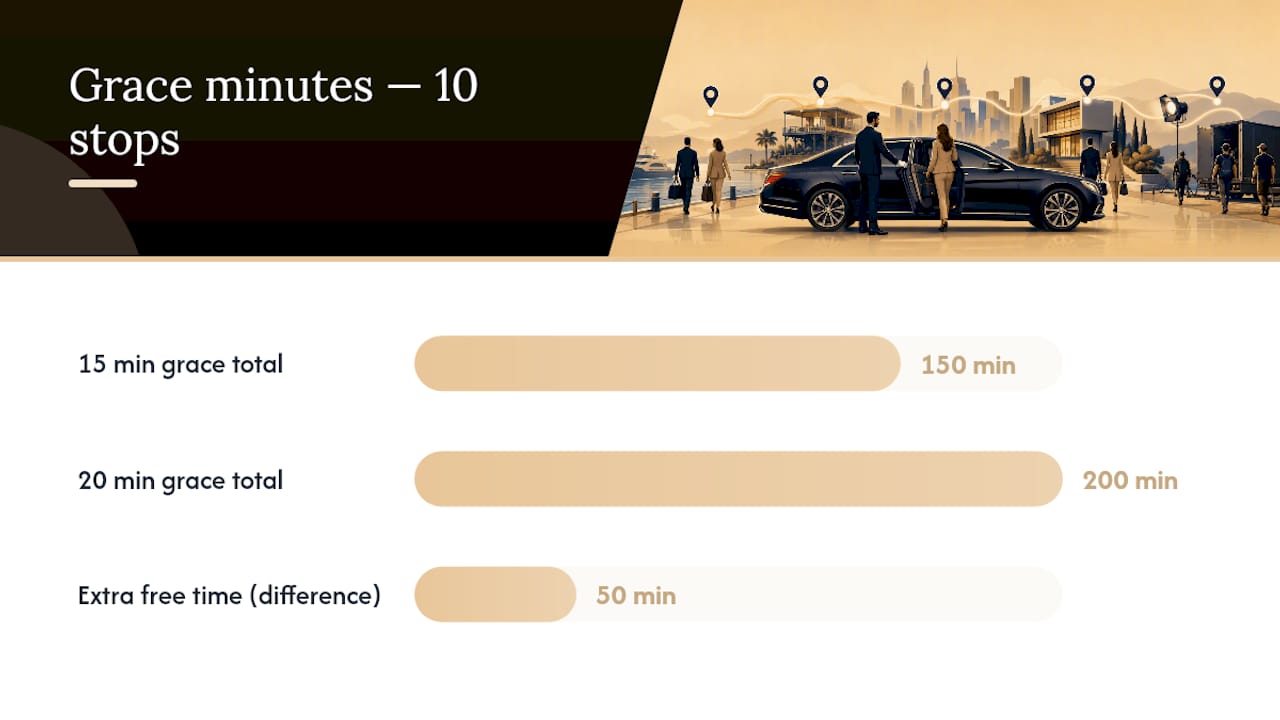
- Grace periods, typically 15 to 20 minutes free at each stop before per-minute or per-hour wait fees kick in
- Per-minute or per-hour wait billing once the grace period expires, which Riga Global Travel documents explicitly in its wait-time policy so production teams know the exact trigger point
- Congestion and toll pass-throughs, billed at cost rather than marked up
- Airport access fees, charged per pickup regardless of how many hours are booked
- Minimum-hour utilization, where a two-hour minimum on a 45-minute run still bills the full block
That last point matters more than it looks. Staging a Sprinter with a three-hour minimum for a full production day often produces a lower effective per-person cost than running three sedans on separate two-hour minimums, because each sedan resets its own minimum independently.
Pro Tip: Ask any operator for their wait-time grace period in writing before the shoot day, not the morning of. A 15-minute grace period versus a 20-minute one adds up fast across a ten-stop schedule.
What Drives the Price Difference Between Chauffeur Operators?
Operators running W-2 chauffeur rosters carry higher labor costs than those relying on 1099 contractors, but they also carry lower classification risk and tighter control over NDA compliance, background checks, and consistency, all of which matter when talent or executives are in the vehicle. Commercial auto and general liability insurance is another major line item baked into the published rate. Analysis of the New York premium ground transport market points to vehicle amortization, insurance, and back-office dispatch costs as the real drivers behind a published hourly figure, not arbitrary pricing.
When evaluating an operator for production work, look for:
- A published rate card that holds at confirmation rather than shifting closer to pickup
- A current certificate of insurance available on request
- W-2 chauffeur staffing, particularly for talent or executive movements
- Dispatch and staging capability for multi-vehicle, multi-stop days
Rigaglobaltravel covers what to verify in more depth in its guide to evaluating corporate chauffeur services, and the distinction between a chauffeur and a general driver is worth understanding before you sign anything, covered in this breakdown of chauffeur versus personal driver roles.
How Do You Lock in an All-In Hourly Quote?
Verbal quotes and hourly ranges are starting points, not commitments. Getting a number you can actually budget against means putting specific terms in writing before the vehicle is confirmed.
Insist the written quote or contract specifies:
- Vehicle tier and minimum hours, matching exactly what will show up curbside
- A full list of included pass-throughs, so tolls, fuel surcharges, and airport fees aren't a surprise line item later
- Wait-time policy, including the grace period and the per-minute or per-hour rate after it expires
- Overtime and late-night rates, spelled out as a percentage or flat add-on
- Gratuity handling, stated as included or billed separately
- Certificate of insurance, provided proactively for corporate account setup
- Cancellation terms, particularly relevant for production schedules that shift
Pro Tip: For any recurring corporate account, ask for a "rate locked at confirmation" clause in writing. It's the single line that prevents a quote from creeping upward between booking and pickup.
Sample Budgeting Example: A 6-Hour Production Retainer
Take a conservative Escalade-tier booking at $110 an hour for six hours: $660 in base hourly time.
Add a second stop, a late-night premium, or a second vehicle for a larger talent party, and that total moves quickly.
Tips for Negotiating Better Rates With Chauffeur Services
Corporate accounts have more leverage than one-off bookings, and most operators will negotiate structure before they'll negotiate the base rate itself.
Volume is the strongest card you hold. A production company booking recurring hourly service across a multi-week shoot schedule should ask for a corporate account rate rather than accepting the standard published card. Operators price recurring, predictable volume differently than one-time calls, because it reduces their own dispatch uncertainty.

Ask about minimum-hour flexibility before you negotiate the hourly figure. A three-hour minimum on a Sprinter that regularly gets used for five or six hours is a better deal than a two-hour minimum on a sedan that constantly resets. Consolidating multiple short runs into fewer, longer bookings usually beats negotiating a discount on the per-hour number itself.
Push for transparency on pass-throughs rather than a lower headline rate. An operator who agrees to a fixed toll and fee estimate upfront, rather than billing actuals after the fact, gives you a number you can actually hold a production budget to. And always ask what the late cancellation window is before you sign, since production schedules shift and a rigid 48-hour cancellation policy can cost more than a slightly higher hourly rate elsewhere.
Finally, ask for the certificate of insurance and W-2 staffing confirmation as part of the negotiation, not as an afterthought. An operator confident in its own compliance posture rarely hesitates to provide either.
An Editorial Note on Reading Chauffeur Rate Cards
Most rate confusion in this industry comes from comparing a headline number without asking what's excluded. Sammy has watched production budgets blow past estimates not because the hourly rate was wrong, but because nobody asked about wait-time billing until the invoice arrived. Rigaglobaltravel's own wait-time policy exists because that gap is where trust breaks down, and a W-2 chauffeur roster earns its higher cost back in fewer surprises on set.
— Sammy
Book Production-Grade Chauffeur Service With a Rate That Holds
Rigaglobaltravel prices hourly bookings the way production budgets actually work: you get a locked all-in confirmation before the vehicle is dispatched, not a headline number that grows once tolls and wait time show up. That means fewer line-item disputes on a multi-week shoot and a rate your production accountant can plan against instead of pad for.

Every booking runs on W-2 chauffeur staffing with current certificates of insurance available for corporate account setup, and the same wait-time grace periods apply whether you're staging a hotel-to-set transfer or a full-day talent itinerary. If your production is based in Los Angeles, check hourly availability for LAX, Beverly Hills, and studio transfers and get a written all-in quote before your next call sheet goes out.
Sources
- NYC Hourly Chauffeur Rates 2026: Full Pricing Comparison | BCJ
- Limousine rental pricing: what travel managers need to know about costs and value