
A certificate of insurance (COI) proves your production carries the coverage locations and rental houses require, and the single most important check is whether the COI includes the exact endorsements the certificate holder demands. Miss that step and the document that a location manager or gear rental house holds in their hand is worthless to them, even if your policy is fully paid up and active.
A COI is a one-page summary your insurance broker issues to prove active coverage without handing over the entire policy. Locations, equipment rental houses, municipalities, and casting services all ask for one before they let your production near their property or gear. What trips up first-time producers is assuming the COI itself is the coverage. It isn't. It's a snapshot, and if it's missing the right language, the certificate holder will bounce it back and your call sheet slips.
Before anything else on a preproduction checklist, confirm three things with your broker:
- The certificate holder is named exactly as they request it, including any specific legal phrasing.
- The required endorsements (Additional Insured, Waiver of Subrogation, Primary and Non-Contributory) are attached, not just mentioned.
- The Description of Operations field matches the location or rental house's actual wording request, not a generic template.
Key Takeaways
A certificate of insurance protects your production only when its endorsements and Description of Operations wording match exactly what the certificate holder demands.
| Point | Details |
|---|---|
| COI is a summary, not the policy | Verify endorsement forms are actually attached, not just referenced in the Description of Operations. |
| Match the exact limits | $1,000,000 CGL is the industry floor; equipment, auto, and umbrella limits should reflect real production risk. |
| Request three core endorsements | Additional Insured, Waiver of Subrogation, and Primary and Non-Contributory status prevent most rejections. |
| Build in real turnaround time | Standard COIs take 48 to 72 hours; endorsements often need longer, so request early. |
| Loop in transport vendors early | Rigaglobaltravel helps productions confirm auto liability wording and coordinate pickups around finalized COIs. |
Table of Contents
- Certificate of Insurance Film Production Basics: Reading the ACORD Form
- Required Coverages and Typical U.S. Limits for Productions
- Endorsements and Sample Wording Every Producer Should Request
- How to Secure a Compliant COI Before Pickup Day
- Real Permit and Rental-House Requirements to Match Against
- Common Mistakes That Stop a Shoot Cold
- How Transport Planning Ties Into Your COI Tracker
- Updating or Extending a COI Mid-Production
- Resolving Disputes When a COI Doesn't Match a Claim
- Why This Deserves a Point Person, Not a Checklist Buried in Email
- How Riga Global Travel Reduces COI Friction on Production Days
- Sources
Certificate of Insurance Film Production Basics: Reading the ACORD Form
Every U.S. production COI runs on the same skeleton: the ACORD form, an industry-standard template your broker fills out and sends. Learning to read it in under a minute saves you from chasing corrections the day before a shoot.
The top section identifies the players. You'll see the "producer" (your insurance broker, not your production company), the named insured (your production LLC or loan-out), and the insurer issuing the actual policy. Below that sits a grid of coverage types, each with a policy number, effective date, and expiration date. A COI that's expired or about to expire is functionally useless to a location manager checking it against your shoot dates.
- Named insured block: confirms this policy actually covers your production entity, not a sister company or a previous project.
- Insurer and broker contact: gives the certificate holder someone to call if they have questions about coverage validity.
- Coverage grid: lists general liability, auto, inland marine (equipment), workers' compensation, and umbrella, each with its own limit.
- Description of Operations box: the free-text field where endorsements, loss payee status, and location-specific wording actually live.
That last box is where deals get made or broken. Sample ACORD forms show that the Description of Operations is the section where loss payee designations, additional insured status, and waiver of subrogation language actually appear in writing. A COI that lists General Liability at the right limit but leaves that box blank or generic still gets rejected, because the policy language a rental house needs to see hasn't been documented anywhere on the page.
Pro Tip: Keep a saved copy of a real, filled-out sample ACORD form on your production drive. When you request a new COI, paste the correct Description of Operations phrasing directly into your broker email instead of describing it from memory.
Required Coverages and Typical U.S. Limits for Productions
Certificate holders aren't guessing at what they want to see. Most U.S. locations, rental houses, and permit offices ask for the same handful of coverage types, just with different limits depending on production size and risk.
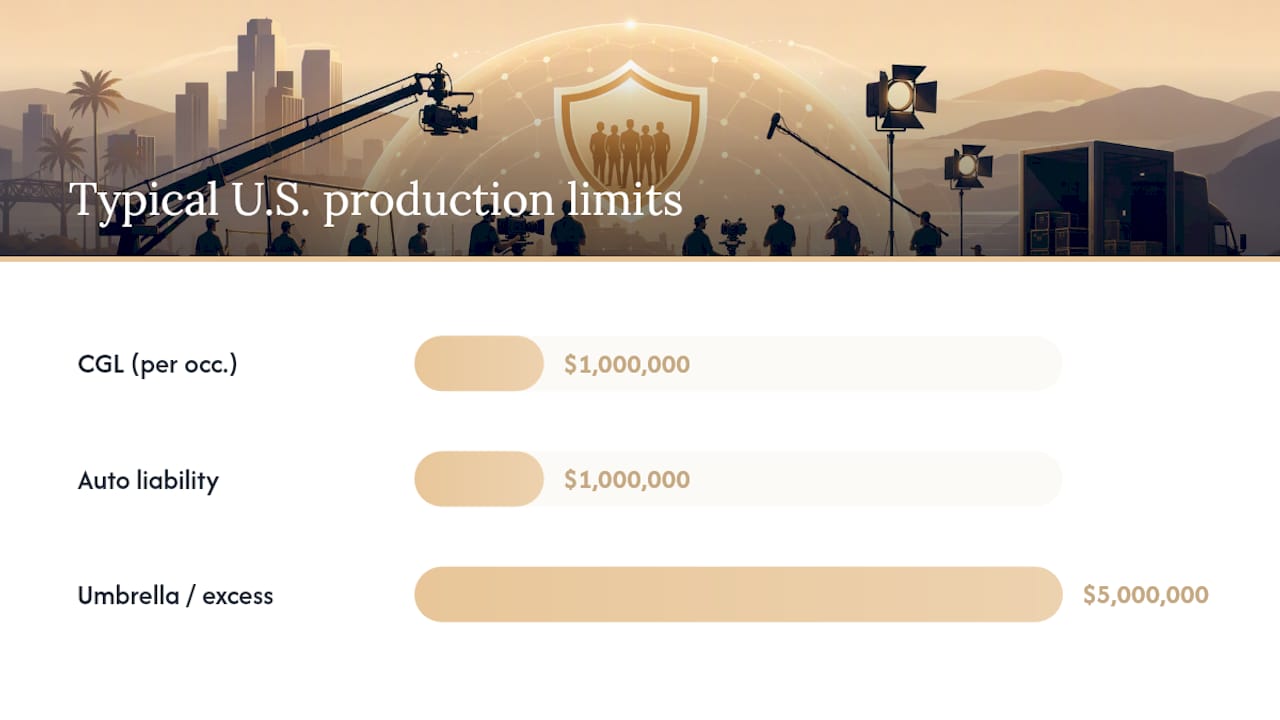
Commercial General Liability (CGL) is the baseline everyone asks for. A $1,000,000 per-occurrence limit is the industry floor, and it's also the exact figure the California Film Commission requires for state permits, along with a separate additional insured endorsement naming the State with specific wording. Bigger budgets, stunt work, or high-value locations often push that number to $2 million or higher.
- Inland marine (equipment) coverage: rental houses want proof your equipment limit sits at or above replacement value, with the rental house named as both Loss Payee and Additional Insured, a standard condition of releasing gear under a producer's package.
- Hired and non-owned auto liability: kicks in the moment cast or crew drive rented vehicles or their own cars for production purposes; sample limits typically match your CGL at $1 million.
- Workers' compensation: mandatory in nearly every state the moment you have paid crew, with rules on volunteers and unpaid interns varying by jurisdiction, so check your state's labor board before assuming anyone is exempt.
- Excess/umbrella coverage: financiers, studios, or high-profile venues frequently require a layer above your base limits, often $5 million or more stacked on top of CGL and auto.
None of these figures are arbitrary. A rental house that just watched a $40,000 camera package walk off a set with inadequate coverage isn't inclined to skip the paperwork next time.
Endorsements and Sample Wording Every Producer Should Request
Three endorsements separate a COI that gets accepted from one that lands in the rejection pile. Certificate holders in film consistently expect Additional Insured status, a Waiver of Subrogation, and Primary and Non-Contributory wording, and a COI missing any of them frequently gets bounced back regardless of how solid the underlying policy is, according to Wrapbook's producer guide.
Here's what each one actually does:
- Additional Insured: extends your liability coverage to protect the location, rental house, or venue if a claim arises from your production's activity there.
- Waiver of Subrogation: stops your insurer from turning around and suing the certificate holder to recover a payout, even if the holder shares some fault.
- Primary and Non-Contributory: forces your policy to pay first, before the certificate holder's own insurance is ever touched.
Being listed as an "additional insured" in the Description of Operations box is not the same as having an actual endorsement form attached to the policy. Permit offices and larger venues increasingly ask for both.
Description of Operations: "The State of California, its officers, agents, and employees are named as Additional Insured with respects to General Liability per attached endorsement. Waiver of Subrogation applies. Coverage is Primary and Non-Contributory."
That's close to the exact phrasing pattern the California Film Commission expects, and it's a useful template to hand your broker verbatim rather than paraphrasing from memory. Endorsement requests take longer than standard COIs because underwriters have to draft and issue a separate form, so build that lag into your timeline instead of discovering it the day before pickup.
How to Secure a Compliant COI Before Pickup Day
Getting production insurance requirements sorted early is the difference between a smooth pickup and a stalled call sheet. Treat it as a workflow, not a last-minute phone call.
- Collect every certificate holder's requirements up front. Pull the exact wording each location, rental house, and permit office wants and drop it into one shared tracker document before principal photography starts.
- Send your broker everything at once. Shoot dates, equipment values, any hazardous or stunt activity, and the permit's specific insurance language all go in the same request. Piecemeal requests are what generate delays.
- Know when a self-service portal is enough. Some carriers offer online COI generation for standard requests, but anything involving a custom endorsement or unusual Description of Operations wording still needs a human broker.
- Build in real turnaround time. Standard COIs typically take 48 to 72 hours, and endorsements can push that further out if underwriting has questions.
- Log and confirm distribution. Note who requested each COI, when it was sent, and get a confirmation reply from the certificate holder that it was received and accepted.
Pro Tip: Assign one person, not a rotating list of production assistants, to own the COI tracker. A single point of accountability catches expiration dates and missing endorsements before they become a Friday afternoon crisis.
Real Permit and Rental-House Requirements to Match Against
Generic advice only gets you so far. Matching your COI against actual, published requirements from real certificate holders is what keeps your paperwork from bouncing.
- The California Film Commission requires proof of General Liability at $1,000,000 per occurrence minimum, plus a separate endorsement naming the State of California, its officers, agents, and employees using their specific wording, not a paraphrase.
- Equipment rental houses commonly require your inland marine coverage to sit at or above full replacement value, with the rental house named as Loss Payee and Additional Insured before they'll release cameras, grip gear, or lighting packages.
- Central Casting's sample certificate requirements spell out an exact certificate-holder naming block along with a 30-day notice of cancellation, a stricter window than the 10 to 30 days many standard policies default to.
- Productions flying drones should confirm their broker has issued a UAS-specific endorsement separately. Standard aviation exclusions in a general policy usually won't cover drone operation without one.
Every one of these examples shares a pattern: the wording has to match, not just the coverage amount.
Common Mistakes That Stop a Shoot Cold
Most COI failures aren't coverage gaps. They're paperwork gaps, and they're avoidable with a checklist you actually run every time.
Track these fields for every COI in your production: who requested it, the exact wording the certificate holder needs, the expiration date relative to your shoot dates, whether the endorsement form (not just a mention) is attached, and the carrier's rating.
- Expired COIs. A certificate that lapses mid-shoot because nobody flagged the expiration date is the single most avoidable failure on this list.
- Missing endorsement forms. A Description of Operations that mentions Additional Insured status without an attached endorsement form gets rejected by rental houses even when the underlying policy would have covered a loss.
- Wrong wording in the Description of Operations. Generic phrasing instead of the certificate holder's exact requested language is the most common single rejection reason.
- Undervalued equipment limits. Naming a limit below actual replacement cost invites a rental house to simply hold the gear.
When something breaks the day before a shoot, call your broker directly rather than emailing. A temporary letter of authority or a verbal confirmation to the certificate holder can buy you hours you don't have.
How Transport Planning Ties Into Your COI Tracker
Ground transportation vendors have their own insurance checklist, and it belongs in your production's master COI tracker right alongside locations and rental houses. Auto liability wording, specifically hired and non-owned coverage, and proof of driver coverage are what transport vendors and large venues actually check before letting a vehicle onto a lot.
- Confirm your transport vendor's certificate names your production as Additional Insured for any pickups on studio or municipal property.
- Schedule cast and equipment pickups only after transport COIs are confirmed, not while they're still pending with a broker.
- Fold transport vendor requirements into the same tracker you use for locations and rental houses, so nothing gets checked twice or missed entirely.
Certified transport vendors sometimes satisfy large venues with proof of commercial auto coverage and a direct carrier contact rather than a full endorsement, though municipal permits still often insist on the formal Additional Insured form.
Updating or Extending a COI Mid-Production
Productions rarely finish exactly on the schedule they started with. When principal photography runs long, adds a location, or picks up new rental equipment, your existing COI doesn't automatically stretch to cover it.
Start by comparing your current COI's expiration date against your revised shoot schedule the moment a schedule change is confirmed, not the week it happens. If the policy period runs out before wrap, ask your broker to issue a renewal or extension COI reflecting the new end date. Don't wait for a rental house or location to catch the gap themselves.
Adding a location mid-shoot means a new Description of Operations, potentially a new Additional Insured name, and sometimes a new Waiver of Subrogation request if the added party has its own wording standard. Treat each new certificate holder as its own request, even if you're mid-production and tempted to reuse an old template.
New or upgraded equipment triggers the same review on your inland marine coverage. If your camera package just got a $60,000 upgrade, your existing equipment limit may no longer sit at replacement value, which is exactly the gap a rental house checks for before releasing anything else to you.
Set a calendar reminder roughly two weeks before any COI's expiration during active photography. That buffer gives your broker time to process a renewal without forcing a same-day scramble, and it keeps your tracker from ever showing a red flag on a day you actually need the gear.
Resolving Disputes When a COI Doesn't Match a Claim
A dispute usually surfaces the same way: something goes wrong on set, a claim gets filed, and the certificate holder discovers the COI they were handed doesn't match the actual policy terms. That gap, not the accident itself, is often what turns a routine claim into a drawn-out argument.
The first move in any dispute is pulling the actual policy documents, not just the COI. Because a certificate of insurance is a summary rather than a contract, the underlying policy language is what actually governs coverage. If the Description of Operations promised an endorsement that was never formally issued, the certificate holder's recourse is against your broker's error, not automatically against your carrier.
Most disputes resolve through your broker acting as the intermediary between your carrier and the certificate holder, since brokers already have the relationship and the paperwork trail. If the endorsement genuinely wasn't issued despite being promised, carriers will sometimes backdate a correction once notified, particularly when the omission was clearly an administrative miss rather than a coverage exclusion.
When a claim escalates past that point, it moves into the same claims adjustment process any liability claim follows: investigation, an assessment against policy limits, and a settlement or denial. The COI itself rarely becomes the center of a legal fight. What matters is whether the underlying policy, and its endorsements, actually existed at the time of the incident. That's exactly why confirming endorsement forms before the shoot, not just Description of Operations wording, is worth the extra phone call to your broker.
Why This Deserves a Point Person, Not a Checklist Buried in Email
The lesson that keeps repeating across every production I've watched navigate this: lock your COIs early, or the schedule pays for it later. Name one person, an executive producer or coordinator, to own the tracker from day one.
— Sammy
How Riga Global Travel Reduces COI Friction on Production Days
Transport is one of the last things producers think about when they're deep in COI paperwork, and it's exactly where a missed endorsement causes a real delay. Rigaglobaltravel works inside the entertainment industry every day, moving talent, executives, and equipment on schedules built around confirmed insurance, not hopeful timelines.

Rigaglobaltravel provides chauffeured airport transfers, talent transport, and equipment moves for productions across the markets it serves, coordinated directly with your production office rather than booked through a generic dispatch line. Add transport vendor requirements to your COI tracker the same day you lock locations and rental houses, and share them with your broker early so auto liability wording is confirmed before pickup day arrives, not the morning of. Producers working in Los Angeles can check availability and get a quote through the Los Angeles limousine service page, and productions based in New York can start the same conversation through the New York corporate car service page.
Sources
- Producer's Guide: Certificates of Insurance in Film — Wrapbook
- Insurance Requirements - California Film Commission
- Film Production Insurance: The Complete 2026 Guide — Akker, LLC