
Private jet travel routinely includes concierge-grade ground transportation, and it can be arranged by your charter operator, broker, FBO, or a dedicated limousine concierge. You don't have to figure this out at the curb. The parties who typically deliver and coordinate luxury ground transfers are:
- Charter operator or broker — often bundles ground transport into the total service package, coordinating through the FBO so a vehicle is waiting as you exit the aircraft
- Fixed Base Operator (FBO) — acts as a private terminal and can stage chauffeurs, handle luggage, and manage meet-and-greet on-site
- Third-party concierge or limousine provider — specialists like Rigaglobaltravel who take direct instruction from the traveler or coordinator and manage the full air-to-door sequence independently
The core benefits: complete privacy from ramp to destination, minutes saved versus any commercial alternative, vehicle and routing customized to your passenger mix, and the flexibility to adjust on the fly when flights shift.
Key Takeaways
Coordinated private jet ground transportation depends on three things working together: a provider with direct FBO access, live flight tracking, and a written contingency plan for delays.
| Point | Details |
|---|---|
| Book 24–48 hours out | Confirm planeside vs. lobby pickup and vehicle availability before the day of travel. |
| Share full flight details | Provide tail number, FBO name, passenger count, and luggage profile at booking. |
| Require a contingency plan | Ask for written backup vehicle and delay protocols before confirming any provider. |
| Match vehicle to passenger mix | Crew and group transfers need a coach or multi-vehicle coordination, not a sedan. |
| Rigaglobaltravel as your ground partner | Covers New York, Connecticut, Miami, and Los Angeles with FBO-coordinated transfers and corporate billing. |
Table of Contents
- What private jet ground transportation actually covers
- Who arranges your private jet transfer?
- Vehicle and service-level options for every passenger mix
- How coordination works from booking to handoff
- What drives the cost of a private jet ground transfer
- How to book private jet ground transportation
- Special arrangements: crew transport, medical transfers, and security escorts
- How Rigaglobaltravel coordinates private jet ground transfers
- What most guides get wrong about private jet ground transfers
- Rigaglobaltravel handles the ground segment so you don't have to
- Sources
What private jet ground transportation actually covers
The term "private jet ground transportation" describes a concierge-grade transfer that begins at the aircraft or FBO and ends at the passenger's final destination, with a professional chauffeur managing every step in between. It is the ground half of a door-to-door private aviation experience.
Standard inclusions across most providers:
- Chauffeur service with a pre-staged, inspected vehicle
- Flight tracking so the driver adjusts to real arrival times, not scheduled ones
- Meet-and-greet at the FBO lobby or, where permitted, planeside
- Luggage handling from aircraft to vehicle
- Multi-vehicle coordination for groups or production crews
- Security escort when requested in advance
What typically costs extra or requires a separate request: armed security personnel, medical transport equipment, oversized or specialty cargo handling, exotic or one-off vehicle brands, and multi-stop itineraries beyond the primary drop.
According to Global Jet Centre's VIP arrival guide, FBOs manage immigration and customs assistance, luggage, and ground transport coordination to minimize the time passengers spend on the ground. That coordination is the infrastructure your transfer provider plugs into.
Pro Tip: Always confirm whether planeside pickup is available at your specific FBO before booking. Amalfi Jets notes that planeside access is permission-dependent and not guaranteed — request it, but book a lobby pickup as your fallback.
Who arranges your private jet transfer?
Any of the four parties below can arrange it. The real question is which one gives you the most control, the clearest pricing, and the fastest response when something changes.
| Arranger | Best for | Strength | Watch out for |
|---|---|---|---|
| Charter operator | Single-flight, bundled service | One invoice, pre-coordinated with FBO | Ground transport is secondary to the flight; limited vehicle options |
| Charter broker | Recurring travelers, complex itineraries | Broad vendor network, can source specialty vehicles | Adds a layer; confirm who is actually liable for on-time |
| FBO directly | Travelers already using FBO services | On-site authority, ramp access knowledge | FBO ground transport varies widely in quality and fleet |
| Third-party limousine concierge | VIPs, talent, production, recurring corporate | Dedicated fleet, direct accountability, pricing transparency | Requires you to share flight details proactively |
Presidential Aviation explains that charter operators and brokers commonly work with local FBOs to have transportation ready at the exit or planeside, and that flight tracking keeps vehicles timely. That works well for a standard transfer. For talent, production crews, or multi-vehicle logistics, a dedicated limousine concierge who owns the ground segment outright gives you tighter control.
The process flow in a well-run transfer: the limousine provider receives the flight number and tail number, monitors the aircraft via live tracking, communicates any delay to the FBO, and confirms vehicle staging with the FBO's ramp coordinator. The FBO controls ramp access, so the driver needs explicit staging instructions from the FBO to be allowed planeside.
Pro Tip: When using a third-party provider, send them the FBO's direct contact number at booking. That single step eliminates the most common source of staging delays.
Vehicle and service-level options for every passenger mix
Matching the vehicle to the passenger profile is where coordinators most often cut corners. Here are the main classes:
- Executive sedan (Mercedes S-Class, BMW 7 Series) — one to two passengers, minimal luggage, business or solo VIP transfers
- Luxury SUV (Cadillac Escalade, Chevrolet Suburban) — two to four passengers, generous luggage capacity, preferred for talent and family groups
- Stretch limousine — ceremonial arrivals, red-carpet events, or clients who specifically request it
- Executive minibus or coach — production crews, sports teams, corporate delegations of six or more
- Armored vehicle — VVIP, diplomatic, or security-sensitive transfers; requires advance notice and specialist operators
For vetted chauffeur services at the level private aviation demands, look for: commercial auto liability insurance at appropriate limits, background-checked drivers, GPS-monitored vehicles, and documented vehicle sanitization protocols. A provider who cannot answer those four points in writing is not operating at the standard the transfer requires.
| Passenger count | Luggage profile | Recommended vehicle |
|---|---|---|
| 1–2 | Carry-on only | Executive sedan |
| 1–4 | Standard checked bags | Luxury SUV |
| 2–6 | Heavy or oversized bags | Large SUV or executive van |
| 6–15 | Mixed, high volume | Executive minibus |
| Any | Security-sensitive | Armored SUV with escort |
How coordination works from booking to handoff
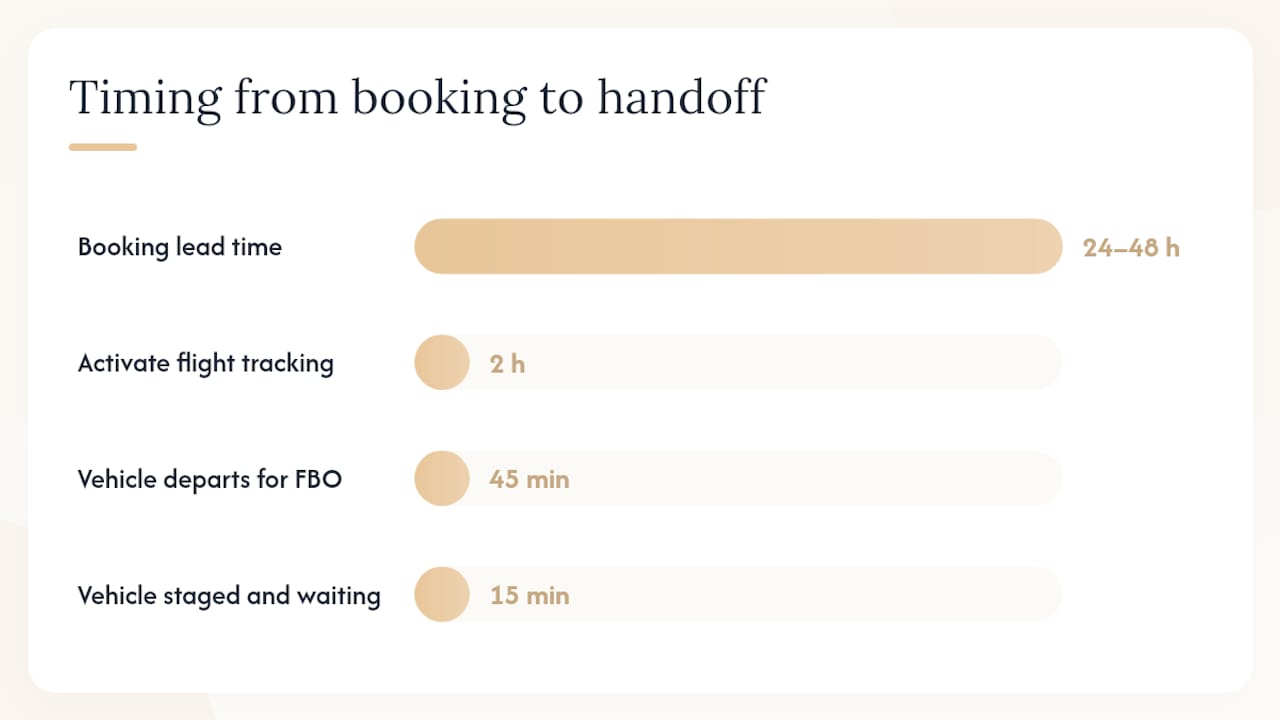
A flawless transfer runs on a tight operational sequence. Here is the timeline from booking to departure from the FBO:
- T-minus 24–48 hours: Book the transfer and confirm planeside vs. lobby pickup with the FBO. Amalfi Jets advises at least 24–48 hours lead time to confirm policies, vehicle availability, and FBO coordination; complex or multi-vehicle requests need more runway.
- T-minus 2 hours: Provider activates live flight tracking on the tail number. Vehicle is assigned and driver briefed on passenger profile, luggage count, and any special instructions.
- T-minus 45 minutes: Vehicle departs for the FBO. Driver confirms staging location with the FBO coordinator.
- T-minus 15 minutes: Vehicle staged and waiting. Driver in contact with FBO agent.
- Touchdown: FBO agent meets the aircraft. Luggage is collected and moved to the vehicle. Passengers proceed to the lobby or directly to the vehicle if planeside access is approved.
- Departure from FBO: Passengers loaded, luggage secured, route confirmed. Driver departs.
- Post-trip: Provider confirms delivery, logs any issues, and processes billing.
Flight-tracking and active liaison between the operator, FBO, and chauffeur are the single most important operational control for a clean transfer, according to Global Jet Centre's coordination notes. When that chain breaks, passengers wait.
Pro Tip: Build a written contingency protocol into every booking: define the wait-time pricing threshold, the backup vehicle mobilization trigger, and the passenger contact number if the primary driver cannot reach the FBO. A written plan prevents disputes after a delayed or diverted arrival.
What drives the cost of a private jet ground transfer
Price varies more than most coordinators expect. The main drivers:
- Vehicle class — an armored SUV costs materially more per hour than an executive sedan
- Staging and wait time — most providers charge from vehicle dispatch, not passenger pickup; a two-hour delay costs real money
- Airport ramp access and parking fees — FBO ramp fees vary by airport and can be passed through to the client
- Distance and drive time — a 15-minute FBO-to-hotel run versus a 90-minute transfer to a private estate are priced differently
- After-hours and last-minute premiums — late-night arrivals and same-day bookings typically carry surcharges
- Security or specialty equipment — armed escorts, medical transport, or specialty vehicles add to the base rate
Illustrative U.S. ranges (these are market estimates, not guaranteed rates):
| Transfer type | Approximate range |
|---|---|
| Short city transfer (under 20 miles) | $150+ |
| Regional transfer (20 miles or more) | $350+ |
| Long-distance transfer (over 20 miles) | $700+ |
| Multi-vehicle crew shuttle (3+ vehicles) | $1,200+ |
| Armored or security transfer | $800+ |
Invoicing models vary: fixed-fee per ride is standard for point-to-point transfers; hourly and day rates apply when the vehicle is held for a full day of use; corporate accounts and retainers offer direct billing and priority availability for high-frequency travelers.
How to book private jet ground transportation
Booking a transfer well is a checklist exercise. Give your provider every item below at the time of booking:
- Flight number or operator name and aircraft tail number
- Expected touchdown time and FBO name and address
- Passenger count and names (for meet-and-greet cards)
- Luggage count and any oversized items
- Vehicle preference or passenger profile notes
- Security or privacy requirements
- Primary contact phone number (reachable on landing)
- Billing instructions and purchase order number if applicable
When vetting a provider, ask these questions directly:
- What are your commercial auto liability insurance limits?
- How do you conduct driver background checks?
- Do your drivers have experience with planeside access at this FBO?
- How do you track vehicles in real time?
- What is your backup vehicle policy if the primary vehicle is unavailable?
- Do you have an on-time guarantee, and what does it cover?
- Can you provide corporate references or client testimonials?
Red flags to reject or renegotiate:
- Vague or evasive answers about insurance coverage
- No documented experience with ramp access at the relevant airport
- Vehicle photos that don't match the vehicle description or year
- No written contingency plan for delays or diversions
- Inability to provide a direct driver contact number
Pro Tip: For last-minute VIP ground transport, confirm backup vehicle availability explicitly — not just primary vehicle availability. A provider with one vehicle in class is a single point of failure.
Special arrangements: crew transport, medical transfers, and security escorts
Standard transfers cover most private jet passengers. These scenarios require extra lead time and specific capabilities.
- Crew shuttles for film and TV productions — multiple vehicles, staggered ETAs, a dedicated operations contact, and often a 24-hour window tied to aircraft turnaround schedules. Pre-staging vehicles with staggered arrival times prevents the bottleneck that happens when a full crew deplanes at once. See the VIP production crew transport guide for multi-vehicle logistics detail.
- Medical transfers — stretcher-capable vehicles, trained medical attendants, and coordination with receiving facilities. These require advance notice of at least 48 hours and documentation of the patient's condition and equipment needs.
- Armored and security escort transport — specialist operators, advance route planning, and often law-enforcement liaison for motorcade movements. Airport ramp permits and local authority coordination may be required.
- Multi-vehicle convoy for delegations — synchronized staging, lead and follow vehicles, and a single operations coordinator who communicates with all drivers and the FBO simultaneously.
Quick Jet Aviation's ground transport overview confirms that specialized providers offer pre-scheduled and on-demand VVIP vehicles, GPS-monitored fleets, and protocols for medical and escort transport as standard service categories.
For production and delegation transfers, the difference between a smooth operation and a 45-minute delay on the ramp usually comes down to one thing: whether a single operations contact owns the communication between the FBO, all drivers, and the client. Fragmented communication — where the FBO calls one driver and the coordinator calls another — is the most common failure point in multi-vehicle private aviation transfers.
How Rigaglobaltravel coordinates private jet ground transfers
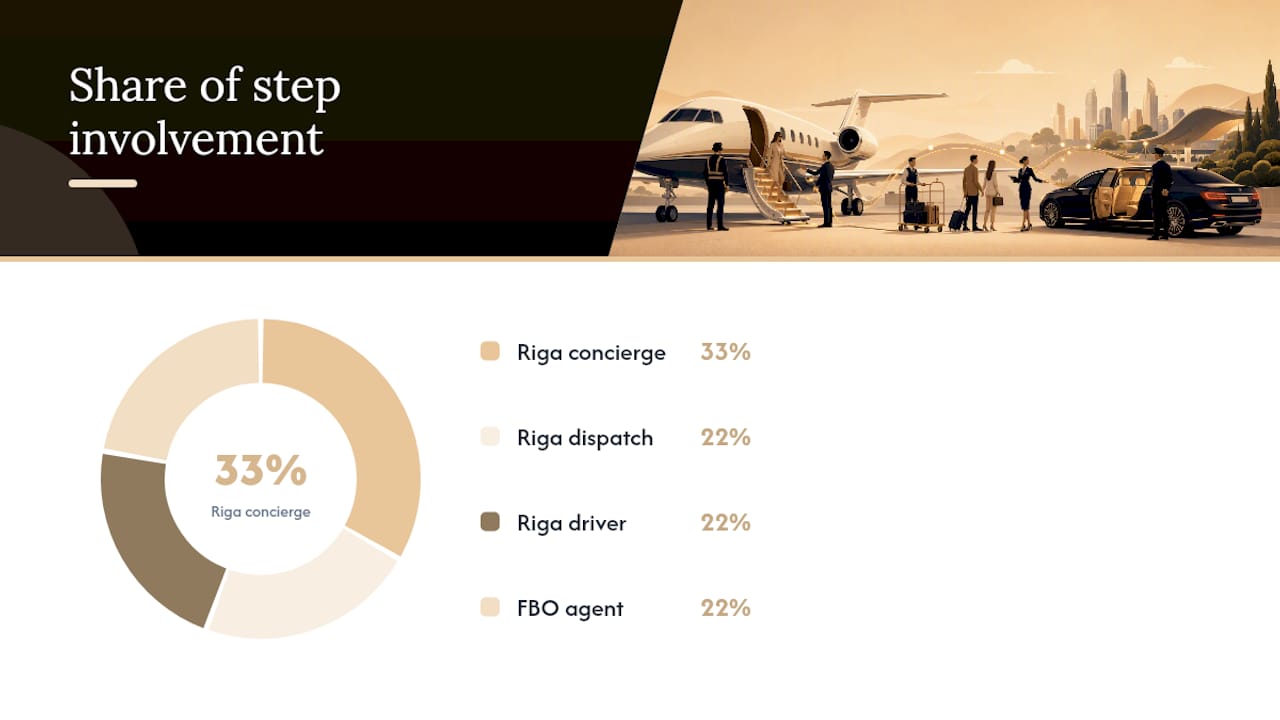
Rigaglobaltravel's process for a private jet ground transfer runs in six steps:
| Step | Action | Owner |
|---|---|---|
| Booking | Collect flight details, FBO, passenger profile, vehicle preference | Riga concierge |
| FBO liaison | Confirm staging location, planeside vs. lobby, ramp access | Riga concierge + FBO agent |
| Vehicle staging | Dispatch vehicle, brief driver, confirm arrival window | Riga driver + dispatch |
| Flight tracking | Monitor tail number live; adjust staging for delays or early arrivals | Riga dispatch |
| On-ground handoff | Meet and greet, luggage transfer, passenger departure | Riga driver + FBO agent |
| Post-trip | Confirm delivery, process invoice, flag any issues | Riga concierge |
An example itinerary for a New York arrival: a client lands at Teterboro Airport (TEB) at 6:30 PM. Rigaglobaltravel's dispatch activates tracking on the tail number at 4:30 PM. The Escalade departs for TEB at 5:45 PM, staged at the FBO by 6:15 PM. The FBO agent meets the aircraft at the ramp. Luggage is loaded while the client proceeds to the vehicle. Departure from TEB by 6:40 PM, en route to Midtown Manhattan. The full airport transfer service covers JFK, LGA, EWR, and HPN in addition to Teterboro.
For entertainment industry clients, Rigaglobaltravel also manages studio executive car service and production crew logistics, with corporate billing available for production companies and talent agencies.
Pro Tip: Give Rigaglobaltravel the FBO's direct operations line at booking. It cuts the staging confirmation call from 20 minutes to two.
What most guides get wrong about private jet ground transfers
The standard advice is to book early and confirm the vehicle class. That is correct but incomplete. The part most coordinators miss is the communication chain between the FBO and the ground provider.
Most delays in private jet ground transfers don't happen because the vehicle was late. They happen because the driver didn't know the aircraft was early, or the FBO didn't know the driver was waiting on the wrong side of the building. Flight tracking solves the first problem. A direct FBO-to-driver contact number solves the second. Neither of those is a luxury add-on; they are the baseline for a transfer that actually works.
The other underrated point: planeside pickup is worth requesting every time, but it should never be the only plan. Airport rules change, ramp conditions shift, and an FBO can revoke planeside access on the day. A coordinator who builds the entire arrival sequence around planeside access and has no lobby fallback is one phone call away from a frustrated client standing at the wrong door.
The vehicle class matters less than most clients think. An executive sedan with a driver who knows the FBO layout, has the FBO agent's number, and is tracking the flight live will outperform a stretch limousine whose driver is circling the parking lot waiting for a text.
Rigaglobaltravel handles the ground segment so you don't have to
When the flight lands, the last thing a VIP client or production coordinator should be managing is a vehicle that hasn't arrived. Rigaglobaltravel provides luxury airport transfers and executive ground transportation across New York, Connecticut, Miami, Los Angeles, and beyond, with direct FBO coordination built into every booking.

The fleet covers executive sedans, luxury SUVs, stretch limousines, and executive coaches. Every driver is background-checked and commercially insured. Every booking includes live flight tracking and a dedicated concierge contact. Corporate accounts with direct billing are available for production companies, talent agencies, and travel managers who need a reliable ground partner on retainer.
To arrange a private jet ground transfer or request a corporate account, contact Rigaglobaltravel directly with your flight details and FBO. Same-day requests are handled when availability permits; 24–48 hours advance notice is recommended for multi-vehicle or specialty transfers.
Sources
- VIP Private Jet Arrival & Departure Experience | GJC
- Private Jet Ground Transportation Arrival: From Ramp to Road | Amalfi Jets
- Transportation Options from Your Private Jet Charter FBO - Presidential Aviation
- Crew & Passenger Ground Transport - Quick Jet Aviation