Most people assume limo fleets at streaming events exist for appearances. They see a line of black vehicles outside a venue and think someone just wanted to look important. The reality is that why streaming companies use limo fleets has nothing to do with vanity. It comes down to branding exposure, operational control, privacy protection, and the kind of logistical precision that rideshare apps simply cannot deliver. If you are making transportation decisions for a streaming company or content-driven event, this guide breaks down the strategic thinking behind professional fleet services so you can use them the same way the industry's biggest players do.
Table of Contents
- Key Takeaways
- Why streaming companies use limo fleets for event logistics
- Branding power of limo fleets at streaming events
- Privacy and discretion in high-profile streaming transfers
- Global consistency across multi-city streaming events
- Integrating limo fleets into your event strategy
- My take: limo fleets are the most undervalued tool in streaming logistics
- How Rigaglobaltravel supports streaming companies
- FAQ
Key Takeaways
| Point | Details |
|---|---|
| Reliability over rideshare | Limo fleets eliminate surge pricing and inconsistency that routinely disrupt streaming event schedules. |
| Branding as a media channel | Branded vehicles extend your brand presence to multiple venues and high-attention audience moments. |
| Privacy by design | Professional fleets use NDA-covered chauffeurs, masked communications, and controlled pickups to protect VIPs. |
| Global consistency matters | One-stop fleet providers deliver uniform service standards across multiple cities, reducing operational risk. |
| Fleet as strategy, not expense | Integrating limo services into attendee journey design increases engagement and protects brand reputation. |
Why streaming companies use limo fleets for event logistics
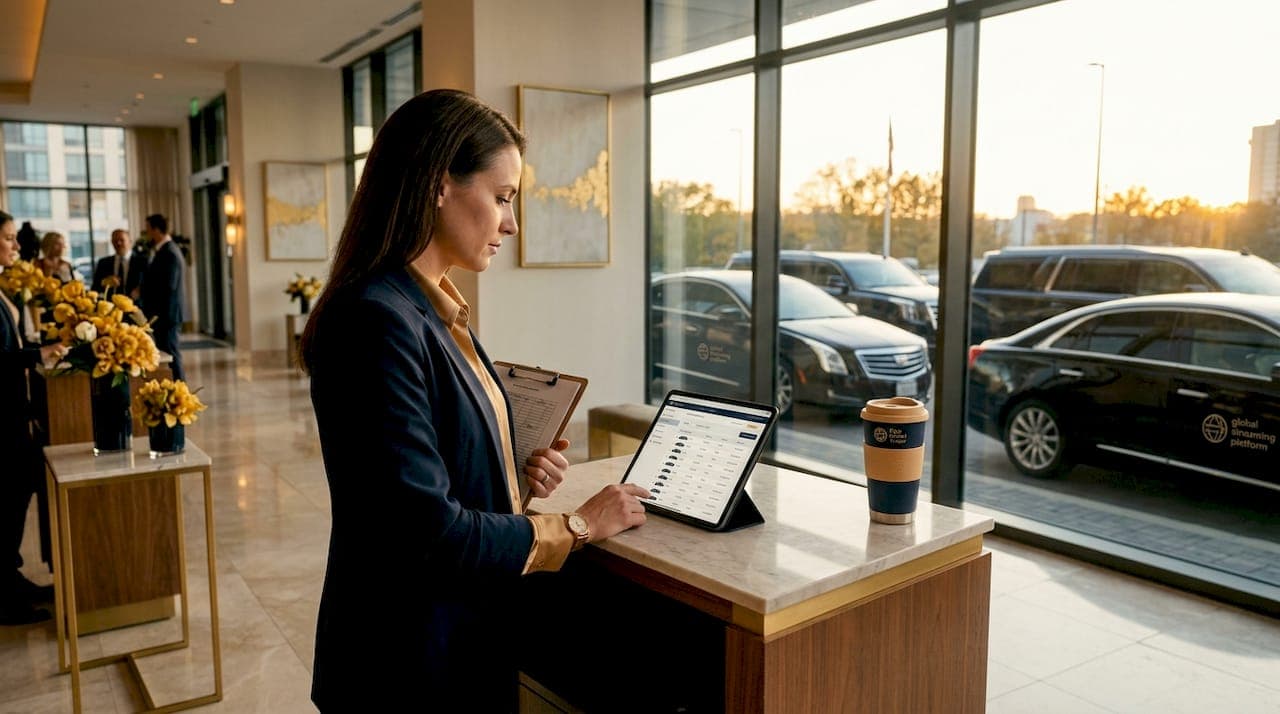
The formal term for what professional fleet providers offer streaming companies is ground transportation management, and it goes well beyond getting people from point A to point B. Streaming events run on tight, multi-location schedules. A panel discussion at one venue, a product activation across town, a creator meet-and-greet at a third location. Any gap in transportation breaks the entire program.
Streaming audiences value reliability and personalized digital coordination during events, making limo fleets a natural fit for complex itineraries that rideshare platforms were never designed to handle. With a professional fleet, every vehicle is pre-scheduled, every driver is briefed on the event timeline, and every pickup is confirmed before the day begins.
The contrast with rideshare becomes sharp the moment an event gets busy:
- Surge pricing can triple transportation costs within minutes of a venue reaching capacity.
- Driver inconsistency means different vehicles, different quality, and different levels of discretion on every trip.
- No group coordination makes it nearly impossible to move teams, equipment, and executives in synchronized waves.
- Zero event context means a rideshare driver has no idea your speaker has two minutes before their keynote starts.
Modern limo providers use AI-enabled booking and real-time tracking while keeping the human service layer that premium clients expect. Dispatchers communicate directly with event coordinators. Routes adjust in real time. And critically, equipment transport, including cameras, lighting rigs, and branded merchandise, gets handled in vehicles with enough space and driver awareness to protect it.
Pro Tip: When building your event run-of-show, assign a dedicated fleet coordinator from your limo provider. Having one contact who knows your full schedule is worth more than any technology feature.
Branding power of limo fleets at streaming events
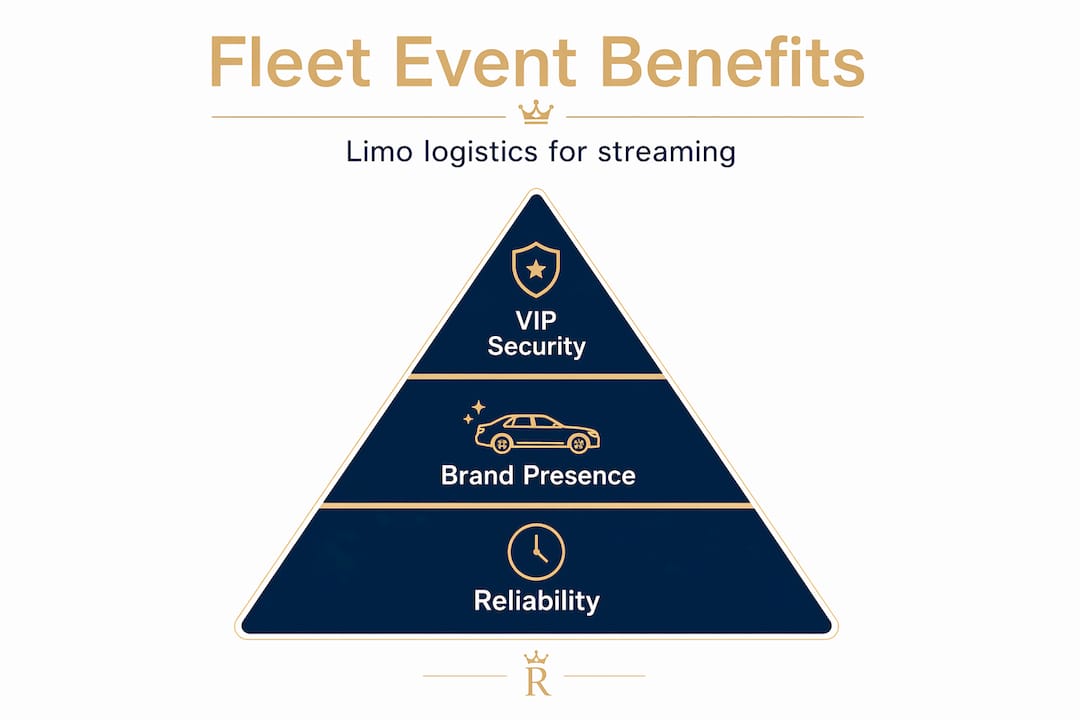
Here is where streaming decision-makers often miss a major opportunity. A limo fleet is not just transportation. It is a moving brand environment that operates across every venue your event touches.
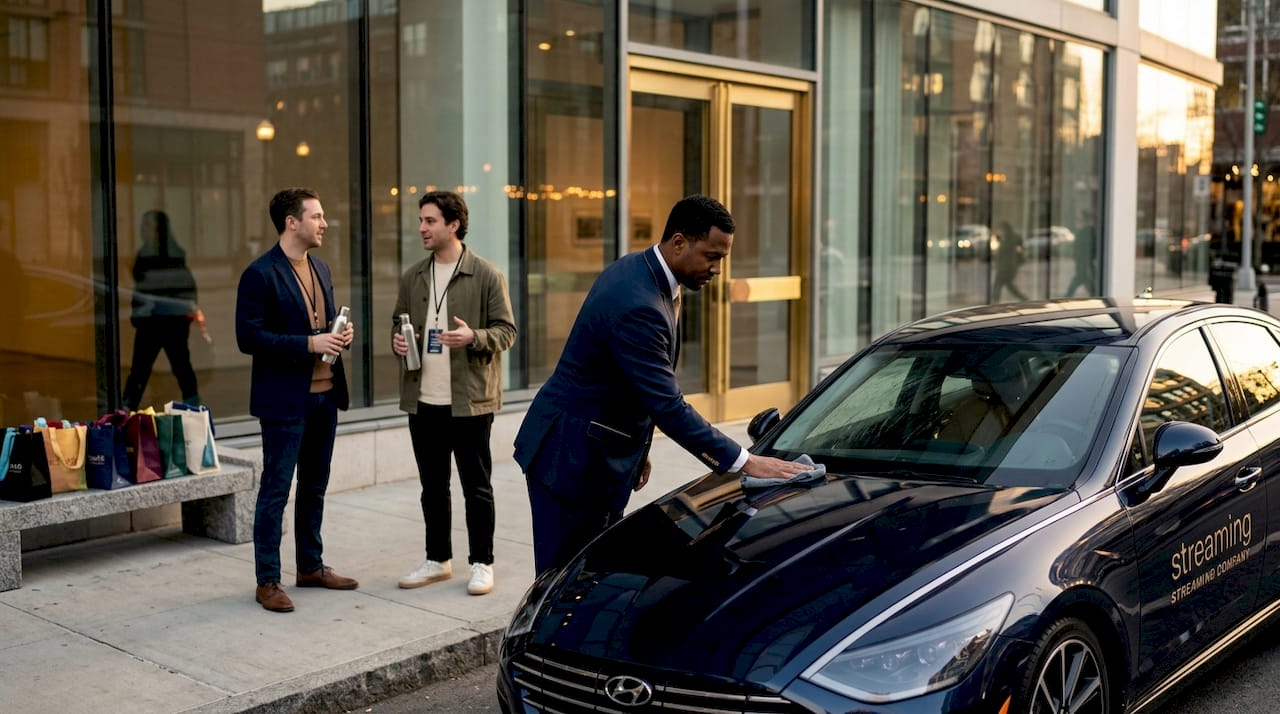
The industry term for this is an event-anchored branded chauffeur campaign, and it works differently from a billboard or a social ad. Your audience is inside the vehicle, captive, and moving between the exact locations your brand controls. Branded vehicles create premium experiences at multiple event touchpoints with a level of dwell time that static advertising cannot match.
Consider what a typical out-of-home ad achieves versus what a branded fleet does:
| Advertising format | Dwell time | Audience context | Brand control |
|---|---|---|---|
| Billboard | 2-5 seconds | Passive, distracted | Low |
| Rideshare app ad | Under 10 seconds | Scrolling, disengaged | Low |
| Branded limo interior | 15-45 minutes | Captive, event-primed | High |
| Branded limo exterior | Repeated impressions | Venue-concentrated crowd | Medium |
The math on branding ROI shifts dramatically once you account for audience concentration. At a streaming conference or product launch, event-anchored fleets become strategic media touchpoints at moments when your audience's attention is at its highest. You are not competing with their phone or the next post in their feed. You have them in a seat, moving toward your content.
"The strategic advantage of branded chauffeur vehicles lies in their ability to maintain event-anchored visibility where audiences are concentrated and attention is high, making luxury fleets controlled, high-impact media touchpoints." — Carvertise, Adrian Award Report
For product launches, creator summits, and streaming conference activations, this is not a nice-to-have. It is a channel most brands are underutilizing while paying far more for less engaged impressions elsewhere.
Privacy and discretion in high-profile streaming transfers
Privacy is where limo fleet services for streaming companies separate themselves most clearly from any gig economy alternative. This is not about preference. For executives, top-tier creators, and brand ambassadors, it is an operational requirement.
The industry framework here is called Privacy by Design, and professional providers operationalize it through specific, layered protocols:
- Controlled pickup zones. Vehicles stage away from public entrances, and guests are routed through access-controlled areas to minimize paparazzi exposure and fan contact.
- Pseudonymous bookings. Client names never appear on driver manifests. Bookings use codes or pseudonyms so that if any document is ever compromised, it reveals nothing identifying.
- NDA-covered chauffeurs. Professional drivers sign non-disclosure agreements before handling high-profile clients, unlike gig drivers who have no such accountability.
- Masked communications. Phone numbers and contact details for both clients and drivers are routed through temporary tokens so neither party's real information is ever exchanged.
- Staggered arrival windows. VIPs do not all arrive and depart at the same time. Timed gaps reduce crowding, cut paparazzi opportunities, and allow for individual security protocols.
Privacy-by-design protocols like these protect more than the individual. They protect your event from becoming a story about security failures rather than the content you produced. One unauthorized photo of a creator in transit, one leaked schedule, and your event narrative gets hijacked.
Pro Tip: Ask any fleet provider specifically how they handle pseudonymous bookings and driver NDAs before signing a contract. If they cannot answer in detail, that tells you everything you need to know about their VIP readiness.
Professional chauffeurs trained in executive etiquette and privacy management represent a fundamentally different category of driver than what any app dispatches. The training covers discretion, crisis response, and local context awareness, all of which reduce operational risk at exactly the moments it matters most.
Global consistency across multi-city streaming events
Streaming companies do not just run events in one city. A major platform might coordinate launches, press junkets, creator summits, and partner activations across a dozen markets in the same quarter. Managing local vendors in each city is not a transportation strategy. It is a coordination nightmare.
The solution is working with what the industry calls a one-stop-shop global fleet network. These providers operate with centralized dispatch, real-time tracking, and unified billing so your team interacts with one platform regardless of whether your event is in New York, London, or Los Angeles.
Here is what that consistency looks like in practice:
| Service element | Fragmented local vendors | Global fleet network |
|---|---|---|
| Booking experience | Different apps per city | Single platform, uniform interface |
| Driver standards | Varies by market | Centralized vetting and training |
| Billing | Multiple invoices, reconciliation required | One account, unified reporting |
| Real-time tracking | Inconsistent or absent | Live across all vehicles, all cities |
| Privacy protocols | Undefined or unverifiable | Standardized and contractually guaranteed |
Centralized vetting and uniform training combined with high-tech tracking allow one-stop networks to deliver consistent service whether your event is in a city where the provider has ten vehicles or five hundred. For a streaming decision-maker managing multiple markets, this removes an entire category of operational risk from your event planning.
Integrating limo fleets into your event strategy
Knowing why limo fleets matter is one thing. Knowing how to actually build them into your event logistics is where strategy becomes practice. Here is how to approach it:
- Audit your event needs first. Map every moment your creators, executives, or guests need to move. Identify which transfers require privacy, which require group coordination, and which involve equipment.
- Partner with providers who offer custom branding. Not every fleet company does vehicle wraps or interior branding. Confirm this capability early, and get samples or case studies before committing.
- Build transportation into your attendee journey design. The ride to and from your venue is part of the experience. Treat it that way with branded environments, curated content on screens, or simple premium touches like refreshments.
- Set communication protocols before the event. Establish a single point of contact between your event team and the fleet dispatcher. Define how last-minute changes get communicated and what the escalation path looks like.
- Measure what you actually care about. Brand impressions from wrapped vehicles, attendee satisfaction scores, on-time arrival rates, and cost per transfer compared to rideshare alternatives all tell a real story about ROI.
- Avoid the common pitfalls. Poor communication briefings leave drivers unprepared. Skipping privacy discussions creates liability. Using inconsistent providers across different event dates destroys the brand experience you built.
The benefits of limo fleets for streaming companies only materialize when the fleet is treated as a planned component of the event, not an afterthought booked the week before.
My take: limo fleets are the most undervalued tool in streaming logistics
I have worked with entertainment clients long enough to know that transportation gets treated like catering. Something that has to happen, gets handed off, and never gets the strategic attention it deserves until something goes wrong.
What I have actually seen is that the companies who get the most out of limo fleet services are the ones who bring us into event planning at the start, not after the venue is booked and the schedule is set. When transportation is built into the attendee journey from day one, everything else gets sharper. Creator arrivals feel deliberate. Brand exposure extends beyond the stage. Privacy incidents drop to near zero.
The thing I find most underappreciated is how much the interior of a branded vehicle does for audience priming. By the time an attendee arrives at your event in a wrapped, staffed limo, they are already in your world. That psychological shift is real, and it shows up in engagement metrics.
My honest recommendation for any streaming decision-maker reading this: stop treating luxury ground transportation as an optics decision. The ROI on privacy protection alone, measured in avoided crises, is worth the investment. Everything else, branding reach, operational reliability, creator satisfaction, is a compounding return on top of that.
— Sammy
How Rigaglobaltravel supports streaming companies
At Rigaglobaltravel, we work specifically with entertainment industry clients who need more than a vehicle. Streaming companies, content creators, and event decision-makers come to us because we understand how the industry actually runs. Our fleet services are built around privacy-by-design protocols, branded vehicle options, centralized dispatch for multi-city events, and real-time coordination tools that integrate directly with your event operations team.
We also work closely with VIP safety standards to make sure every transfer, whether it is a keynote speaker, a top creator, or a key executive, meets the kind of security and discretion those clients expect. If you are planning a streaming event or content activation and want transportation that works as hard as the rest of your strategy, reach out to Rigaglobaltravel for a tailored consultation.
FAQ
Why do streaming companies prefer limo fleets over rideshare apps?
Rideshare apps cannot offer fixed pricing, group coordination, privacy protocols, or event-specific briefing for drivers. Limo fleets provide all of these under one contracted service, making them far more reliable for complex streaming event logistics.
How does a branded limo fleet work as a marketing channel?
Branded vehicles wrap in event or sponsor visuals and transport high-value attendees between venues, generating repeated brand impressions at moments of high audience attention. Branded chauffeur campaigns consistently outperform traditional out-of-home advertising in audience engagement and dwell time.
What privacy protections do professional limo fleets offer?
Professional providers use NDA-covered chauffeurs, pseudonymous bookings, masked communications, and controlled pickup zones to protect high-profile clients from paparazzi, leaks, and unauthorized access during transfers.
Can a single limo provider handle events in multiple cities?
Yes. One-stop global fleet networks use centralized dispatch and unified billing to deliver consistent service standards across hundreds of cities, eliminating the complexity of managing separate local vendors for each market.
When should streaming companies start planning fleet transportation?
Fleet transportation should be integrated during the initial event planning phase, not added at the end. Early coordination allows for custom branding, privacy protocol setup, and route optimization that cannot be arranged last minute.