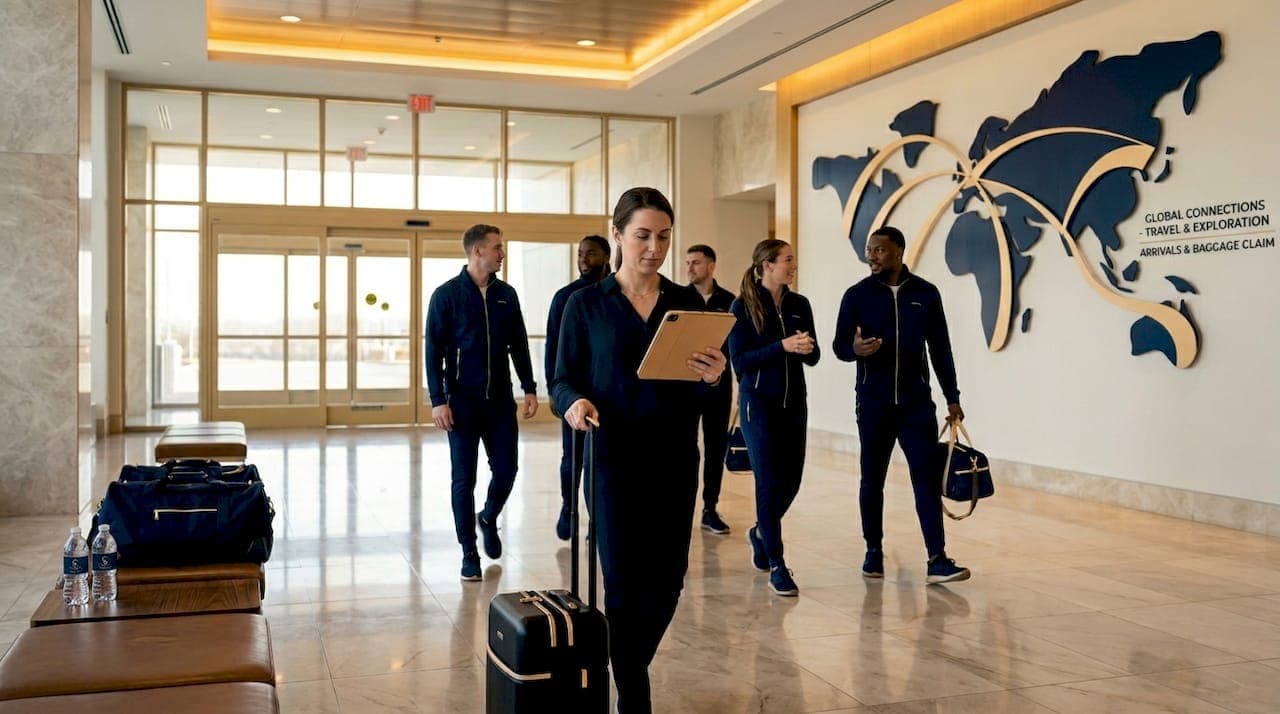
When you're coordinating athlete transport for a Netflix sports documentary, a WWE pay-per-view, or an NBC Sports broadcast weekend, the margin for error is essentially zero. The types of athlete transport services you choose directly affect whether talent arrives rested, on time, and ready to perform. Get it wrong and you're not just dealing with a delayed SUV. You're looking at cascading schedule failures, unhappy talent, and a production that loses momentum before the cameras roll. This guide breaks down the main transport options, how to evaluate them, and how to match each to your production's specific demands.
Table of Contents
- Key criteria to evaluate types of athlete transport services
- Chartered air travel services for athletes
- Bus charter and shuttle services for athlete transport
- Integrated multi-modal athlete transport logistics
- Comparison of athlete transport service types
- Why integrated athlete transport logistics is the future of event production
- How Riga Global Travel streamlines athlete transport for productions
- Frequently asked questions
Key Takeaways
| Point | Details |
|---|---|
| Multiple transport types | Athlete transport relies on charter flights, bus charters, and integrated logistics to meet diverse needs. |
| Flexibility and security | Flexible schedules and strict security are essential to protect and prepare athletes effectively. |
| Equipment logistics | Specialized cargo handling ensures timely and safe delivery of sports gear and nutrition supplies. |
| Integrated coordination | Seamless planning across air, ground, and cargo transport reduces complexity and supports performance. |
| Technology support | Real-time route automation and 24/7 support prevent travel disruptions and save costs. |
Key criteria to evaluate types of athlete transport services
Before you compare vendors or sign contracts, you need a clear framework. Not every transport service is built for the complexity of a multi-day sports production, and the wrong choice will cost you more than money.
Scheduling flexibility is the first filter. Athlete itineraries shift constantly. A game runs long, a press obligation gets added, a recovery session extends by 45 minutes. Your transport provider needs to absorb those changes without charging you a crisis premium or leaving a driver waiting in the wrong location. Sports team travel logistics requires precision, flexibility, and security to ensure athletes arrive rested and prepared.
Security and discretion matter more than most coordinators initially budget for. High-profile athletes traveling for WWE or Amazon Prime events require discreet pickup points, confidential scheduling, and drivers who understand that what happens in the vehicle stays there. Loose-lipped transport is a liability.
Equipment handling is where most first-time coordinators underestimate complexity. Sports production involves more cargo than a touring band. Think training equipment, nutrition coolers, medical bags, camera gear, and broadcast hardware. Your transport solution needs to handle all of it, not just the people.
Crew and multi-party coordination rounds out the framework. Athletes, coaching staff, production crew, and security teams rarely travel together, but they all need to arrive at the same place within tight windows. Here's a simple checklist before you evaluate any provider:
- Does the vendor offer 24/7 dispatch and real-time tracking?
- Can they handle equipment cargo alongside passenger transport?
- Do they have documented security protocols for high-profile talent?
- Can they coordinate across multiple transport modes in one booking?
- Do they have experience with sports productions specifically, not just corporate travel?
Pro Tip: Ask every vendor for a reference from a sports production or live event. General corporate transport experience does not prepare a provider for the pace and pressure of game-day logistics.
For productions that need seamless travel solutions from day one, the vendor evaluation stage is where you separate professionals from generalists.
Chartered air travel services for athletes
Chartered air travel is the gold standard for athlete transportation options when distance, recovery time, and schedule control are all in play. The advantages over commercial flights are not marginal. They're structural.
Sport air charters provide direct routing, flexible departure times, and custom cargo handling with private terminal access, all of which directly support athlete recovery protocols. That last point matters more than people realize. Boarding a commercial flight means 45 minutes of standing in lines, overhead bin fights, and exposure to crowds. A private terminal eliminates all of that, and for an athlete who needs to be sharp in 18 hours, that recovery time is real.
Key benefits of chartered air travel for sports productions include:
- Custom cabin configurations that accommodate trainers, nutritionists, and medical staff alongside athletes
- Dedicated cargo holds sized for bulky equipment including weights, recovery tools, and broadcast hardware
- Flexible departure windows that adjust to event overruns without rebooking fees
- Confidential manifests that protect athlete locations from public disclosure
- Direct routing that eliminates layovers and the fatigue that comes with them
For a production like an Amazon Prime boxing special, where the main event fighter needs to travel from training camp to the event city without media exposure, a charter is not a luxury. It's a production requirement.
Pro Tip: When booking charters for large athletic groups, request a cabin layout diagram in advance. Seating trainers near athletes and separating production crew from talent is a small logistical detail that makes a measurable difference in how rested everyone arrives.
Working with a provider that offers chartered air travel expertise built specifically for entertainment and sports productions means you're not explaining your needs from scratch every time.
Bus charter and shuttle services for athlete transport
Not every leg of an athlete's journey requires a plane. For intra-city movement, airport transfers, and venue-to-hotel runs, bus charter and athlete shuttle services are often the most practical and cost-effective transport solutions for athletes.
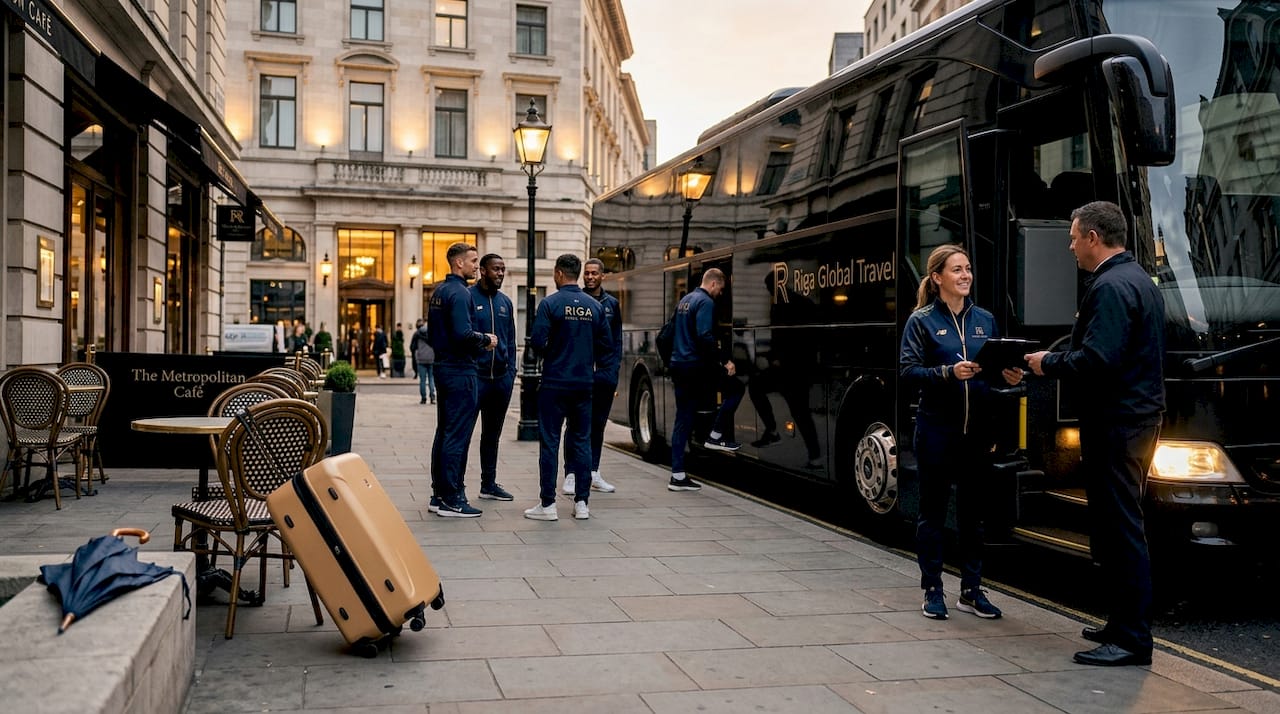
STM Driven manages bus charters for approximately 150 athletic programs yearly, supporting nearly 20,000 related events. That scale reflects how central bus transport is to sports logistics at every level, from college programs to professional productions.
The advantages of bus charters for sports productions are specific:
- Group consolidation keeps entire teams and production crews moving together, reducing the coordination overhead of managing 20 individual vehicles
- Cost scaling works in your favor when headcount is high. Per-seat costs drop significantly compared to running multiple SUVs
- Real-time route optimization allows drivers to respond to traffic, road closures, and last-minute venue changes
- Branding and privacy options let you run blacked-out windows or branded wraps depending on whether visibility or discretion is the priority
One underused tactic in large-scale sports productions is repurposing school bus contracts for fan transport or secondary crew movement. For major events where you're moving hundreds of people across a campus or stadium complex, this approach can cut ground transport costs by 30 to 40 percent without sacrificing reliability.
Pro Tip: For multi-day productions, build a dedicated shuttle loop between the athlete hotel, production base, and venue. A fixed loop with a 20-minute frequency eliminates the need for individual ride requests and keeps your transport budget predictable.
Coordinating bus charter options through a single provider rather than booking locally at each event city gives you consistent service standards and a single point of accountability.
Integrated multi-modal athlete transport logistics
The most complex productions don't choose between air charters and bus charters. They run both simultaneously, alongside cargo logistics that start days before the athletes arrive. This is where athlete transport logistics becomes a genuine discipline rather than a booking task.
Complex event itineraries require integrated planning for athlete movements, equipment, and ground transport to remove logistical complexity and maintain focus on performance. For a WWE pay-per-view or an NBC Sports championship broadcast, that integration looks something like this:
- 18-wheeler trucks depart 48 to 72 hours before the event, carrying ring equipment, broadcast hardware, and production infrastructure
- Police-escorted convoys move high-value cargo and principal talent through urban environments on tight timelines
- Technology platforms cross-reference fixture calendars, hotel check-in windows, and venue access schedules to eliminate empty vehicles and wasted trips
- Hotel and ground transport alignment ensures that when athletes land, their room is ready and their ground transfer is waiting, not circling the airport
The integration piece is where most productions lose money and time. A charter flight lands on schedule, but the ground transport wasn't updated on the revised arrival gate. The bus is at Terminal A, the team exits Terminal C. Twenty minutes lost, and the ripple effect hits the entire day's schedule.
Running integrated transport coordination through a single provider with a unified communication layer is the only reliable way to prevent these gaps.
Comparison of athlete transport service types
Sound coordination across air, ground, and cargo transport is essential to keep athlete travel focused on performance. Here's how the main service types stack up across the criteria that matter most to production coordinators:
| Criteria | Charter flights | Bus charters | Integrated logistics |
|---|---|---|---|
| Cost per seat | High | Low to moderate | Variable, optimized |
| Scheduling flexibility | Very high | High | Highest |
| Security and privacy | Excellent | Good | Excellent |
| Equipment handling | Dedicated cargo holds | Limited to luggage | Full cargo management |
| Distance range | Long haul, national | Local and regional | All distances |
| Crew coordination | Partial | Partial | Full multi-party |
| Best for | Intercity athlete travel | Venue and hotel transfers | Full event productions |
For a Disney sports docuseries filming across multiple cities, you likely need all three running in parallel. For a single-venue regional event, bus charters with a coordinating athlete transport service may be all you need.
Why integrated athlete transport logistics is the future of event production
Here's the uncomfortable truth most transport vendors won't tell you: the biggest failures in athlete transport don't happen because someone chose the wrong vehicle type. They happen because different parts of the transport chain were managed by different people who didn't talk to each other.
The air charter team books the flight. A local vendor handles the buses. Someone else arranges the equipment trucks. And nobody owns the handoff between them. That's how a perfectly executed charter flight ends with a world-class athlete standing on a curb outside baggage claim for 25 minutes while a production coordinator frantically calls three different vendors.
Integrating deep travel expertise with logistics allows teams and production staff to focus entirely on performance and event execution. That's not a marketing line. It's the operational reality that separates productions that run smoothly from ones that spend half their budget on crisis management.
The other overlooked factor is athlete recovery. Every unnecessary wait, every crowded terminal, every last-minute vehicle swap adds stress and fatigue to a body that needs to perform at its peak. When you manage transport in silos, you're making a performance decision, not just a logistics one.
Technology is closing some of these gaps. Real-time platforms that connect flight tracking, ground transport dispatch, and hotel check-in status in a single dashboard are now available to production coordinators who know to ask for them. But technology only works when the humans behind it are operating from the same playbook.
The productions that will run the best athlete transport in the next five years won't be the ones with the biggest budgets. They'll be the ones with a single trusted partner who owns the entire chain and is accountable for every handoff. That's the model worth building toward, regardless of your production's scale.
How Riga Global Travel streamlines athlete transport for productions
Production coordinators at major networks and streaming platforms need more than a vendor. They need a partner who already understands the pace, the stakes, and the specific demands of moving athletes and talent through complex event schedules.
Riga Global Travel provides seamless travel solutions for entertainment and sports productions, covering charter flight coordination, bus and shuttle logistics, cargo planning, hotel alignment, and security-conscious ground transport. Every engagement is built around your production schedule, not a standard travel template. Dedicated account managers stay connected throughout your event, giving you a single point of contact when plans change, and they always change. Real-time tracking and 24/7 dispatch mean issues get resolved before they reach the talent. If you're coordinating athlete transport services for an upcoming production, the conversation starts with your schedule and your specific requirements.
Frequently asked questions
What are the main types of athlete transport services available?
The primary types include chartered flights, bus charters, and integrated logistics combining multiple transport modes for complete athlete movement across all distances and event types.
How does chartered air travel benefit sports teams compared to commercial flights?
Sport air charters offer flexible departure times, direct routing, and private terminal access, eliminating the fatigue and exposure risks of commercial travel while providing dedicated cargo space for sports equipment.
Why is integrated logistics important for athlete transport?
Integrated planning removes logistical complexity by coordinating air, ground, and equipment transport through a single chain of accountability, preventing the costly handoff failures that occur when different vendors manage different legs independently.
How do bus charter services support athlete transport during events?
STM Driven specializes in collegiate bus charters working with 150 athletic programs annually, demonstrating how bus services provide reliable, scalable local transport between hotels, venues, and airports for large groups.
What role does technology play in athlete transport management?
Swvl automates route planning based on fixture calendars and real-time traffic, with 24/7 support to resolve issues before they affect team preparation or production schedules.