
Most event planners discover what talent tour transportation really means the hard way. A car shows up without cleared venue access. An artist lands early, and nobody's tracking the flight. The bus doesn't match the rider spec. Understanding what is a talent tour transportation system before show day isn't just good practice. It's the difference between a flawless event and a contractual nightmare. This guide breaks down the full scope of talent tour logistics, from vehicle types and rider requirements to the advancing process that separates professional operators from expensive guesses.
Table of Contents
- Key takeaways
- What is a talent tour transportation system, really?
- Tour transportation options and vehicle types
- The advancing process and talent riders
- Challenges and best practices in talent transportation
- What I've learned about what most planners miss
- Plan your talent transportation with Rigaglobaltravel
- FAQ
Key takeaways
| Point | Details |
|---|---|
| More than booking a car | Talent tour transportation covers coordinated movement of performers, crews, and equipment across multiple venues and cities. |
| Rider compliance is non-negotiable | Transportation clauses in hospitality riders are legally binding and ignoring them can breach contracts or cancel shows. |
| Advancing drives everything | Pre-tour coordination that finalizes schedules, vehicle types, and security clearances is the backbone of reliable transport. |
| Vehicle choice depends on group size | Luxury coaches suit larger touring groups while chauffeur-driven vehicles serve individual artists and small entourages. |
| Backup planning prevents disasters | Fixed-rate pre-booked services with real-time communication protocols outperform ride-hailing apps for high-profile talent. |
What is a talent tour transportation system, really?
The phrase gets tossed around loosely in production meetings, but the definition matters. Talent tour transportation is the specialized coordination of moving performers and their crews between airports, hotels, and venues in a way that keeps shows on schedule and on budget. It is not a single vehicle booking. It is an operational framework.
The scope includes far more than most planners initially expect. A single tour date might require airport transfers from multiple terminals, shuttle loops between the hotel block and the venue, equipment vehicle convoys timed to load-in windows, and post-show extraction routes that avoid fan crowds. Tour logistics integrates routing, transport, accommodation, and equipment handling into one synchronized plan.
Here is what falls under the talent tour transportation umbrella:
- Airport and private terminal transfers for artists, management, and touring crew
- Hotel-to-venue shuttles timed to technical production schedules and soundcheck windows
- Luxury coaches for overnight or multi-city legs where crew rest is mandatory
- Security escort coordination when artist profiles require law enforcement or private security convoys
- Post-show vehicles staged for immediate departure after the performance
The distinction from generic transportation is stark. A ride-hailing app cannot guarantee a vehicle matching rider specifications, monitor flight arrivals, clear credentialed venue access points, or maintain confidentiality. Professional chauffeur services offer flight delay tracking, VIP access, and fixed pricing that consumer-facing apps simply are not built to deliver. This is talent travel services as a professional discipline, not a convenience purchase.
Tour transportation options and vehicle types
Understanding the available vehicle categories is foundational to how to plan talent transportation correctly. The right vehicle is never just about comfort. It reflects the size of the traveling party, the distance covered, the privacy required, and what the rider specifies contractually.
Luxury entertainer coaches
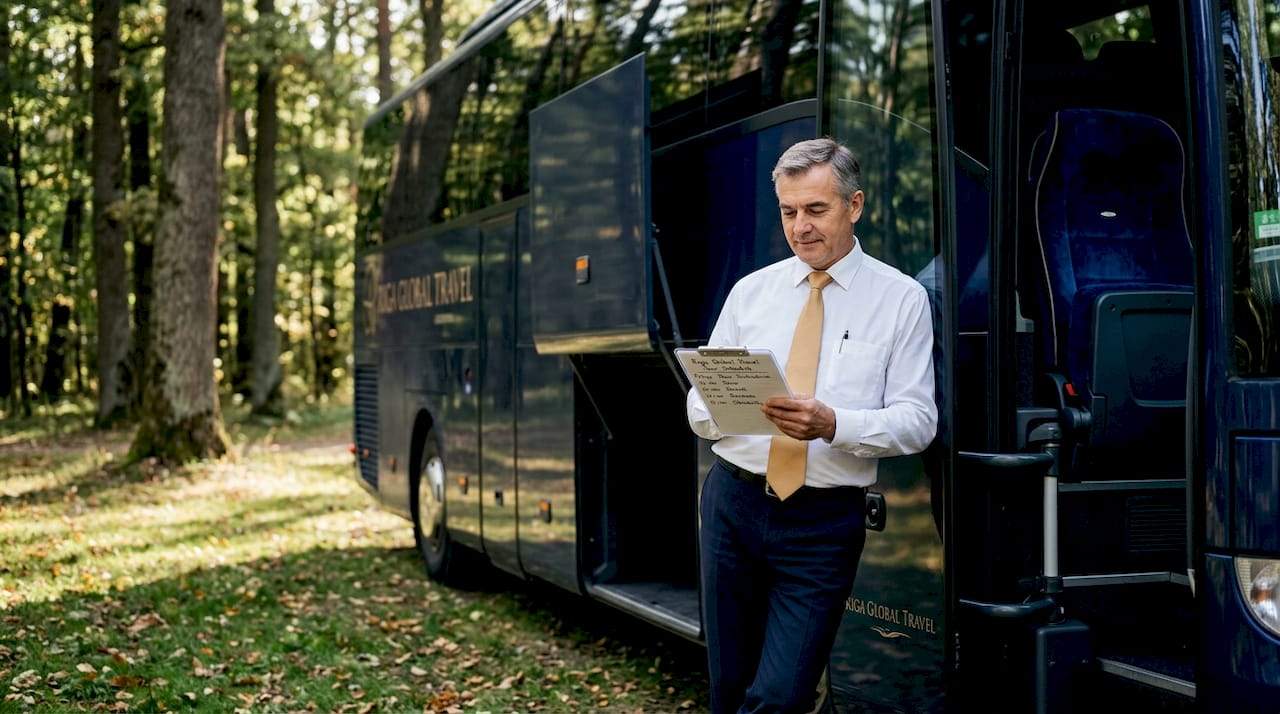
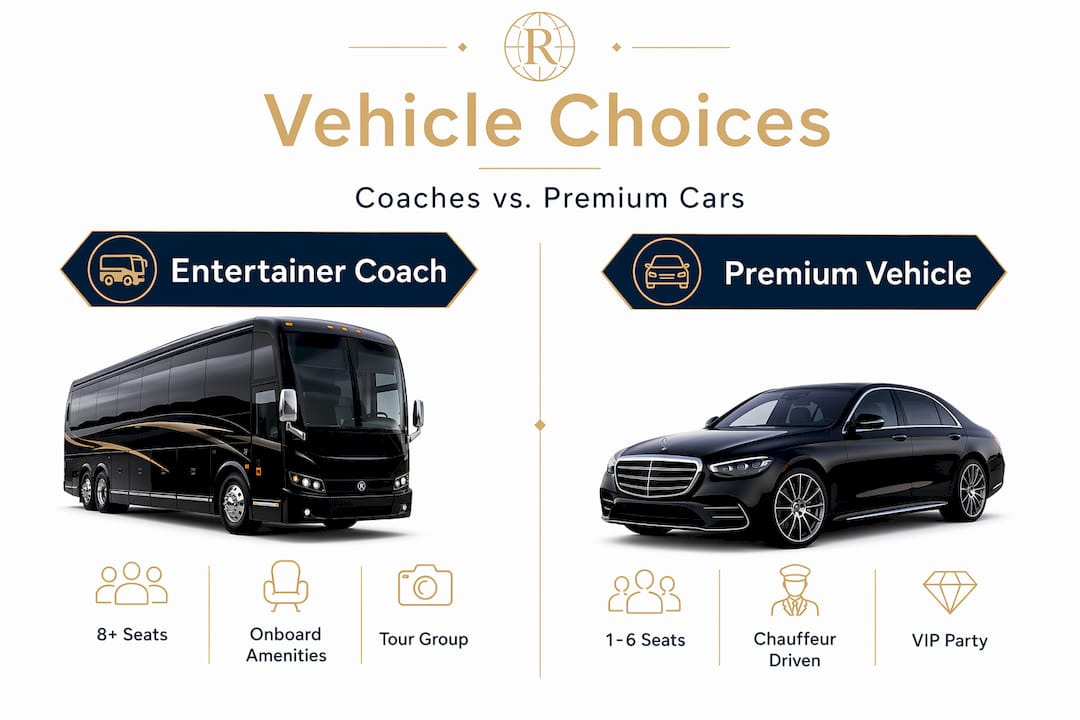
For multi-city tours or when a touring party exceeds eight to ten people, entertainer coaches are the standard. Luxury coaches accommodate 18 to 36 passengers with private suites and lie-flat beds, giving touring crews genuine rest between cities. These vehicles are purpose-built for touring life, with onboard kitchens, entertainment systems, and climate-controlled sleeping quarters. They function as mobile green rooms and save hotel costs on overnight legs.
Chauffeur-driven premium vehicles
For solo artists, their managers, or small VIP parties, a chauffeur-driven sedan, SUV, or sprinter van is the standard approach. These vehicles handle individual airport pickups, inter-venue transfers, and press junket runs with a level of discretion that larger coaches cannot match. The driver profile matters as much as the vehicle. Professional chauffeurs operating in the entertainment space understand confidentiality, timing pressure, and the non-negotiable nature of scheduled arrivals.
Side-by-side vehicle comparison
| Vehicle type | Ideal party size | Key features | Best use case |
|---|---|---|---|
| Luxury entertainer coach | 18-36 people | Suites, lie-flat beds, kitchen | Multi-city overnight touring |
| Luxury SUV or sedan | 1-4 people | Privacy glass, professional driver | Artist airport transfers |
| Sprinter van | 6-12 people | Customizable, group-capable | Small crew or management transfers |
| Charter bus | 40+ people | High capacity, cost-efficient | Full production crew shuttles |
Pro Tip: Pre-book all vehicles on fixed flat rates rather than metered or dynamic pricing. For group transportation logistics, fixed rates eliminate budget surprises, especially when flight delays or schedule shifts push pickups outside standard windows.
Luxury coaches and chauffeur vehicles both center on privacy, comfort, and security. The right choice depends entirely on the rider requirements and the size of the traveling party, which brings us to the process that determines everything.
The advancing process and talent riders
This is where most inexperienced planners get into serious trouble. Understanding talent tours at a professional level requires knowing what advancing means and why it governs every transportation decision.
-
Obtain and review the hospitality rider before anything else. Transportation requirements are outlined in the hospitality rider, specifying minimum vehicle standards, the number of vehicles required, and security protocols. Read it in full before quoting a single vehicle. Riders specify vehicle type down to make and model in some cases.
-
Create or request a detailed day sheet. The advancing process involves a day sheet that specifies exact vehicle assignments, timing, loading zones, and security passes. Every driver needs a copy. Every venue contact needs a copy. Every member of tour management needs a copy.
-
Confirm gate access and credentialing requirements with the venue. A vehicle that cannot clear the loading dock at the right time creates a cascade of delays that hits the artist, the production crew, and ultimately the audience. Confirm access protocols with venue security a minimum of 48 hours before the event.
-
Verify rider-specific vehicle standards. Common transportation requests include tinted or blacked-out windows, specific vehicle makes, minimum security escort requirements, and restrictions on driver communication with the artist. Ignoring rider transportation requirements can breach contracts and in serious cases lead to show cancellations.
-
Circulate final itineraries to all transport providers and tour management simultaneously. Siloed communication is the enemy of clean tour transportation. Everyone in the chain from the driver to the production manager needs the same current document.
-
Build in contingency time at every transfer point. Even premium vehicles fail without detailed advancing. A 30-minute buffer between the airport pickup and venue arrival is not padding. It is professional planning.
The advancing process sounds administrative, but it is genuinely the secret weapon of any well-run tour. Vehicles can be beautiful and drivers can be experienced, but without the coordination layer that advancing provides, the whole system is fragile.
Challenges and best practices in talent transportation
Experienced planners know that unpredictability from weather, traffic, and mechanical failures is the single biggest threat to clean artist logistics. A plan that works on paper at noon can unravel by 6 PM on show day. The goal is not to eliminate unpredictability. It is to build systems that absorb it.
Here are the practices that separate reliable talent transport solutions from amateur-hour operations:
- Flight monitoring is non-negotiable. Professional services actively monitor flight arrivals and update pickup schedules dynamically when delays occur. Static pickup times tied to scheduled arrival windows fail constantly. A driver who only knows the original arrival time is already a liability.
- Backup vehicles must be staged, not just available on paper. A backup that requires 45 minutes to mobilize is not a backup. For high-profile transfers, a secondary vehicle should be positioned within the same zone as the primary.
- Real-time communication protocols matter. All drivers, tour management, and your coordination team need to operate in a shared communication channel on show day. Text message threads are not sufficient for complex multi-vehicle movements.
- Local expertise is a force multiplier. A driver who knows the venue's loading dock quirks, the street-by-street traffic behavior during event egress, and the fastest alternative routes is worth significantly more than a driver imported from another market. Flexible, adaptive plans that consider local traffic patterns minimize delays in ways that no app can replicate.
- Document everything after each tour date. What worked, what failed, and what required improvisation. This documentation feeds the advancing process for the next date.
Pro Tip: Transparent pricing and detailed coordination reduce anxiety for planners managing complex tour logistics. Ask your transport provider for a written confirmation of every vehicle assignment, driver name, and contingency protocol before the tour begins. If they cannot provide it, find a provider who can.
The best event logistics approaches treat transportation as a living system rather than a fixed schedule. Rigidity creates failure points. Preparation, communication, and local knowledge are what keep talent on stage on time.
What I've learned about what most planners miss
I've worked across enough tours to say with confidence that vehicle selection is the least important decision in talent tour logistics. It's the one that gets the most attention in planning meetings, and it's genuinely the last thing that causes a show to fall apart.
What actually causes problems is the gap between what the rider says and what the transport provider was told. I've seen situations where a rider specified blacked-out windows and a security escort, and the provider showed up with a town car with standard glass because nobody passed the rider document through. That is not a vehicle problem. That is a communication failure, and it is entirely preventable.
The other thing I've seen planners chronically underestimate is the advancing timeline. Most people start advancing transportation two to three days before the show date. For complex, multi-leg tours with overlapping crews and strict rider clauses, advancing needs to begin the moment the contract is signed. The day sheet should exist before the artist even knows the route.
Relying on standard ride-hailing for any talent movement, even a short hotel-to-venue run, is a gamble that is not worth taking. The lack of flight tracking, the absence of vetted drivers, the inability to guarantee vehicle specs, and the complete disconnect from the rider process make consumer apps a non-starter for professional talent travel services. The cost difference between a professional service and an app fare is trivial compared to the cost of a delayed show or a violated rider.
My bottom line: the planners and promoters who run the cleanest tours are the ones who treat transportation as an extension of production, not a hospitality afterthought.
— Sammy
Plan your talent transportation with Rigaglobaltravel
Rigaglobaltravel specializes in luxury limousine and concierge services built specifically for the entertainment industry. Whether you need chauffeur-driven airport transfers for a headlining artist or coordinated multi-vehicle logistics for an entire touring crew, Rigaglobaltravel brings the advancing expertise, local city knowledge, and fixed-rate pricing that serious tour management demands. Every vehicle assignment comes with driver confirmation, real-time flight monitoring, and the kind of client-focused coordination that eliminates day-of surprises. For event planners and promoters who need a transport partner that understands rider compliance and production schedules, explore the full range of talent transportation services at Rigaglobaltravel before your next tour date locks in.
FAQ
What does talent tour transportation include?
Talent tour transportation covers the full coordination of moving performers, crew, and equipment between airports, hotels, and venues. It includes airport transfers, hotel-to-venue shuttles, luxury coaches, security escorts, and post-show extraction logistics.
Why can't you use ride-hailing apps for talent transport?
Standard ride-hailing apps lack flight delay tracking, vetted drivers, rider-compliant vehicles, and venue access credentials. Professional talent transport solutions offer fixed pricing, real-time monitoring, and guaranteed vehicle specifications that apps cannot match.
What is a hospitality rider in the context of transportation?
A hospitality rider is a contractual document that specifies the exact transportation requirements an artist requires, including vehicle type, tinted windows, security escorts, and the minimum number of vehicles. Failing to meet these requirements can breach the contract.
What is the advancing process in tour transportation?
Advancing is the pre-tour coordination process where planners confirm vehicle assignments, timing, gate access, security clearances, and day sheets with all parties. It is the foundational step that prevents delays and contractual issues on show day.
How early should you start planning talent transportation?
Transportation advancing should begin as soon as the performance contract is signed. Waiting until a few days before the show date leaves insufficient time to address rider requirements, secure appropriate vehicles, and coordinate venue access protocols properly.