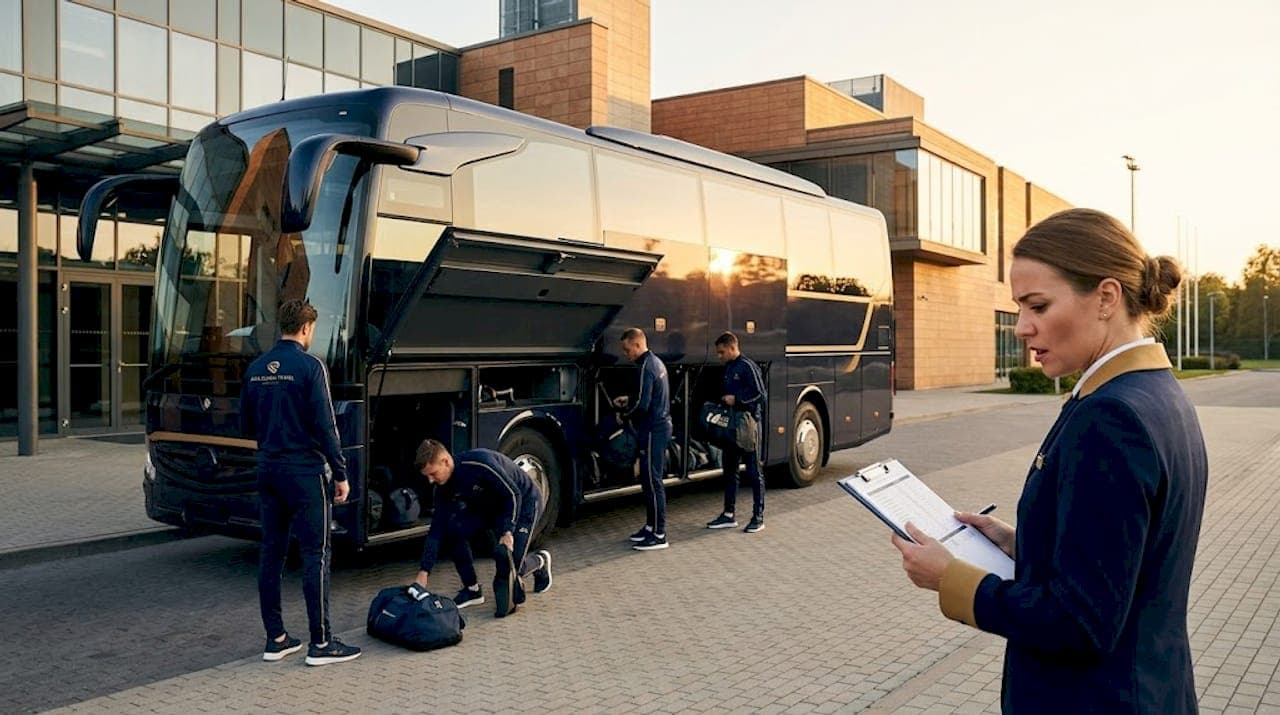
Getting sports crew transportation wrong doesn't just mean a late arrival. It means athletes cramped into undersized seats, equipment left behind at the loading dock, and confidential strategy sessions happening in a vehicle with zero privacy. The types of luxury buses sports crews require span three distinct categories, each built for different group sizes, amenity levels, and logistical demands. If you're booking premium sports transport for a production or live event, the wrong call costs you time, money, and trust. This guide cuts through the noise so you choose right the first time.
Table of Contents
- Key criteria for choosing a luxury bus for sports crews
- Full-size charter buses: the industry standard for large sports teams
- Minibuses and executive mini-coaches: flexible options for smaller crews
- Comparison table: luxury bus types for sports crews
- Avoiding common pitfalls: logistics and driver considerations for sports crews
- Rethinking sports crew buses: transforming travel into a team-building asset
- Why Riga Global Travel is your trusted partner for sports crew luxury transportation
- Frequently asked questions
Key Takeaways
| Point | Details |
|---|---|
| Bus types vary by team size | Full-size coaches fit large teams while minibuses and mini-coaches suit smaller groups. |
| Athlete comfort is essential | Minimum 40-inch seat pitch and climate control ensure comfort for tall athletes. |
| Plan for logistics timing | Allow extra time for equipment loading and unloading to avoid delays. |
| Driver expertise matters | Choose drivers experienced with entertainment and sports industry protocols. |
| Luxury buses build team unity | Design interiors for collaborative equality and use travel time productively. |
Key criteria for choosing a luxury bus for sports crews
Building on those logistical stakes, every booking decision for sports crew luxury transportation starts with the same foundational criteria. Get these wrong and no amount of premium upholstery fixes the problem.
Passenger capacity is the first filter. Luxury transportation for sports crews is categorized into three primary tiers, each with its own capacity range and price point. Matching vehicle size to actual headcount matters more than most planners realize. An oversize bus for a 15-person crew wastes budget and creates an awkward travel environment. An undersized one is simply not an option.
Athlete comfort standards are non-negotiable. Professional sports transport mandates specific amenities: Wi-Fi for tactical briefings, secure equipment storage, and climate control calibrated to athlete recovery needs. A 40-inch minimum seat pitch isn't just a comfort preference for 6-foot-plus players. It's a functional requirement to prevent fatigue and injury risk during transit.
Beyond the basics, high-profile teams require privacy tinting on all windows and discreet rear-door boarding. This matters enormously for entertainment industry productions where talent exposure before an event is a security and PR liability. Good logistics management for sports crews accounts for load-in and load-out time at every stop, not just drive time between venues.
Key criteria to evaluate before signing any contract:
- Confirmed passenger count plus staff and security personnel
- Seat pitch of 40 inches or greater
- Underfloor storage cubic footage relative to gear volume
- Onboard Wi-Fi with sufficient bandwidth for video streaming
- Climate zones (some coaches allow front and rear zone control)
- Privacy glass and rear-entry configuration
- Driver credentials and entertainment industry experience
Pro Tip: Always request the specific vehicle registration and photos before booking. Bait-and-switch vehicles (a premium quote, a standard delivery) are a known issue in charter markets during high-demand event windows.
Full-size charter buses: the industry standard for large sports teams
With criteria defined, start with the workhorse of professional sports travel: the full-size charter bus. These are the full-size charter buses that most major league teams, touring production companies, and large sports entertainment crews default to, and for good reason.
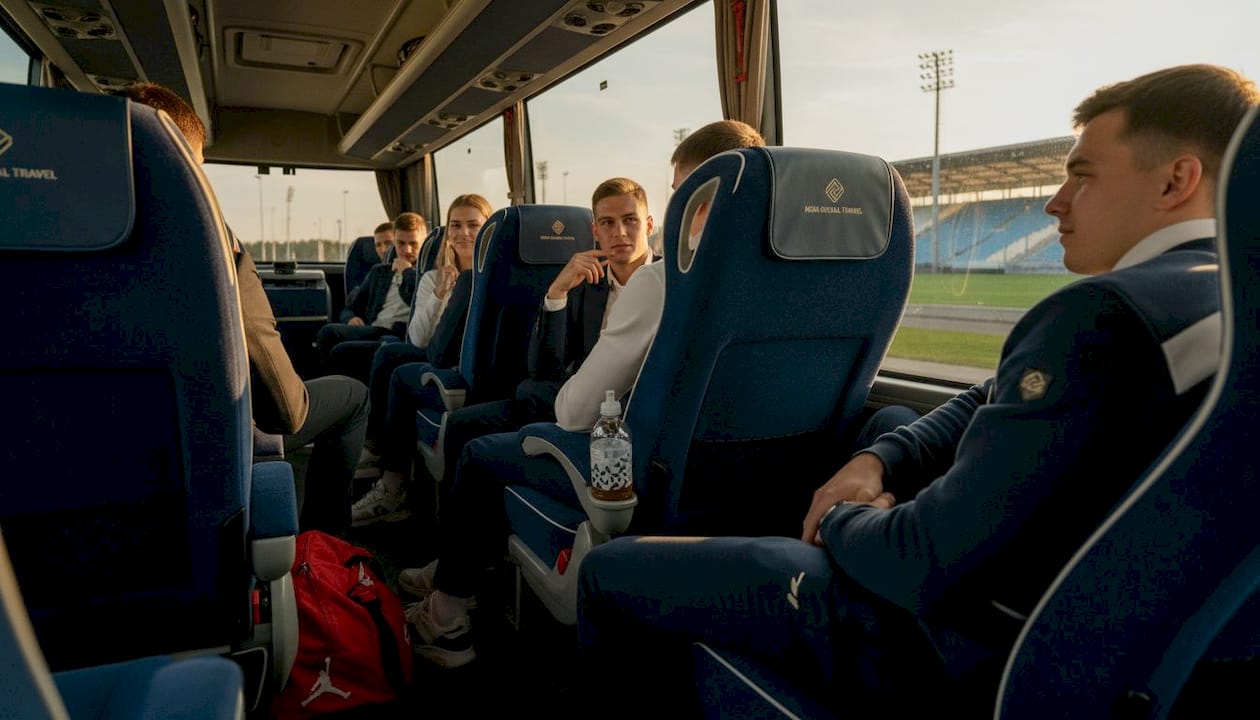
Full-size charter buses accommodate 40 to 56 passengers at hourly rates typically ranging from $200 to $350, with a minimum 40-inch seat pitch built into premium configurations. For a 45-person roster plus coaching staff and media personnel, there is simply no practical alternative that keeps the group together.
The underfloor luggage hold is the detail that separates a sports-grade coach from a standard charter. Professional teams require secure luggage holds with enough cubic footage for equipment bags, medical kits, and broadcast gear, all locked and easily accessible at scheduled stops. Standard charter buses often fall short here. Specify cubic footage in your contract.
Onboard, full-size coaches configured for high-end charter buses typically offer:
- Reclining premium seats with individual tray tables and power outlets
- Overhead compartments for carry-on bags and smaller gear
- Single or dual restrooms depending on configuration
- Onboard Wi-Fi and entertainment screens for team briefings
- Climate control with front-to-rear consistency
- Optional privacy partition separating coaching staff from players
Managing large sports crews in transit is not only about the vehicle. It's about vehicle workflow. Assign a designated crew coordinator to manage boarding order, equipment check-in, and departure timing before the day of travel.
Minibuses and executive mini-coaches: flexible options for smaller crews
Beyond full-size coaches, minibuses and executive mini-coaches deliver tailored solutions for smaller sports crews, support staff segments, or VIP subgroups traveling separately from the main squad.
Minibuses accommodate 20 to 30 passengers at $110 to $160 per hour, while executive mini-coaches hold 14 to 23 passengers with luxury features and often fixed-rate pricing structures. The cost efficiency for a crew of 18 is significant. You are not paying for 30 empty seats.
Executive minibuses feature leather seating, elevated interior specs, and VIP-grade amenities that rival full-size coaches in every way except capacity. These are the vehicles you deploy for coaching staff traveling separately, broadcast crew, or talent requiring a higher degree of privacy and exclusivity than the main group transport provides.
When to choose mini-coaches for sports teams:
- Scouting trips with 10 to 15 personnel
- Separate VIP or executive transport for team ownership and management
- Broadcast and production crew transfers between remote venues
- Pre-game tactical sessions in a discreet mobile environment
- Airport transfers for partial squad arrivals
Pro Tip: Even on smaller executive mini-coaches, always confirm underfloor or in-cabin storage capacity. Camera equipment, medical bags, and tactical tablets add up fast, and a vehicle that feels spacious with 12 people becomes chaotic without planned storage allocation.
Comparison table: luxury bus types for sports crews
To clarify distinctions across the three primary tiers of luxury sports crew transport, here is a direct side-by-side breakdown. Use this as your first-pass filter when matching vehicle type to crew profile.
| Bus type | Capacity | Hourly rate | Key amenities | Best for |
|---|---|---|---|---|
| Full-size charter bus | 40 to 56 passengers | $200 to $350/hr | Wi-Fi, underfloor storage, dual restrooms, premium seating | Full roster, large production crews |
| Standard minibus | 20 to 30 passengers | $110 to $160/hr | Wi-Fi, basic storage, climate control | Mid-size crew or support staff |
| Executive mini-coach | 14 to 23 passengers | Fixed rates vary | Leather seating, VIP amenities, privacy glass | Coaching staff, VIP subgroups, media teams |
For event planners comparing luxury bus types across multiple vehicles for a single production, this table simplifies the first conversation with your transport vendor. Lead with capacity needs, then layer in amenity requirements and budget ceiling.
The tier you choose communicates something to the athletes and crew riding it. That perception matters.
Avoiding common pitfalls: logistics and driver considerations for sports crews
Beyond vehicle type, mastering logistics and driver expertise separates a smooth operation from a costly one. These are the mistakes planners make even after selecting the right vehicle.
Planners routinely underestimate load-in and load-out time by 30 to 45 minutes per stop, causing cascading delays across the day's schedule. Sports equipment is heavy, bulky, and often fragile. It doesn't move fast. Build that buffer into every departure and arrival window, not as a courtesy but as a hard scheduling requirement.
Security-vetted, entertainment-experienced drivers ensure NDA compliance and discreet timing. This is not something you leave to a generic charter fleet. Request documentation of entertainment industry experience and ask specifically about confidentiality protocols. A driver who doesn't understand why a team's arrival timing is sensitive is a liability, not an asset.
Logistics checklist for planning sports team logistics:
- Add 30 to 45 minutes per stop for equipment handling
- Confirm rear-door boarding and privacy tinting on delivery vehicle
- Brief drivers on NDA requirements before day of travel
- Designate a crew coordinator for boarding management
- Pre-plan climate settings appropriate for post-game athlete recovery
- Verify parking clearances at each venue in advance
Pro Tip: Treat the bus as a mobile extension of the team facility, not a shuttle. That mindset shift changes how you configure the interior, how you brief the driver, and how you schedule the day.
"The biggest logistical failures in sports crew travel come from treating the bus as an afterthought. The vehicle is part of the production."
Weather is the wildcard most planners skip. In cold-weather markets, buses sitting idle for 90 minutes lose climate conditioning. Instruct drivers to maintain interior temperature during pre-game waits rather than shutting down systems to save fuel.
Rethinking sports crew buses: transforming travel into a team-building asset
Here is the honest truth most transport guides won't say out loud: the operational checklist matters less than the strategic intent behind the booking.
Most planners treat the bus as the lowest-stakes decision in a production. Pick a size, check the amenity boxes, confirm the price. Done. That thinking leads to sports team travel that misses the most valuable opportunity in a long travel day: turning transit time into cohesion time. Experts consistently point to collaborative equality in interior layouts as a key factor in team morale. That means resisting the instinct to separate coaches and players into hierarchy-heavy seating arrangements that reinforce division rather than unity.
The second mistake we see repeatedly: confusing vehicle categories. Sports buses prioritize high-density seating and gear storage, while band tour buses optimize for sleeper berths and overnight comfort. Booking a band-configured sleeper bus for a sports day-trip because it "looks luxurious" is a real and costly error. The layout, storage, and seating density are fundamentally incompatible with sports crew needs.
What we recommend for clients booking luxury coach team travel: brief your transport vendor on the purpose of each trip, not just the headcount. A post-game recovery transfer needs different climate, lighting, and noise management than a pre-game activation trip. A media crew transfer has different privacy priorities than a full-squad movement. The vehicle is a tool. Use it intentionally.
The planners who get this right stop thinking in terms of "bus rental" and start thinking in terms of mobile environment design. That is the shift that separates forgettable logistics from transport people actually comment on.
Why Riga Global Travel is your trusted partner for sports crew luxury transportation
You now have the framework. The vehicle categories, the criteria, the logistics traps, and the strategic mindset. The next question is who executes it at the level elite sports and entertainment clients require.
Riga Global Travel specializes in luxury group transportation for the entertainment industry, with a fleet spanning full-size charter coaches and executive mini-coaches configured specifically for high-profile sports and production crews. Every vehicle meets the amenity standards professional teams demand: privacy glass, secure underfloor storage, climate zones, and onboard Wi-Fi ready for tactical use. Drivers are vetted for entertainment industry protocols, including NDA compliance and discreet timing. Flexible scheduling accounts for the real load-in and load-out windows your production requires. When the stakes are high and the margin for error is zero, Riga Global Travel delivers.
Frequently asked questions
What types of luxury buses are best for large professional sports teams?
Full-size charter buses seating 40 to 56 passengers with amenities like Wi-Fi, secure underfloor storage, and a minimum 40-inch seat pitch are the gold standard for large professional sports teams.
How important is driver experience when hiring a luxury bus for sports crews?
Driver experience is critical. Security-vetted, entertainment-industry experienced drivers ensure NDA compliance, precise timing, and the kind of discretion high-profile sports crews require.
What amenities should a luxury sports team bus include?
A properly configured luxury sports team bus includes tactical Wi-Fi, secure equipment storage, climate control, privacy tinting, and rear-door boarding as the core non-negotiables.
How can event planners avoid transport delays with sports equipment loading?
Build an additional 30 to 45 minutes per stop into your schedule for equipment load-in and load-out. This single adjustment eliminates the most common source of sports crew travel delays.
What is the difference between sports team buses and band buses?
Sports buses prioritize dense seating and gear storage for day-use travel, while band buses are configured with sleeper berths for overnight touring comfort. They are not interchangeable for professional sports use.