
When you need to plan luxury coach rentals for production teams, the complexity hits fast. You're coordinating department call times, bulky grip and lighting equipment, overnight travel, and a crew that needs to be functional the moment they step off the bus. Generic charter solutions don't account for sleeping bunks, galley kitchens, or the kind of schedule precision that a call sheet demands. This guide breaks down exactly what production managers need to gather, select, coordinate, and verify when booking luxury coach transport for film, television, and event productions.
Table of Contents
- Key takeaways
- What to gather before you plan luxury coach rentals for production teams
- Choosing the right coach configuration
- Coordinating logistics with your transport provider
- Common mistakes that derail production transport
- How to verify your transport plan worked and improve next time
- My take on production transport and where most teams get it wrong
- How Rigaglobaltravel supports production transport
- FAQ
Key takeaways
| Point | Details |
|---|---|
| Gather logistics before booking | Collect crew headcounts, equipment volume, and call sheet details before contacting any provider. |
| Match coach type to crew role | Crew buses suit larger groups needing rest; entertainer buses suit smaller, premium-comfort needs. |
| Build HOS compliance into the schedule | Driver Hours of Service limits must shape your transport schedule from day one, not as an afterthought. |
| Communicate like a call sheet | Share pickup times, parking info, and department schedules with your transport provider in writing. |
| Verify carriers on safety, not price | Legal liability shifts to production if you select an operator without verifying safety credentials. |
What to gather before you plan luxury coach rentals for production teams
Before you contact a single provider, you need a clear picture of what your production actually requires. Booking without this information leads to undersized vehicles, missed pickup windows, and crew arriving on set exhausted instead of ready.
Start with crew headcounts by department. Grip, electric, camera, art, and production each have different call times and sometimes different pickup locations. A single count of "we have 40 people" tells a transport provider almost nothing useful. What you want is a breakdown that mirrors your call sheet structure, because call sheet details for transport should include department call times, location addresses, and parking and load-in instructions.
Equipment volume is the second area most production managers underestimate. Camera packages, lighting rigs, wardrobe cases, and grip gear take up more cargo space than a typical charter bus is designed to handle. Measure or estimate the cubic footage of your largest items and note any fragile or temperature-sensitive gear that needs special handling.
Here is the information you should have ready before making your first inquiry:
- Total crew count with department breakdown and individual call times
- Equipment inventory with approximate dimensions and weight for cargo
- Location addresses for each pickup and drop-off, including any restricted-access lots
- Production shoot dates, including any overnight or multi-day travel legs
- Whether the transport will double as a rest and workspace during transit
On overnight or long-haul runs, your crew is not just traveling. They are sleeping, eating, and prepping for the next shoot day. That changes what you need from a vehicle entirely.
Pro Tip: Build a one-page transport brief using your call sheet as the foundation. Include GPS-friendly addresses, load-in times, and a named point of contact for the driver. Providers who work in production transport will recognize the format immediately and it reduces back-and-forth by half.
Driver compliance is non-negotiable before booking. The US DOT limits driving to 10 hours within a 15-hour duty window, with at least 8 consecutive off-duty hours required. If your shoot schedule runs long or your locations shift, a driver who has already hit their limit cannot legally move the vehicle. Build that buffer into your planning phase, not after you've committed to a schedule.
Choosing the right coach configuration
Not all luxury coaches are built for the same purpose, and the difference matters on a production. The three main vehicle types you'll encounter are crew buses, entertainer buses, and standard motorcoaches. Each serves a distinct function.
| Vehicle type | Best for | Key features | Typical capacity |
|---|---|---|---|
| Crew bus | Large department crews on overnight shoots | Sleeping bunks, galley kitchen, bathroom, Wi-Fi, lounge | 10 to 20 crew members |
| Entertainer bus | Featured talent or premium small groups | Fewer bunks, premium lounge, high-end finishes | 4 to 12 occupants |
| Motorcoach | Day travel, location transfers, base camp shuttle | Seating, overhead storage, basic amenities | 40 to 57 passengers |
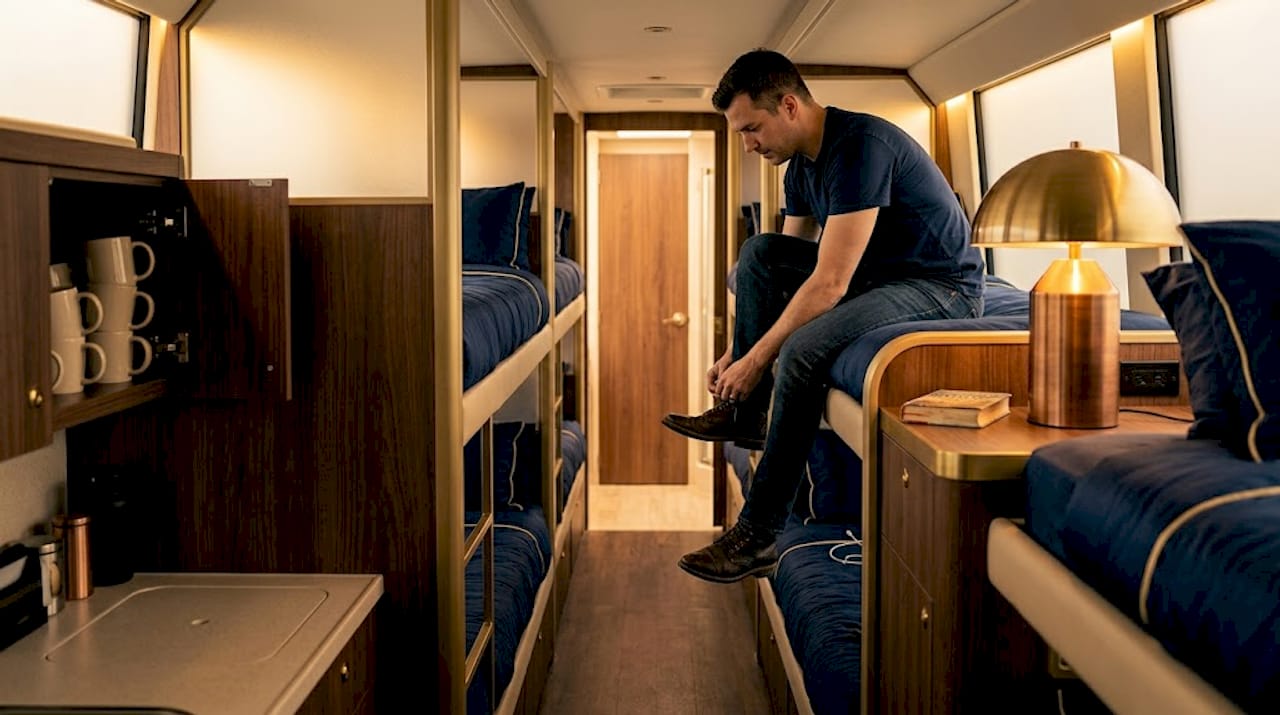
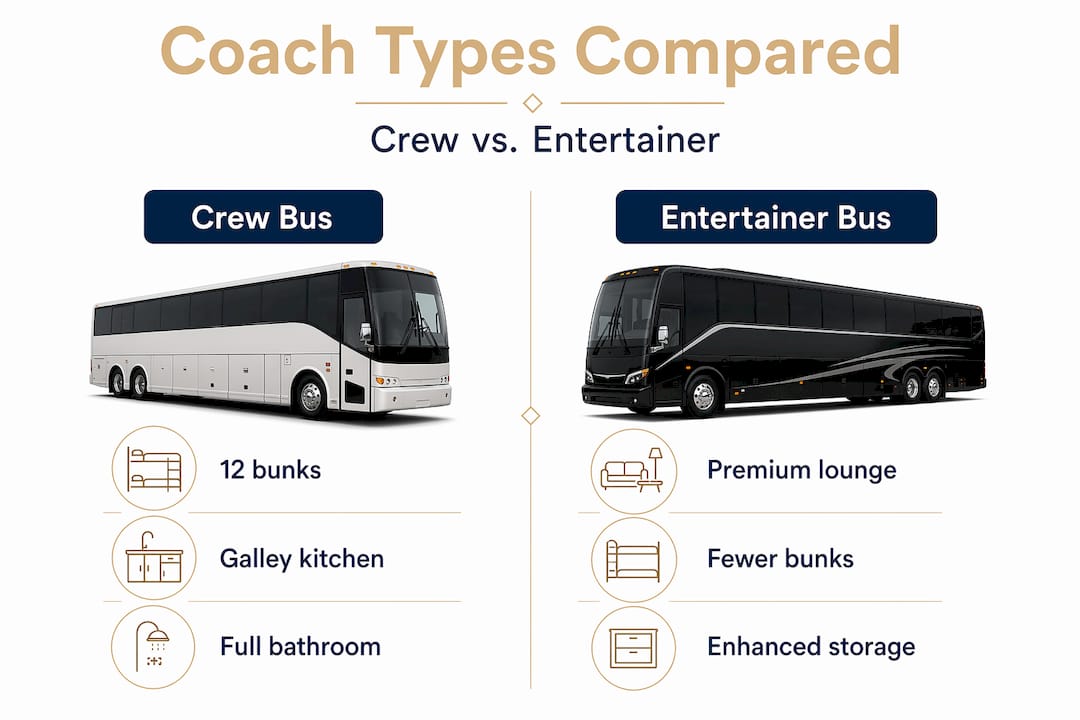
Crew buses for production typically include up to 12 sleeping bunks with privacy curtains, a galley kitchen, full bathroom, onboard Wi-Fi, and a lounge. These are designed to function as mobile rest and work bases during long production schedules, reducing fatigue between overnight locations.
Entertainer buses follow a different logic. They feature fewer bunks but more premium lounge areas, making them better suited to featured talent or department heads who need a higher-comfort environment without the density of a full crew configuration. If you're transporting a lead actor and their team separately from the crew, this is the right category.
Storage is where many production managers make their biggest mistake. A coach that seats 20 may have far less cargo capacity than you expect once bunks, kitchen units, and lounge furniture occupy the floor plan. Evaluate storage separately from seating, and ask providers directly about exterior bays and interior gear space.
Fleet size is another factor. On most productions, you won't run a single vehicle. You'll mix a crew bus for the overnight haul, a motorcoach for base camp shuttle runs, and possibly a cargo van for the heaviest equipment. Planning your vehicle mix early keeps costs predictable and prevents the scramble of adding vehicles at the last minute.
Vehicle branding packages are worth considering for productions with a public-facing presence. Some providers handle design, printing, and installation as part of the rental, creating a cohesive fleet image that reflects the production's brand on location.
Pro Tip: Always ask whether you're dealing with a direct operator or a broker. Brokers can source vehicles quickly but add a margin and sometimes reduce accountability when issues arise. Direct operators own their fleet and are directly responsible for driver compliance and vehicle condition.
Coordinating logistics with your transport provider
Once you've selected your vehicles, the coordination phase is where productions either run smoothly or fall apart. The key is treating your transport provider as an operational partner rather than a vendor you call the night before.
Follow this process to align your provider with production requirements:
- Share a written transport brief at least two weeks out. Include pickup and drop-off locations with GPS coordinates, crew call times by department, and any site-specific access instructions such as gate codes or production base camp locations.
- Confirm amenity requirements in writing. If you need onboard Wi-Fi operational from departure, a stocked galley, or specific temperature settings, put it in writing and get confirmation back. Verbal agreements disappear under production pressure.
- Map your schedule against driver HOS rules. Violations of HOS regulations can pull drivers out of service mid-production and strand your crew. Work with your provider to identify any legs where a driver swap or layover is required.
- Assign a production-side transport coordinator. This person is the single point of contact between your team and the driver or dispatch. On complex shoots, split communication between departments leads to missed pickups.
- Build contingency into every leg. Productions run late. Locations change. Add a 30-minute buffer to each leg and agree in advance on the protocol if a shoot day extends past the scheduled pickup time.
Integrating call-sheet information into your transport workflow directly reduces errors and delays. A provider who receives a properly structured brief can dispatch and position vehicles with the same precision you expect from any other production department.
Pro Tip: Set up a group chat that includes your transport coordinator, the lead driver, and your AD or production coordinator. When a location changes at 6 PM, everyone gets the update simultaneously instead of through a chain of phone calls.
Common mistakes that derail production transport
Even experienced production managers repeat the same errors when booking luxury coach transport for crews. Knowing what to watch for saves you from discovering the problem on shoot day.
- Underestimating equipment storage. Crew buses are optimized for rest and movement, not cargo. If your gear doesn't fit in the exterior bays, it either travels in a separate vehicle or occupies crew space. Neither option is ideal without planning.
- Skipping overnight facility requirements. A crew that sleeps in a quality bunk bus arrives rested. A crew that sleeps in a standard motorcoach because no one confirmed bunk availability arrives stiff and frustrated. Verify bunk count against your overnight headcount before confirming.
- Ignoring driver hours until it's too late. The DOT 10-hour driving limit is not flexible. Productions that schedule 14-hour transport legs without accounting for mandatory rest periods end up with parked vehicles and stranded crews.
- Failing to integrate transport with the call sheet. Your transport plan is not a separate document. It should reference and align with every location change, department call time, and wrap time in your call sheet.
- Skipping carrier verification. The Supreme Court ruling in Montgomery v. Caribe Transport II makes clear that carrier selection carries legal weight. Using an unvetted operator to save money creates liability that can follow the production company long after wrap.
How to verify your transport plan worked and improve next time
After wrap, most production teams move straight to the next project. The managers who get better at logistics are the ones who take 48 hours to document what happened with transport before closing the production.
Collect structured feedback from crew leads on comfort, punctuality, and any issues with vehicle condition or driver communication. One conversation with your key grip or DP about whether the bunk bus met expectations gives you concrete data for your next booking decision.
Review the transport logs against your original call sheet. Were pickups on time? Were there any HOS compliance events? Did any vehicle fall short on amenities that were confirmed in writing? Each gap is a specific item to address in the next transport brief.
Look at how equipment loading and unloading performed at each location. Slow load-ins affect crew call times and, in turn, affect your shooting day. If loading took 40 minutes when you budgeted 15, that's a routing or staging problem you can solve in advance next time.
Document everything in a short post-mortem. Even a one-page summary of what worked, what didn't, and what to specify differently covers the gap between a stressful transport experience and a smooth one on the next production. Productions that skip this step book the same mismatched vehicles again six months later.
My take on production transport and where most teams get it wrong
I've watched production managers treat transport as the last item on the pre-production list, something to sort once locations are locked and crew is confirmed. That order of operations costs them every time.
What I've learned from working with entertainment teams is that crew comfort during transit is directly tied to on-set performance. A crew that travels eight hours in a properly equipped luxury charter bus for crews with working Wi-Fi, hot food, and a bunk arrives ready to work. A crew that travels in a cramped motorcoach without those basics arrives depleted, and you see it in the first hour of shooting.
The safety credential piece is the one I feel strongest about. Carrier safety selection is not a procurement formality. It is a legal and ethical responsibility. I've seen productions choose the cheapest operator available and then face serious consequences when something goes wrong on the road. The liability doesn't disappear just because you saved money on the day.
The other thing most teams overlook is direct communication between the AD department and the transport provider. When the transport coordinator is getting schedule updates in real time, vehicles are in position before the crew wraps. When that connection doesn't exist, you get 30-minute waits in a parking lot at the end of a 14-hour day.
— Sammy
How Rigaglobaltravel supports production transport
Rigaglobaltravel specializes in luxury ground transport for the entertainment industry, with coach transport for film teams that accounts for the specific demands of production schedules, crew size, and equipment logistics. The fleet includes options for overnight crew travel, executive transfers, and group transport for production teams at any scale.
When you work with Rigaglobaltravel, you get direct access to a team that understands call sheets, HOS compliance, branded fleet options, and the kind of schedule flexibility that productions actually require. Whether you need a single luxury bus for a key crew or a coordinated fleet across multiple departments, the booking process is built for production managers who can't afford surprises. Contact Rigaglobaltravel early in pre-production to secure the right vehicles for your schedule.
FAQ
What coach type is best for overnight production crew travel?
Crew buses with sleeping bunks, a galley kitchen, and onboard Wi-Fi are the best option for overnight travel. They function as mobile rest bases that keep crew rested and ready for the next shoot day.
How do driver HOS rules affect production transport scheduling?
US DOT regulations limit drivers to 10 hours of driving within a 15-hour duty window. Productions must build driver swap or layover time into any transport leg that approaches that limit.
Why does carrier safety verification matter legally for productions?
Following Montgomery v. Caribe Transport II, courts have held that the party selecting a carrier shares legal responsibility for transport safety. Choosing an unvetted operator to cut costs creates direct liability for the production company.
What information should I give a luxury coach provider before booking?
Share a transport brief that includes crew headcounts by department, call times, pickup and drop-off addresses with parking instructions, equipment volume, and any overnight or amenity requirements.
Can luxury coaches be branded for a specific production?
Yes. Some providers offer wrap and branding packages that cover design, printing, and installation, giving your fleet a consistent look across all production vehicles.