
When a show wraps at 1 AM and your client has a 6 AM flight, the difference between a flawless exit and a publicized disaster often comes down to one thing: whether you actually prepared to manage after-hours celebrity transportation needs before the night started. Most coordination failures at this level don't trace back to bad luck. They trace back to an operations plan that assumed daytime logic would hold at midnight. It won't. Late-night logistics for high-profile clients carry a different weight, and one missed call can erase $500 or more in future revenue while sending your client straight to a competitor.
Table of Contents
- Key Takeaways
- Managing after-hours celebrity transportation needs: the foundation
- Step-by-step planning for late-night celebrity transport
- Troubleshooting common challenges in after-hours transport
- Measuring success and improving your process
- My honest take on after-hours transport
- Why Rigaglobaltravel handles this differently
- FAQ
Key Takeaways
| Point | Details |
|---|---|
| Dispatch reliability is non-negotiable | After-hours operations require 24/7 coverage with guaranteed SLA response windows, not on-call guesswork. |
| Role separation prevents breakdown | Assign a Transport Lead, Security Lead, and Event Ops Director separately to eliminate conflicting instructions. |
| Buffer time protects every leg | Build 30% additional time into routes with marine or multi-stop segments to absorb real-world delays. |
| Technology closes the gap | Live flight tracking and automated driver alerts remove client intervention from the equation during disruptions. |
| Post-event review drives improvement | Track on-time pickups, call answer rates, and client feedback to build SOPs that scale across future events. |
Managing after-hours celebrity transportation needs: the foundation
Before any car moves, your operation needs to be built on systems, not assumptions. Reliable after-hours coverage is primarily a systems challenge involving staffing structures, software integration, and SLA enforcement. Vehicle availability is the easy part. What breaks down at 2 AM is the human and technological infrastructure around it.
Dispatch and personnel structure
A functioning after-hours setup starts with dispatch that operates from 6 PM to 8 AM, every day, with calls answered within 3 rings on a 99.5% uptime guarantee. That is not a feature. That is the baseline.
On the personnel side, three roles need clear ownership:
- Transport Lead: Owns vehicle assignments, staging logistics, and driver coordination throughout the night.
- Security Lead: Manages client movement, monitors crowd conditions, and approves route activation.
- Event Ops Director: Holds the master timeline and serves as the single authority for schedule changes.
- Client Liaison: Handles all direct communication with the celebrity or their personal team, filtering information to protect privacy.
Role clarity prevents leaks and eliminates the single most common cause of after-hours coordination failure: two people giving conflicting instructions to the same driver.
Technology requirements
| Tool | Function | Why it matters at night |
|---|---|---|
| Live flight tracking | Monitors real-time arrival changes | Adjusts driver position without client call |
| Encrypted manifest system | Stores itinerary with time-limited access links | Protects client identity and stops schedule leaks |
| Real-time GPS vehicle tracking | Confirms driver position at all times | Allows re-routing without radio silence |
| Secure group communication | Links Transport Lead, Security Lead, and driver | Prevents crossed messages and public exposure |
Pro Tip: Set time-limited access links on all digital manifests to expire within 15 minutes of each transfer leg. This limits exposure if a device is lost or compromised during the event.
Step-by-step planning for late-night celebrity transport
Good after-hours transport management is not improvised on the day of an event. It is built weeks before.
Pre-event groundwork
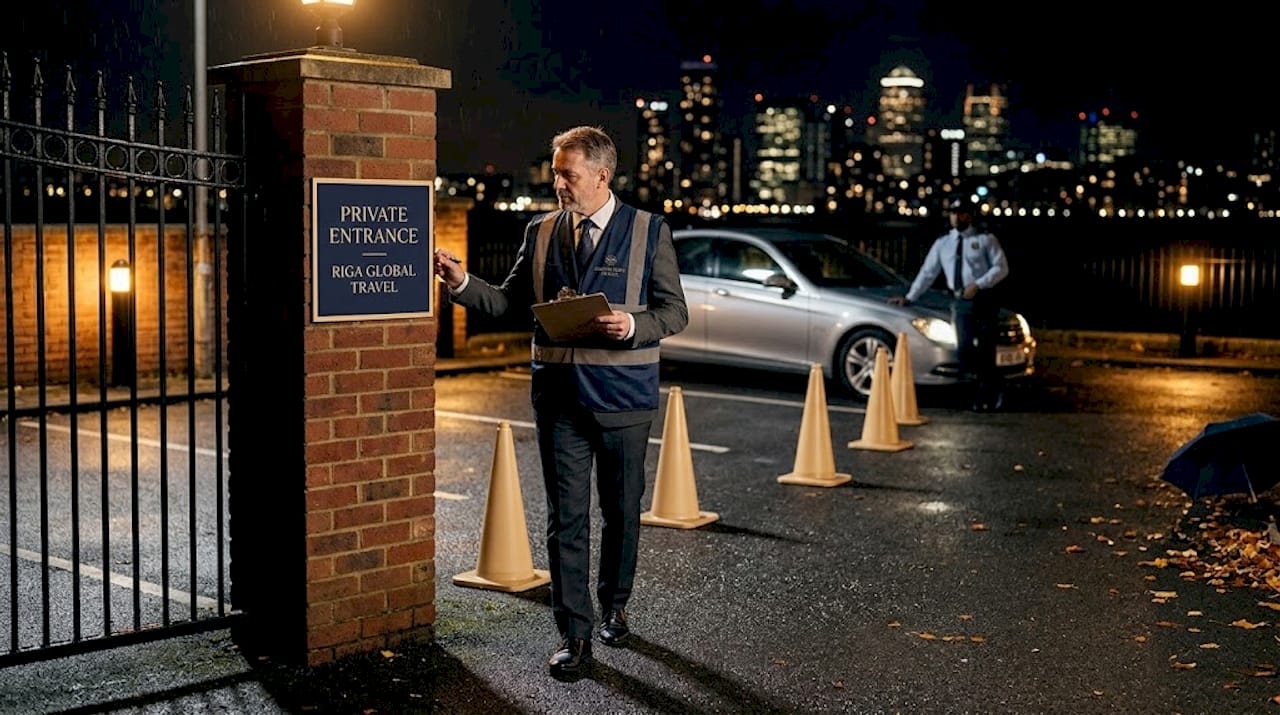
Start with a site survey. Walk every location in the itinerary, including loading docks, private entrances, parking structures, and any water or marine segments. Permit applications for after-hours access or police escorts should begin 10 to 21 business days in advance, since pre-op work and permitting routinely takes that long even in cooperative jurisdictions.
Route design and timing
Map a primary route and at least one alternate for every leg of the transfer. Assign time window buffers between each stop based on conditions. For any segment involving marine transport, ferries, or private watercraft, build in up to 30% additional time as a minimum standard. Conditions change fast after midnight, and a buffer that feels excessive in planning feels like genius at 1:30 AM when traffic or a crowd delays departure by 12 minutes.
Day-of coordination
Work through this sequence the day of the event:
- Confirm all vehicle assignments, driver identities, and current license/insurance status by 3 PM.
- Brief every driver on primary and alternate routes, staging positions, and radio discipline.
- Distribute encrypted manifests with time-limited links to Transport Lead, Security Lead, and Event Ops Director only.
- Confirm staging area access with venue security no later than 2 hours before the event ends.
- Establish a communication check-in every 30 minutes starting 90 minutes before the expected transfer window.
- Pre-position backup vehicles at designated secondary staging locations before the event ends.
Pro Tip: Designate a physical "hold point" 2 to 3 blocks from the primary pickup location. Keeping the lead vehicle out of the immediate venue perimeter until 3 minutes before departure reduces visibility and prevents crowd gathering.
Integrating with security
Successful after-hours celebrity transportation requires that transport and security teams operate as one coordinated unit, not as parallel tracks. Your Security Lead needs to approve route activation before any vehicle moves. The Transport Lead confirms vehicle readiness. The Event Ops Director gives the final green light. This three-point confirmation takes under 60 seconds and eliminates the chaos of spontaneous decisions at departure.
Troubleshooting common challenges in after-hours transport
Even the best-prepared operations face disruptions. The difference is how fast you recover.
Handling schedule changes and delays
Last-minute changes are the rule, not the exception. When a show runs long or a client adds a stop, the information chain matters as much as the change itself. Communicate exclusively through your designated secure channel, never through personal cell phones or public messaging apps. Automated driver notifications triggered by flight tracking software let dispatch adjust arrival times without pulling the client liaison into a phone call.
For ground delays, predefined backup options should include nearby hotels, alternate airports, and pre-vetted car services that can activate within 15 minutes. At late-night hours, rideshare surge pricing and availability make it an unreliable fallback. Know your backup before you need it.
Multi-vehicle convoy and decoy operations
When a celebrity's movements require multiple vehicles, convoy discipline is critical. Here is what most coordinators get wrong: they brief the lead driver thoroughly and assume the others will follow. Every driver in a convoy needs an individual briefing, an individual copy of the route, and an individual instruction on what to do if they lose visual contact with the lead vehicle.
Decoy operations, where one vehicle takes a public route while the client travels a separate path, require the Security Lead's direct management. The Transport Lead coordinates timing so both vehicles depart within seconds of each other, reducing the window for any observer to distinguish which vehicle carries the client.
"In after-hours transport, operational security is not about secrecy for its own sake. It's about giving the client the freedom to move without managing the logistics themselves. That's what they're paying for."
Checking the group logistics framework
For events involving multiple celebrity guests or coordinated arrivals, understanding group transportation logistics helps coordinators design pickup sequences that do not create bottlenecks. Staggered departure windows of 5 to 7 minutes between vehicles prevent a convoy effect that draws attention and strains staging areas.
Measuring success and improving your process
Once the transfer is complete, the work is not done. The gap between good operations and great operations is closed in the review phase.
Key performance indicators to track
| Metric | Standard to aim for | Why it matters |
|---|---|---|
| On-time pickup rate | 98% or better | Measures operational precision across all legs |
| Call answer rate (after-hours dispatch) | 99.5% within 3 rings | Reflects reliability of your dispatch infrastructure |
| Client-reported satisfaction score | 9/10 or higher | Captures subjective experience beyond logistics |
| Incident documentation rate | 100% of deviations logged | Creates the evidence base for SOP improvements |
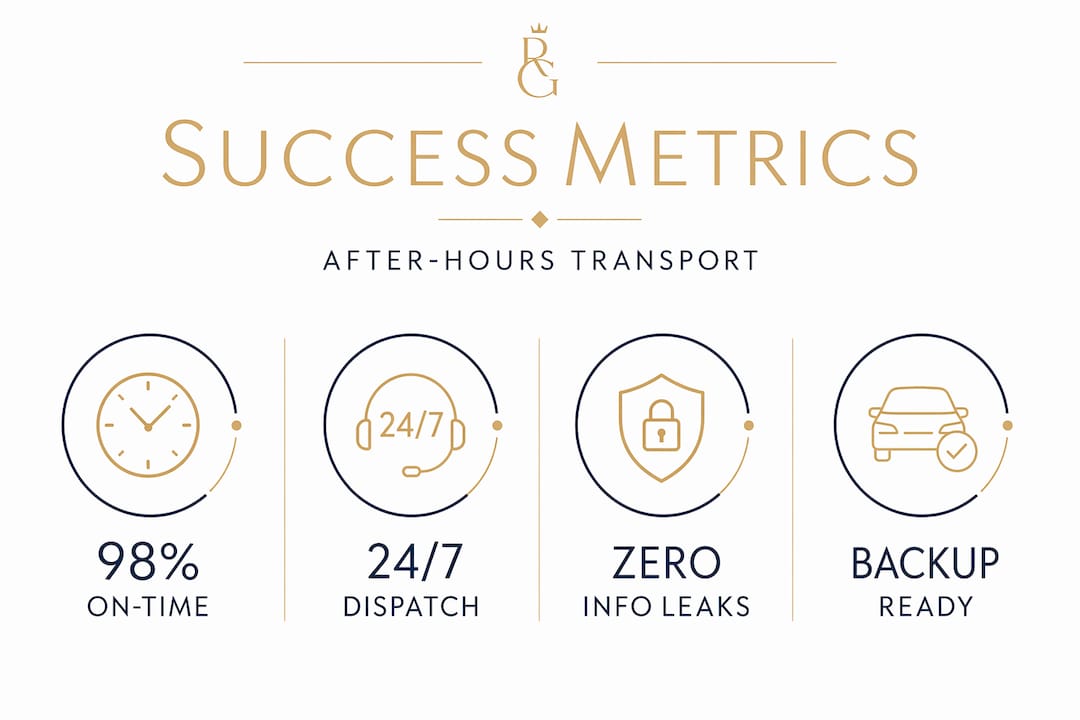
Review these metrics with your operations team within 48 hours of the event. Bring in the Transport Lead, Security Lead, and Event Ops Director for a 30-minute structured debrief. What worked on paper but failed in execution? Where did the timeline slip? What decision was made without a protocol to guide it?
Pro Tip: Build a one-page "lessons learned" document after every high-profile transfer and add it to your SOP file. After 10 events, you will have an operational playbook that no competing coordinator has.
Pricing transparency and after-hours terms
Budget planning for overnight celebrity transport is easier with flat-rate pricing models that eliminate overtime surprises. Negotiate your commercial terms before the event to include after-hours activation windows, standby fees for backup vehicles, and cancellation terms for late-night changes. Clients and their business managers appreciate financial predictability, and transparent pricing builds the kind of trust that leads to repeat bookings.
My honest take on after-hours transport
I've managed enough late-night celebrity transfers to know that the operations most likely to fail are not the ones with bad vehicles or unreliable drivers. They're the ones where someone assumed the daytime playbook would translate to midnight.
What I've seen repeatedly is that coordinators underestimate the role separation requirement. When the Transport Lead is also fielding security questions because the Security Lead is unavailable, the whole operation becomes one person's judgment call under pressure. That is a fragile system, and it cracks exactly when you need it most.
I've also learned that technology is not a luxury at this level. For high-profile concierge logistics, a live flight tracker is not an upgrade. It is the difference between a driver sitting in the right spot and a client waiting at the curb wondering where their car is. The tools exist. Using them consistently is the discipline that separates good coordinators from great ones.
My honest recommendation: spend as much time on your communication architecture as you do on your route plan. Clear channels, defined roles, and a single decision-making authority at each tier will get you through disruptions that no amount of route planning can anticipate.
— Sammy
Why Rigaglobaltravel handles this differently
Managing high-profile clients after hours requires more than a good car and a reliable driver. It requires the kind of operational depth that most providers do not offer at midnight.
Rigaglobaltravel was built specifically for the entertainment industry, with 24/7 dedicated dispatch, encrypted client manifests, and a vetted fleet designed for discretion. Every transfer is coordinated through a team that understands the protocols outlined in this article, from three-point confirmation at departure to decoy vehicle management. If you coordinate celebrity transport and need a partner that works at the speed your clients demand, visit Rigaglobaltravel to discuss your next event. The conversation is confidential. The service is built for nights like the ones you are planning for.
FAQ
What makes after-hours celebrity transport different from standard service?
After-hours celebrity transport requires 24/7 dispatch coverage, encrypted communications, role-separated personnel, and pre-mapped alternate routes. Standard service does not carry these operational requirements.
How far in advance should I plan late-night celebrity transport?
Plan at least 10 to 21 business days in advance to allow time for site surveys, permit applications, and route verification for all transfer legs.
What technology is required for reliable after-hours transport?
Live flight tracking, real-time vehicle GPS, encrypted manifest systems, and secure group communication are the four core technology tools required for dependable late-night celebrity transport management.
How do I handle a last-minute schedule change during an event?
Route all changes through your designated secure communication channel and use automated driver notification tools to adjust pickup timing without requiring client intervention.
What pricing model works best for after-hours celebrity transport?
Flat-rate hourly pricing removes overtime surprises and simplifies budget planning. Negotiate standby fees, after-hours activation windows, and cancellation terms before the event begins.