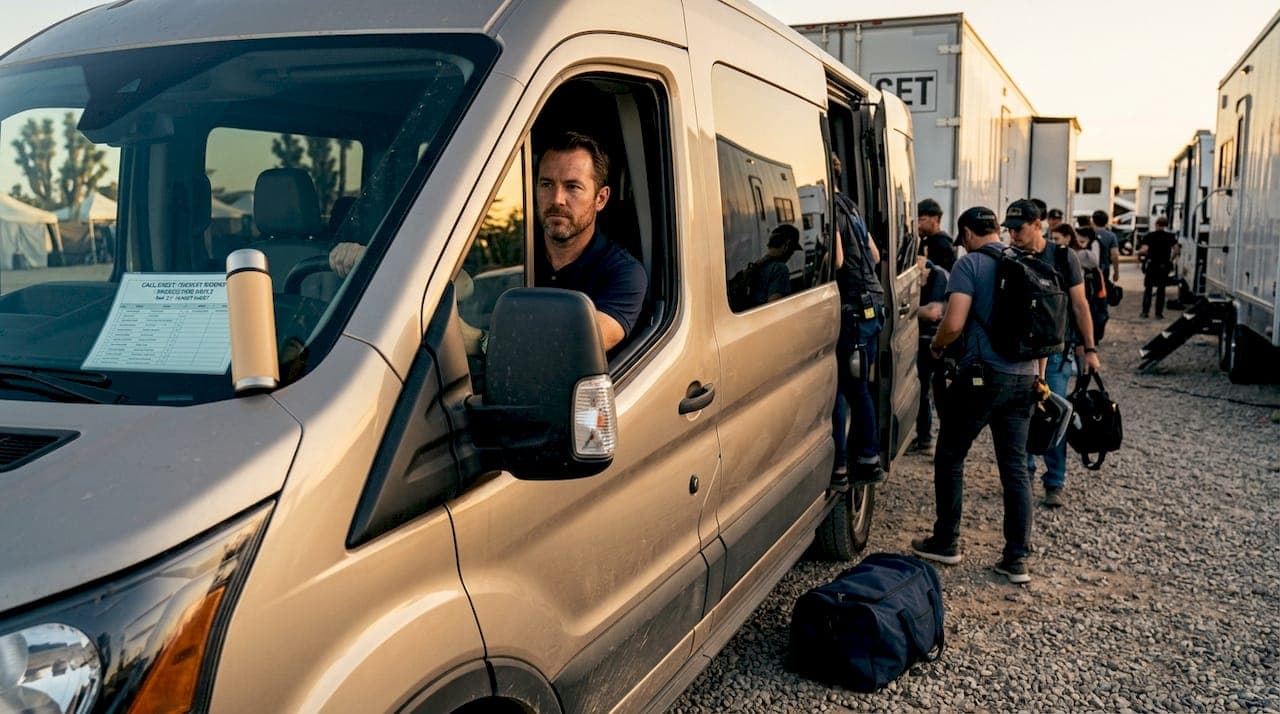
Most productions assume that ride-shares or personal vehicles can handle crew movement between base camp and set. That assumption gets expensive fast. Lost shooting time can cost $500,000 or more per day, and even a single missed shuttle can trigger a cascade of overtime charges, permit violations, and schedule collapses. This article breaks down exactly what film crew shuttle service is, how it operates on a real shoot day, what makes it different from generic transport, and what best practices your production team should follow to protect the schedule and the budget.
Table of Contents
- What is a film crew shuttle service?
- How film crew shuttles operate during production
- Coordination and flexibility: The backbone of reliable shuttle operations
- Production realities: Edge cases, cost impact, and industry best practices
- Why production-grade shuttle services are not a luxury
- Take the next step: Secure professional crew transport
- Frequently asked questions
Key Takeaways
| Point | Details |
|---|---|
| Specialized shuttle services | Film crew shuttle services are tailored to film industry needs, ensuring efficiency and compliance with complex logistics. |
| Continuous and flexible operations | Effective shuttles run in loops, adjust for call times, and quickly respond to production changes. |
| Coordination is critical | Direct collaboration with production teams ensures shuttles support schedules and minimize risks. |
| Cost of unreliability | Failing to provide dedicated transport can lead to major financial losses and jeopardize shooting schedules. |
What is a film crew shuttle service?
Film crew shuttle service is a dedicated, coordinated transportation system designed specifically to move cast, crew, and department personnel between key production locations. These locations typically include offsite parking areas, base camps, holding areas, and the active set itself. Unlike general charter buses or ride-hailing apps, these shuttles are built around the operational rhythm of a film or television production.
The reason standard transport options fall short comes down to a few hard realities. Film sets are often located in areas with strict parking enforcement, limited vehicle access, and location-specific permits that dictate exactly how many vehicles can be on site and where they can stage. A production with 150 crew members cannot simply ask everyone to drive themselves to a restricted urban location or a remote outdoor site. The logistics collapse immediately.
Here is what film crew shuttle service actually solves:
- On-time arrivals aligned with call sheets: Every department has a specific call time, and the shuttle schedule mirrors those times precisely.
- Permit compliance: Shuttle operators understand location permits and staging requirements, keeping the production legally compliant.
- Parking pressure relief: Crew vehicles park at a designated offsite lot, and shuttles handle the last mile to set.
- Safety and accountability: Knowing exactly who is on which shuttle and when they arrive reduces liability and improves set safety.
- Schedule reliability: Consistent, repeatable routing eliminates the variability of individual driving decisions.
"These services are used to keep crews on time when permits, limited parking, traffic, and tight call sheets make relying on ride-share or individual cars unreliable for productions."
The result is a transportation layer that functions like a precision instrument rather than an afterthought. When shuttle service is properly set up, crew members arrive focused and on time, not stressed from parking battles or late because their ride-share driver went to the wrong address.
How film crew shuttles operate during production
Understanding the mechanics of shuttle operations helps productions plan more effectively and avoid the common mistake of treating shuttles as a one-size-fits-all solution. In practice, film-crew shuttle setups use repeatable routing patterns, most commonly continuous loops between a parking area or base camp and the set, with timing aligned to staggered department call times.
Here is how a typical shoot day unfolds from a shuttle operations perspective:
- Pre-dawn runs for early departments: Hair, makeup, and wardrobe often have the earliest call times, sometimes 4:00 or 5:00 AM. The first shuttle loop begins before most of the city is awake.
- Principal crew arrivals: Directors of photography, gaffers, grips, and other technical departments arrive in staggered waves. Shuttles run continuously during this window.
- Background and extras transport: Background performers typically arrive later in the morning. Their volume often requires additional vehicles or a dedicated shuttle lane.
- Midday gear and supply runs: Shuttle capacity is sometimes redirected during lunch to move equipment, supplies, or support personnel between locations.
- Wrap and turnaround runs: At the end of the day, shuttles reverse the process, moving crew back to base camp or parking in department-specific waves to avoid bottlenecks.
Sample daily shuttle schedule for a mid-size production:
| Time | Shuttle run | Departments served |
|---|---|---|
| 4:30 AM | First loop from parking to set | Hair, makeup, wardrobe |
| 6:00 AM | Continuous loop begins | Camera, lighting, grip, sound |
| 8:30 AM | Background arrival wave | Extras, stand-ins |
| 12:00 PM | Lunch break loop | All departments |
| 1:00 PM | Post-lunch return loop | All departments |
| 6:00 PM | Wrap wave begins | Department heads first |
| 7:30 PM | Final wrap loop | Remaining crew |
Pro Tip: Always build at least 15 to 20 minutes of buffer into the shuttle schedule for unexpected gear runs, last-minute location adjustments, or department head requests. Productions that run tight schedules with zero buffer consistently experience bottlenecks during wrap.
The continuous loop model is effective because it removes the guesswork. Crew members know the shuttle runs every 10 or 15 minutes, so they do not need to coordinate individual pickups. This predictability is a significant stress reducer on high-pressure shoot days.
Coordination and flexibility: The backbone of reliable shuttle operations
Operational mechanics only work when the shuttle service is deeply integrated with production leadership. Providers emphasize coordination with transportation coordinators, production coordinators, and location managers, along with genuine responsiveness to schedule changes caused by weather, location moves, or extended shooting days.
The most effective shuttle operations begin during prep, not on the first day of principal photography. Meeting with the transportation coordinator and location manager weeks in advance allows the shuttle provider to map routes, identify staging areas, understand permit restrictions, and build contingency plans before any of those problems become day-of emergencies.
Key elements of effective coordination include:
- Real-time communication channels: A dedicated radio channel or group messaging thread between the shuttle dispatcher and the production office keeps everyone aligned when schedules shift.
- Standby vehicle capacity: Productions with tight turnarounds or multiple location days should always have at least one standby vehicle available. This is the shuttle equivalent of a backup generator.
- Flexible routing protocols: When a location move happens mid-shoot, the shuttle service needs to adapt immediately, not after a lengthy rebooking process.
- Driver familiarity with production culture: Drivers who understand set etiquette, confidentiality expectations, and the pace of production are significantly more effective than general transport drivers.
Pro Tip: Share the call sheet with your shuttle coordinator the night before each shoot day. Even a quick scan of department call times and location notes allows the dispatcher to preposition vehicles and anticipate volume surges before they happen.
The standby capacity point deserves emphasis. Even one missed shuttle during a critical morning window can cascade into a 30-minute delay for a department head, which then delays the first shot of the day, which then compresses the shooting schedule, which then triggers overtime for the entire crew. The math on that scenario adds up to costs that dwarf the price of a standby vehicle.
Production realities: Edge cases, cost impact, and industry best practices
Real-world productions rarely follow the clean schedule outlined in prep. Edge cases include multi-location days with multi-stop routes, continuous on-set shuttling to serve moving units, and scenarios where road access or terrain requires different transport modes or specialized planning for people versus equipment.
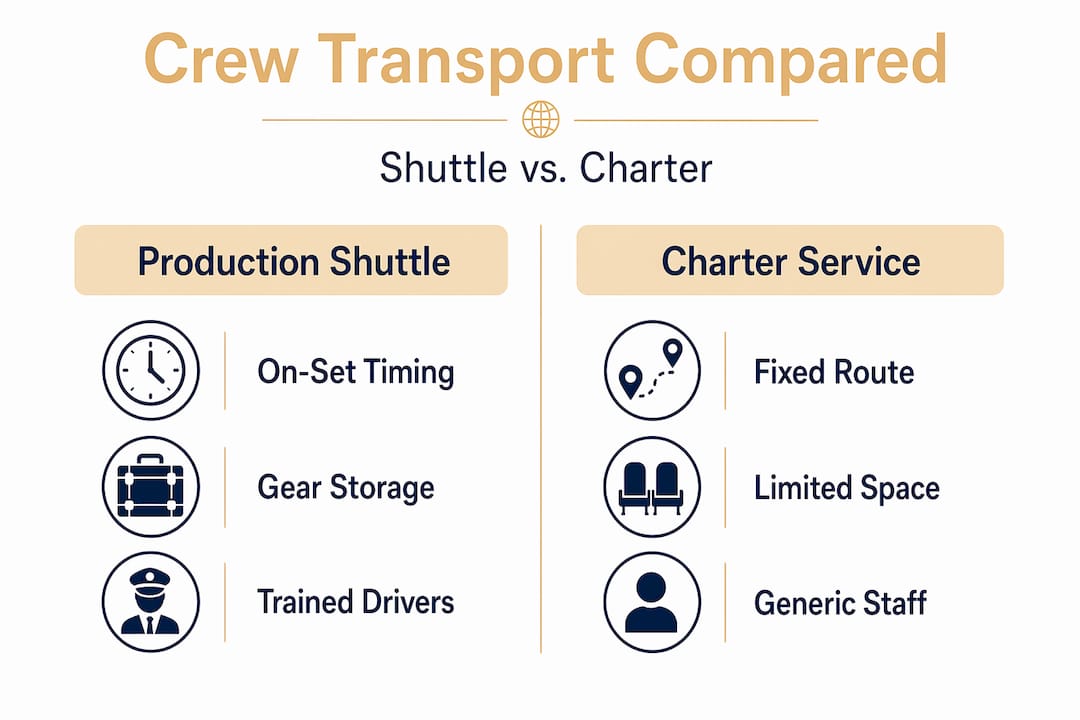
Purpose-built shuttle services vs. generic group transport:
| Factor | Production-grade shuttle | Generic charter or ride-share |
|---|---|---|
| Schedule alignment | Synced to call sheets and departments | Fixed routes and times |
| Real-time adaptability | Adjusts to weather, delays, location changes | Limited or no flexibility |
| Gear and equipment handling | Vehicles configured for production cargo | Standard passenger configuration |
| Permit and access compliance | Operators understand location restrictions | No production-specific knowledge |
| Driver production familiarity | Trained for set etiquette and confidentiality | General transport experience only |
| Standby capacity | On-call vehicles available | Requires separate booking |
The cost impact of getting this wrong is not theoretical. Transport reliability has direct, material consequences for production budgets and shooting schedules, with delays capable of generating $500,000 or more in lost shooting time per day. That figure accounts for crew overtime, equipment rental extensions, location fee overruns, and the compounding effect of a compressed shooting schedule on subsequent days.
Common edge cases that productions must plan for include:
- Multi-location shoot days: When a production moves between two or more locations in a single day, shuttle logistics become significantly more complex. Vehicles must be pre-positioned, and routing must account for travel time between sites.
- Remote or terrain-restricted locations: Desert shoots, mountain locations, and rural areas may require four-wheel-drive vehicles, larger transport capacity, or entirely different staging strategies.
- Specialized gear runs: Camera packages, lighting rigs, and specialty equipment sometimes need dedicated transport separate from crew shuttles to maintain security and proper handling.
- Overnight or split-schedule productions: Productions that shoot nights or split their crew across two units need shuttle operations that run around the clock or overlap between units.
Best practices for engaging production-grade shuttle services:
- Engage the shuttle provider during pre-production, not the week before principal photography begins.
- Share location scouting information so the provider can assess access, staging, and permit requirements in advance.
- Build shuttle costs into the initial budget rather than treating them as a variable line item that gets cut under pressure.
- Require real-time tracking capability so the production office can monitor vehicle locations and anticipate arrival times.
- Establish a direct communication line between the shuttle dispatcher and the key production assistant or transportation coordinator on set.
- Plan for wrap as carefully as you plan for call time. Wrap congestion is one of the most common and most avoidable sources of crew overtime.
Productions that treat shuttle logistics as a commodity purchase consistently pay more in downstream costs than those that invest in purpose-built service from the start.
Why production-grade shuttle services are not a luxury
Here is the assumption we see consistently in productions that run into trouble: a shuttle is a shuttle. If it has wheels and moves people, it solves the problem. That thinking is wrong, and it is wrong in ways that cost real money.
Purpose-built crew shuttles are designed around production realities, including long days, early call times, gear-friendly vehicle configurations, and real-time tracking. Standard group shuttles are not. The gap between those two things shows up on set, not in a vendor comparison spreadsheet.

We have seen productions try to save money by booking generic charter services, only to find that the driver does not know where base camp is, the vehicle cannot accommodate a camera package, and there is no dispatcher available when the location changes at 6 AM. Those are not hypothetical problems. They are predictable outcomes of treating crew transport as a commodity.
The workers' satisfaction angle is also underappreciated. Crew members who spend 45 minutes trying to find a ride-share at the end of a 14-hour day are not coming back tomorrow with high morale. Reliable, comfortable shuttle service is a tangible signal that the production respects the people who make it work. Experienced department heads notice this, and it affects how they talk about the production to their networks.
Experienced producers understand that purpose-built shuttle services pay for themselves. The cost of a standby vehicle is a rounding error compared to the cost of a single delayed shooting day. The cost of a dispatcher who knows your call sheet is nothing compared to the cost of a missed first shot. This is not a luxury decision. It is a risk management decision, and the math is not close.
Take the next step: Secure professional crew transport
Production-grade shuttle logistics are one of the clearest examples of a decision that looks like a cost but functions as insurance. Every element covered in this article, from synchronized call-time routing to standby capacity and real-time coordination, exists because productions that skip these steps pay for it in overtime, overruns, and damaged crew relationships.

If your production is planning a location shoot and needs seamless crew transportation that is built around your schedule, your locations, and your compliance requirements, the right time to start that conversation is now, during prep, not the week before cameras roll. Our team works directly with transportation coordinators and production offices to design shuttle solutions that fit the specific demands of your shoot. Reach out to discuss your project, and let us show you what purpose-built crew transport actually looks like in practice.
Frequently asked questions
How does film crew shuttle scheduling handle changing call times?
Shuttle services build their timing directly around the call sheet and maintain open communication with the production office so they can adapt to last-minute changes, ensuring every department arrives on schedule. Providers prioritize responsiveness to schedule changes as a core operational requirement.
What makes film crew shuttles different from regular charter buses?
Film crew shuttles run continuous loops timed to department call times, accommodate gear and equipment, and adjust in real time to production changes, none of which standard charter routes are designed to do. Purpose-built shuttle services are specifically configured for the demands of a working set.
Why can't we just use ride-hailing services for crew transport?
Ride-hailing services cannot reliably serve large crews in locations with restricted access, limited parking, and strict permit requirements, all of which are standard conditions on film sets. Permits and access enforcement make individual ride-share arrangements a logistical liability.
What are the financial risks of unreliable crew transport?
A single day of delays caused by transport failures can cost a production over $500,000 in lost shooting time, crew overtime, and equipment overruns, making dedicated shuttle capacity one of the most cost-effective investments in the budget.