
Executive protection is a private, client-contracted service bound by contract terms and property jurisdiction, while police are state agents carrying statutory law enforcement powers that apply across an entire city, county, or state. The practical rule is simple: hire executive protection for planned personal security and travel risk, and call 911 for crimes in progress or anything requiring arrest powers.
TL;DR:
- Executive protection is limited to contractual authority and cannot perform arrests, search warrants, or force beyond civil liability, unlike police with statutory powers.
- Private security firms lack standardized national training and accountability measures, making vetting and insurance verification crucial before hiring.
- Coordination with local police is essential at large events, with pre-established communication plans and police liaison relationships improving response times.
- The cost of executive protection varies widely based on team size, risk level, and travel, and it is typically paid directly by the client rather than publicly funded.
- Executive protection cannot act outside property boundaries or scope of the contract, relying on police to handle active crimes or emergencies requiring legal arrest or investigation.
Table of Contents
- Executive Protection vs Police: Roles and Operational Scope
- How Do Training and Hiring Standards Differ?
- What Legal Powers and Accountability Limits Apply?
- Executive Protection vs Police: Side-by-Side Scenarios
- When Should You Call Police vs Hire Executive Protection?
- Practitioner Overlap and What It Means for Executive Transport
- How Did Executive Protection and Police Roles Evolve?
- Oversight, Accountability, and Liability: Who Answers for What?
- What Do Executive Protection and Police Services Cost?
- What Are Executive Protection's Practical Limits?
- What Happens Legally If Protection Personnel Overstep?
- How Do EP Teams and Police Coordinate on the Ground?
- A Policy Perspective on the Public-Private Security Divide
- Secure Transport That Backs Up Your Protection Plan
- Sources
- FAQ
Executive Protection vs Police: Roles and Operational Scope
The mission gap explains almost everything else. Police exist to prevent crime, enforce statutes, and maintain public order across a defined jurisdiction. Executive protection exists to keep one client, or one small group, safe through planning, advance work, and physical presence. Neither role is a smaller version of the other. They're built for different jobs entirely.
An executive protection specialist typically works advance logistics for a trip days before the client arrives, screening hotels, mapping hospital routes, and coordinating with a chauffeur or transport team. A police officer, by contrast, responds to what's happening right now, whatever that is, wherever it falls within their beat.
Where each one is legally allowed to act differs sharply too:
- Executive protection operates on client property, inside a chartered vehicle, or at a contracted event; authority comes from the client agreement, not from statute.
- Police operate anywhere inside their city, county, or state jurisdiction, and their authority comes from law, not from who's paying them.
- Federal agents, such as the U.S. Secret Service, carry statutory protection authority that extends nationally for specific protectees, a scope no private contractor can match.
Typical deployments look nothing alike. Executive protection shows up as a motorcade escort, a red-carpet perimeter, or a quiet presence at a private residence. Police show up on a 911 call, a traffic stop, or a homicide investigation. Industry explainers describe executive protection as inherently proactive: built around advance work, close protection, and medical readiness rather than reaction to a crime already underway.
How Do Training and Hiring Standards Differ?
Police training follows a public, standardized track. Recruits attend a state-certified academy, pass legal and use-of-force certification, and then face ongoing accountability through their department, civilian review boards, and court oversight. That structure doesn't disappear once the academy ends. Officers requalify on firearms, update on case law, and answer to a chain of command that's ultimately answerable to elected officials.
Private executive protection has no single national standard. Many practitioners come from law enforcement or military backgrounds, but plenty don't. Reputable firms layer in specialized certifications: advanced evasive driving, EMT or tactical medical training, and dignitary protection courses modeled on the same skills federal protective agencies use. Quality varies a lot from one contractor to the next, which is exactly why vetting matters.
Before hiring an executive protection provider, check for:
- A documented background check on every team member, not just the lead agent.
- Verifiable references from prior corporate or entertainment clients.
- Active liability insurance covering the specific services being contracted.
- Training logs showing recent, relevant certification, not a credential from a decade ago.
Pro Tip: Ask a candidate protection firm for the name of a local police liaison or watch commander they've worked with before. A firm with real coordination history will have one; a firm that hasn't done this before will hesitate.
What Legal Powers and Accountability Limits Apply?
Police carry statutory authority that private security simply doesn't have. That includes the power to arrest, execute search warrants, and use force under legal standards, all constrained by the Fourth Amendment and Miranda protections that apply specifically to state actors. Those constraints exist because police wield state power. Executive protection agents don't carry that power, and they don't carry those constitutional restrictions either, since the Constitution's limits on government conduct generally don't bind private citizens the same way.
That cuts both ways. Private security personnel operate outside many of the constitutional rules that bind police, which changes how they can gather information or act on a client's property, but they also carry heavier civil-liability exposure when they exceed the scope of what their contract actually authorizes, according to a Florida State University policing roundtable.
Key differences worth knowing:
- Police: arrest powers, warrant execution, use-of-force standards reviewed by courts and internal affairs.
- Executive protection: citizen's-arrest rules only, authority limited to the client's contract, and civil lawsuits as the primary accountability check.
- Coordination tools like memoranda of understanding (MOUs) and, in rare cases, formal deputation let the two work together on a shared event.
Private security officers now outnumber public police by a significant margin nationally, and their functions increasingly overlap with traditional policing work, according to research published in the Journal of Empirical Legal Studies. The National Institute of Justice has flagged the accountability gap that creates: private teams don't answer to the same transparency requirements police departments do, so due diligence on the reader's end matters more than it would with a public agency.
Executive Protection vs Police: Side-by-Side Scenarios
Picture the same flagged threat at a corporate gala, and watch how each side handles it.
- Advance planning, days out. Executive protection walks the venue, identifies choke points, arranges a discreet exit route, and briefs the client's driver. Police aren't involved unless the event organizer requests a visible detail.
- A suspicious individual is spotted near the client an hour before doors open. The protection team repositions the client, tightens the perimeter, and quietly flags the person to venue security. They don't detain anyone, because they can't.
- The situation escalates into a physical confrontation. This is where executive protection's authority runs out. The team calls 911, isolates the client, and hands the scene to responding police officers, who now have arrest power the private team never had.
- Post-incident. Police take statements, secure the scene, and potentially open an investigation with subpoena power and forensic resources. Executive protection files an incident report for the client and insurer, and continues the assignment.
The tools each side uses reflect that split. Executive protection relies on route planning, low-profile surveillance, convoy driving techniques, and encrypted radio communication. Police bring forensics, records access, and legal authority the private side can't replicate. An executive protection team cannot execute a warrant, and a patrol officer generally can't provide the kind of continuous, discreet personal escort a hired detail delivers, unless specifically assigned to that duty.
When Should You Call Police vs Hire Executive Protection?
The decision usually comes down to timing and legal need, not preference.
Call 911 immediately for any crime in progress, medical emergency, or direct physical threat. Police and EMS have the authority and equipment private teams don't, and every minute matters in that situation.
Hire executive protection when the risk is ongoing, targeted, or tied to travel and public exposure: a named threat against an executive, a high-profile event appearance, or repeated travel through unfamiliar cities. This is planning work, done in advance, not a reaction to an active crime.
For large public events, the smartest move often combines both. Executive protection handles the client's immediate safety and movement, while a liaison maintains contact with local police for anything requiring statutory authority.
Pro Tip: Build the police liaison relationship before the event, not during it. A protection team that's already introduced itself to the local precinct gets a faster response if something does go wrong.
- Active crime or medical emergency: call 911.
- Ongoing personal or travel risk: hire vetted executive protection.
- Large public appearance: run both in parallel, with clear communication protocols established in advance.
Practitioner Overlap and What It Means for Executive Transport
Many executive protection agents came up through police departments or the military, and that background shows up in how they plan movement, not just how they handle confrontation. Ask any staffing firm directly whether their agents have that experience, and ask for specifics, not a generic assurance.
Transport is where a lot of protection plans quietly fail. A protection team can do everything right and still get exposed by a driver who doesn't know the route, talks about the client's schedule, or shows up in a vehicle that draws attention. Riga Global Travel's buyer's guide to executive protection transport covers exactly this gap, including the vetting questions worth asking before booking:
- Are chauffeurs background-checked and NDA-bound?
- Does the provider coordinate directly with a client's protection team on routing?
- Is there a documented insurance policy covering the specific service booked?
How Did Executive Protection and Police Roles Evolve?
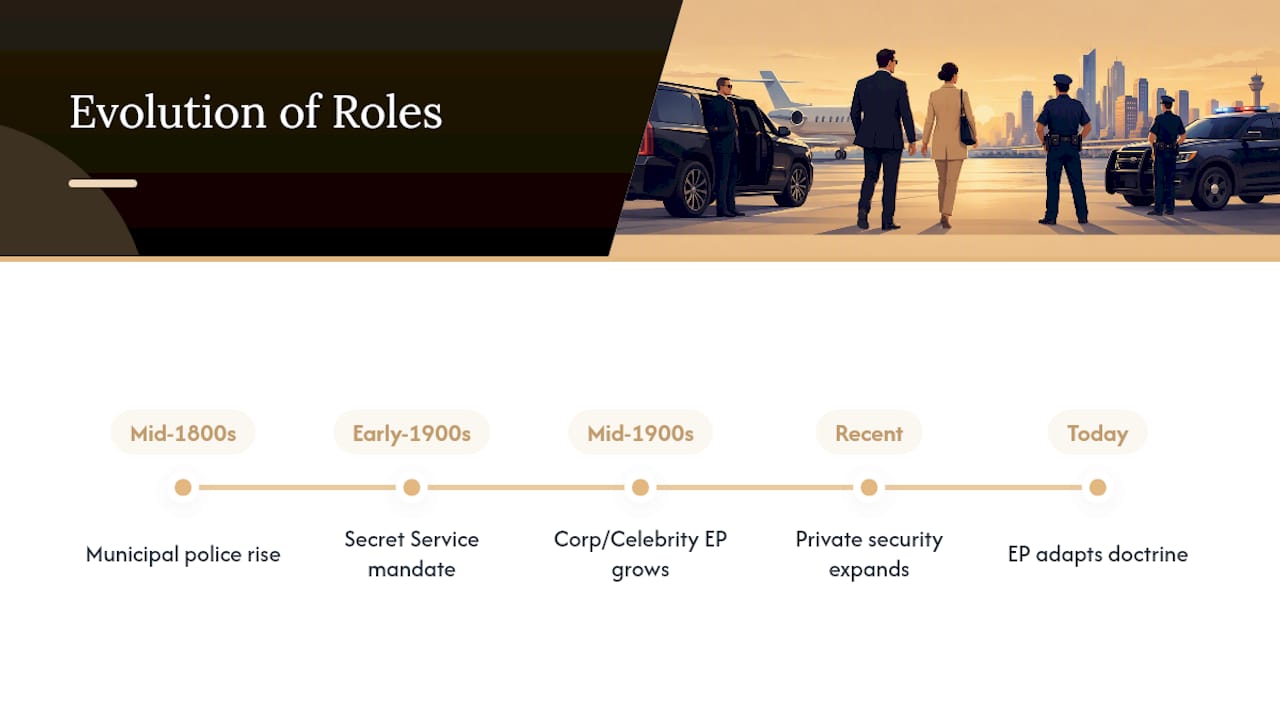
Modern policing in the U.S. traces back to municipal forces built in the mid-1800s, designed around a public mandate: prevent crime, respond to calls, answer to elected government. That basic structure hasn't changed much in over a century, even as tools and training have modernized considerably.
Executive protection has a different, more scattered history. Formal protective details started with government figures. The Secret Service's protective mission, still governed today by 18 U.S.C. §3056, dates back to the early 1900s and remains one of the few explicit federal statutory protective mandates in the country. Corporate and celebrity protection grew later and separately, driven by high-profile kidnappings, stalking cases, and the entertainment industry's growing security needs starting in the mid-20th century.
The two tracks converged as private security scaled up. Government reports tracking the private security industry show steady growth in scope and headcount over recent decades, with executive protection becoming one specialized branch alongside patrol, investigations, and cybersecurity work. That growth means today's executive protection agent is often drawing on techniques that started in federal protective work but adapted for private clients who never had federal statutory cover to begin with. The result is a private industry built on borrowed doctrine, applied to a completely different legal footing.
Oversight, Accountability, and Liability: Who Answers for What?
Police accountability runs through public channels: internal affairs, civilian review boards, court oversight, and, ultimately, elected officials who set department policy. That system is imperfect, but it's visible. Records exist. Complaints get filed somewhere.
Executive protection accountability runs through the contract and the courts, mostly through civil litigation after something has already gone wrong. There's no equivalent to a civilian review board for a private protection firm. If an agent oversteps, the client's main recourse is a lawsuit or contract dispute, not a formal misconduct process.
That gap is a known concern in the research literature. NIJ's analysis of the public-private policing boundary specifically flags the lack of transparency and public accountability that comes with private security's growth, urging police departments to build clearer partnership frameworks rather than let the boundary stay undefined. For a client hiring executive protection, that means the burden of accountability shifts almost entirely onto the hiring process. Ask for insurance documentation up front. Confirm what happens contractually if an agent acts outside their authorized scope. Nobody else is going to ask those questions on your behalf.
What Do Executive Protection and Police Services Cost?
Police protection is funded through taxes: it's a public good, paid for collectively, and available to every resident regardless of ability to pay, though the scope of that service is generalized rather than tailored to one person.
Executive protection is funded entirely by the client, and pricing reflects the customized nature of the work. Costs scale with team size, duration, travel requirements, and risk level. A single-agent local assignment costs far less than a multi-agent detail covering international travel with advance teams and armored transport. There's no fixed public rate card, because there's no public funding involved. Corporations often build protection costs into executive compensation or risk-management budgets, while individuals and entertainment clients typically contract directly with a security firm or bundle protection into broader travel and event logistics arrangements.
That funding difference explains a lot about access. Police protection is universal but generalized. Executive protection is customized but limited to whoever can pay for it, which is part of why policy researchers raise equity concerns about unequal access to personal safety resources.
What Are Executive Protection's Practical Limits?
Executive protection can't arrest anyone. It can't execute a search warrant, compel a witness statement, or invoke the legal authority that comes from being a sworn officer of the state. Every one of those limits traces back to the same root cause: private agents act under contract law, not criminal law authority.
Jurisdiction is another hard boundary. An executive protection team's authority generally stops at the edge of the client's property or the scope of the specific event they're contracted to cover. Step outside that scope, and the team is operating on the same legal footing as any private citizen, nothing more.
Resource limits matter too. Police departments have access to forensics labs, databases, and interagency intelligence sharing that no private firm can replicate. When a threat requires that kind of investigative depth, executive protection's job becomes coordination, not resolution. The best protection teams know exactly where their authority ends and loop in law enforcement before that line gets crossed, not after.
What Happens Legally If Protection Personnel Overstep?
The consequences for an executive protection agent who acts like a police officer, physically detaining someone, searching a bag without consent, or using force beyond self-defense, can be serious, and they land differently than they would for a sworn officer.
A police officer who exceeds legal authority faces internal discipline, potential decertification, and in serious cases, criminal charges, all processed through a public system with defined procedures. A private security agent who does the same thing faces those same criminal exposure risks personally, plus civil liability that can extend to the hiring firm and even the client who contracted the service. There's no qualified immunity defense available to private actors the way there sometimes is for police in the course of official duties.
This is precisely the risk the Florida State University roundtable flags: private agents operate with fewer constitutional restrictions in some respects, but that freedom comes paired with much higher personal and organizational exposure the moment they act outside contractual scope. A false imprisonment claim, an assault claim, or a wrongful detention claim against a private agent doesn't get the procedural protections a police defendant might have. That's a real financial and legal risk clients should understand before assuming their protection team can "just handle it" the way police would.
How Do EP Teams and Police Coordinate on the Ground?
Communication protocols between the two look almost nothing alike, and that mismatch is exactly why advance coordination matters.
Police departments run on centralized dispatch, radio channels tied to a chain of command, and documented incident logs that feed into a public record. Executive protection teams typically run on private encrypted channels, built around a single client's schedule, with communication designed for discretion rather than department-wide visibility.
When the two need to work together, usually at a large public event, coordination happens through a few specific mechanisms: a pre-event briefing with the venue's assigned police liaison, an exchange of contact information for the shift commander on duty, and sometimes a formal memorandum of understanding if the event is large enough to warrant one. CRS reporting on federal protective services notes that only a small number of federal agencies carry explicit statutory protective mandates, which is part of why so much coordination in the private sector happens informally, built on relationships rather than standardized protocol.
The firms that do this well treat that police liaison relationship as part of the job, not an afterthought. The ones that don't tend to find out how much that gap matters at the worst possible moment.
A Policy Perspective on the Public-Private Security Divide
The growth of private security has outpaced the public conversation about who's accountable when it fails. Unequal access to protection is the quieter cost: police coverage is universal, but real personal security increasingly belongs to whoever can afford to contract it. Readers hiring executive protection should insist on documented coordination with local authorities, not vague assurances, and get every liability and scope question answered in writing before an assignment starts.
— Sammy
Secure Transport That Backs Up Your Protection Plan
A protection detail is only as strong as the transport underneath it, and that's where Riga Global Travel fits. Riga Global Travel provides chauffeurs, confidential routing, and direct access to ownership rather than an app, offering the coordination an executive protection team needs from a transport partner.

The service lineup covers what most protection-conscious clients actually need: airport transfers, limousine service, full corporate service accounts, and dedicated celebrity transportation built around privacy and NDA-based screening. If you're coordinating a protection detail around travel, event logistics, or a red-carpet appearance, request a quote through Riga Global Travel's contact page and get a chauffeur team briefed before the client ever lands.
Sources
- Private security and public police
- Managing the boundary between public and private policing (NIJ)
- 18 U.S.C. §3056 — Special agents; appointment; deputation; protection of persons and buildings
- CRS report on federal protective services
FAQ
Who Has Higher Authority Than the Police?
No private actor outranks local police authority within their jurisdiction. Federal agencies with explicit statutory protective mandates, such as the Secret Service under 18 U.S.C. §3056, can operate protective missions that supersede local jurisdiction in specific federal contexts, but that authority is statutory, not a general hierarchy over all police.
What Is the Difference Between a Bodyguard and Executive Protection?
"Bodyguard" usually describes reactive, close-proximity personal security, while executive protection is the broader, proactive discipline covering advance work, route planning, medical readiness, and coordinated logistics. Industry sources describe executive protection as a full planning process, not just a person standing next to a client.
Does the President Have Power Over the Police?
The president has no direct command authority over state or local police departments, which operate under state and municipal law, not federal executive authority. The president does have authority over federal protective agencies like the Secret Service, whose protective mission is set by statute.
Does ICE Have Authority Over Police?
ICE is a federal agency with its own statutory enforcement authority, primarily focused on immigration law, and it does not have command authority over state or local police departments. Coordination between ICE and local police happens through agreements and task forces, not a chain-of-command relationship.
When Should I Hire Executive Protection Instead of Relying on Police?
Hire executive protection for planned, ongoing, or travel-related risk, such as a targeted threat, high-profile public appearance, or frequent travel through unfamiliar locations. Police remain the right call for any active crime or emergency, since only they carry statutory arrest and response authority; for the transport piece of that plan, Riga Global Travel coordinates vetted chauffeurs directly with protection teams.