
Coordinating guest transportation at a private sports event is one of the most underestimated logistical challenges you'll face as an event planner. Parking chaos, curbside gridlock, late arrivals, and disorganized departures can unravel months of meticulous planning in under an hour. The benefits of private sports event shuttles go well beyond simply moving people from point A to point B. They give you control over timing, guest flow, and the overall experience in ways that no other transportation option can match. This article breaks down exactly how.
Table of Contents
- Critical criteria for evaluating private sports event shuttles
- Operational benefits of smart shuttle dispatch and management
- Enhancing guest experience and venue logistics with shuttle transport
- Matching shuttle capacity and frequency to your event demand
- Comparing private shuttle benefits with traditional transportation options
- Why strategic shuttle management outweighs fleet size in event success
- Optimize your sports event transit with Riga Global Travel
- Frequently asked questions
Key Takeaways
| Point | Details |
|---|---|
| Reducing wait times | Smart dispatch and communication reduce guest wait times without increasing fleet size. |
| Improved guest experience | Consolidated shuttle transport minimizes parking stress and enhances venue flow. |
| Capacity matching | Optimizing vehicle size and loop frequency ensures efficient shuttle service during peaks. |
| Environmental impact | Group shuttles lower emissions and support sustainability goals. |
| Operational focus | Effective shuttle performance relies more on management than simply adding more vehicles. |
Critical criteria for evaluating private sports event shuttles
To understand how shuttles deliver value, you first need to assess these critical operational and experience criteria. Skipping this step is how planners end up with too few vehicles at peak hour or a fleet sitting idle at the wrong lot.
The following are the non-negotiable factors to evaluate before committing to any private shuttle services for sports:
- Capacity alignment: Your vehicle size and departure frequency must reflect actual guest demand, not estimated demand. Get headcount data from registration or ticket sales and plan around your peak 30-minute window, not your average.
- Dispatch management: Real-time data about vehicle location and passenger load lets your team move vehicles before queues form, not after.
- Guest communication: Digital ETAs, clear signage, and staff at pickup zones reduce perceived wait times even when actual wait times are unavoidable.
- Sustainability: Venues and sponsors increasingly track carbon impact. Eco-friendly vehicle options give you a talking point and reduce neighborhood congestion.
- Operational flexibility: Demand surges at unpredictable moments. Your shuttle plan needs built-in protocols for redeployment, not a static schedule that collapses when the game ends early.
Each of these criteria directly shapes the return you get from your investment in customized sports event transport.
Operational benefits of smart shuttle dispatch and management
With evaluation criteria in place, let's look at how shuttle dispatch innovations deliver genuine operational results. This is where the advantages of event shuttles become tangible and measurable.
The single most common mistake in event shuttle management is treating dispatch as a passive function. Planners book vehicles, assign routes, and hope for the best. Smart dispatch turns that into an active, data-driven process.
- Proactive redeployment: When live tracking shows a vehicle sitting at a low-traffic pickup point while another zone is overloaded, dispatchers can reroute immediately. This prevents the "where is my shuttle?" panic that damages guest experience.
- Staging protocols: Pre-positioning vehicles near high-demand zones 15 minutes before predicted peak arrivals cuts boarding time significantly.
- Dynamic routing: Adjusting loops in real time based on traffic or venue exit delays keeps headways (the time between successive shuttle arrivals) consistent and predictable.
- Passenger communication tools: Sending real-time ETAs via text or app keeps guests anchored to pickup zones instead of wandering, which accelerates boarding.
- Fixed fleet efficiency: Reducing guest wait and queue formation through dispatch controls and passenger communication enhances shuttle performance without adding vehicles.
"The best shuttle programs don't win on vehicle count. They win on decision speed. A dispatcher who moves one bus 10 minutes early prevents a 40-minute queue."
Pro Tip: Assign a dedicated dispatch supervisor with live vehicle visibility for any event over 500 guests. One person focused solely on redeployment decisions pays for itself in guest satisfaction.
Well-run private sports shuttle operations rely on this kind of active management, not just a fleet agreement. If your provider can't show you their dispatch protocol before event day, that's a red flag. For smaller group movements, structured business minibus group transfers offer a useful model for managing tightly scheduled loops.
Enhancing guest experience and venue logistics with shuttle transport
Beyond operations, the guest-facing benefits of customized sports event transport are just as compelling, and often more visible to the people who matter most: your clients and their guests.
Sports events carry emotional weight. Fans and VIP guests arrive with high expectations and limited patience for friction. Anything that feels disorganized reflects directly on the event brand you are protecting.
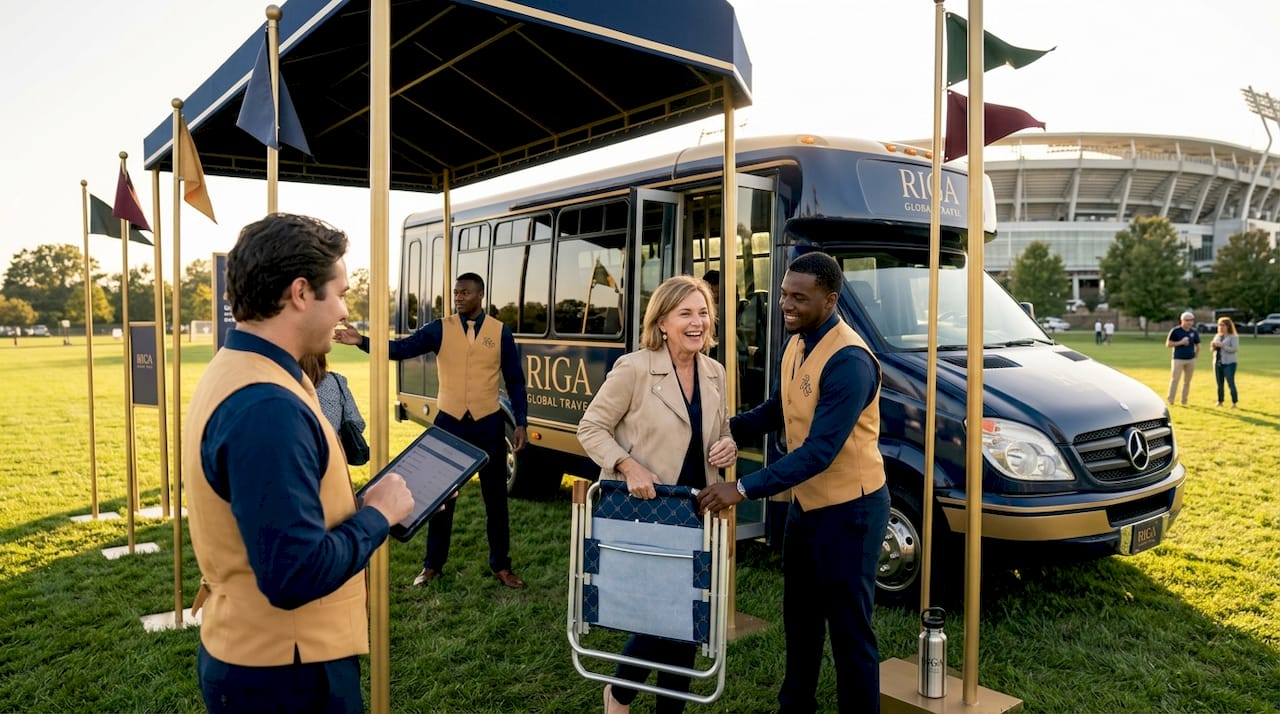
- Centralized loading zones: Shuttles consolidate arrivals and departures into defined areas. This removes the chaos of distributed street-side drop-offs and makes crowd management dramatically easier.
- Reduced walking distance: Guests who park at a remote lot and walk 20 minutes arrive stressed. Shuttle guests arrive at the venue entrance, ready to engage.
- Curbside flow improvement: Consolidated shuttle transport improves curbside flow and reduces guest stress related to parking, long walks, and valet confusion.
- Visible sustainability: When guests see a fleet of low-emission or electric shuttles, they notice. It signals that your organization takes responsibility seriously, which matters increasingly to corporate sponsors and premium ticket holders.
- Professional driver quality: Trained drivers who know the venue layout, the event schedule, and how to communicate with guests are part of the experience, not just transportation staff.
Pro Tip: Place branded signage and a uniformed staff member at every shuttle pickup zone. The visual reassurance alone reduces guest anxiety and speeds boarding by keeping people in place.
For events that include airport transfers or multi-location pickups, the principles behind solid group airport transfer tips apply directly to sports event shuttle planning, particularly around staggered timing and clear guest communication.
Matching shuttle capacity and frequency to your event demand
Now that you understand guest experience and operations, right-sizing your shuttle resources is where the sports event transportation benefits get quantified.
The formula is straightforward: effective hourly capacity equals passenger capacity per vehicle multiplied by trips completed per hour. A 50-seat bus completing two loops per hour delivers 100 guests per hour. A 25-seat minibus completing four loops per hour delivers the same throughput with greater frequency and shorter waits. The right answer depends on your venue layout and your guests' tolerance for waiting.
Here is a step-by-step approach to capacity planning:
- Define your peak demand window. Most events see 60 to 70 percent of total arrivals in the 45 minutes before start time. Build your capacity model around that window, not the full event duration.
- Map your loop. Calculate the complete loop time: travel from parking to venue, unload time (allow 3 to 5 minutes for large groups), return travel, and any traffic buffer.
- Calculate trips per hour. Divide 60 minutes by your total loop time in minutes.
- Multiply by vehicle capacity. This gives you your hourly throughput per vehicle.
- Add a buffer. Plan for 15 to 20 percent above your peak estimate to absorb surges and unexpected delays.
The table below illustrates how loop time affects throughput across vehicle types, based on capacity planning principles that match vehicle capacity and loop frequency to demand:
| Vehicle type | Passenger capacity | Loop time (min) | Trips per hour | Hourly throughput |
|---|---|---|---|---|
| Standard minibus | 25 | 15 | 4 | 100 |
| Coach bus | 50 | 20 | 3 | 150 |
| Large coach bus | 70 | 25 | 2.4 | 168 |
| Shuttle van | 14 | 10 | 6 | 84 |
Pro Tip: Use staggered pickup points across your parking area to distribute demand. Instead of one primary lot overwhelming a single bus stop, multiple smaller zones feed the same fleet more evenly and cut individual wait times noticeably.
Comparing private shuttle benefits with traditional transportation options
To round out your understanding, here is a direct comparison of private sports event shuttles against the alternatives planners typically default to.
| Factor | Private shuttles | Personal vehicles | Rideshare services |
|---|---|---|---|
| Venue congestion | Low (centralized zones) | High (dispersed arrivals) | Medium (surge clustering) |
| Guest wait time | Predictable with planning | Unpredictable | Variable, often long post-event |
| Carbon footprint | Low per person | High (single occupancy) | Moderate |
| Cost predictability | High (fixed contract) | Variable (parking, fuel) | Low (surge pricing) |
| Guest experience control | Full | None | Limited |
| Parking infrastructure needed | Minimal | Extensive | Minimal |
The case for why choose private shuttles over rideshares becomes especially clear post-event. Rideshare demand spikes the moment the final buzzer sounds. Guests face 30 to 60 minute waits at inflated prices. Private shuttles run on your schedule, not an algorithm's.
Group shuttles reduce congestion, emissions, and parking costs while simplifying guest travel compared to individual cars. For high-profile events where guest perception is tied to your brand reputation, that difference is not marginal. It is fundamental.
Key advantages of event shuttles over individual transportation:
- Budget certainty: Fixed contracts mean no surprise invoices. You know the cost before the event, not after.
- Brand continuity: Every guest touchpoint, from the vehicle exterior to the driver's greeting, can reflect your event brand.
- Scalability: Adding a vehicle to a contracted fleet is far simpler than managing a sudden spike in rideshare availability.
- Post-event efficiency: Coordinated departure shuttles move more guests off-site faster than any other method, reducing venue overtime costs.
Why strategic shuttle management outweighs fleet size in event success
With a clear comparison in mind, here is the perspective that most event transportation conversations miss entirely.
The entertainment and sports event industry has a reflex response to transportation problems: add more vehicles. A queue forms, someone calls for two extra buses, and the problem appears solved. But the queue rarely formed because there weren't enough vehicles. It formed because the existing vehicles weren't in the right place at the right time, and no one told the guests what to expect.
Shuttle performance is driven by decision-making and proactive passenger communication rather than fleet size. We have seen events with eight buses underperform events with four, because the eight-bus program had no real-time dispatch oversight and no guest communication. The buses were there. The system wasn't.
This matters for your budget, too. Adding vehicles is expensive. Training a dispatcher and deploying a real-time tracking app costs a fraction of an additional bus contract. The ROI on operational intelligence is consistently higher than the ROI on additional capacity, at least until you have genuinely exhausted your current fleet's potential.
The other blind spot: over-communicating to guests is almost impossible. Text alerts, app notifications, digital signage, and staff announcements at pickup zones stack on top of each other without diminishing returns. Guests who know their shuttle is four minutes away stay put. Guests who don't wander, cluster at vehicle doors, and slow boarding for everyone behind them.
Advanced shuttle management solutions that combine live tracking, proactive dispatch, and multi-channel guest communication consistently outperform larger fleets that operate on static schedules. If your current provider can't articulate how they manage dispatch in real time, you are paying for vehicles, not a program.
Optimize your sports event transit with Riga Global Travel
Private sports event shuttle planning at this level requires a partner who understands both the operational complexity and the experiential stakes involved.
Riga Global Travel shuttle solutions are built specifically for the entertainment industry, where guest experience and brand reputation are non-negotiable. From capacity modeling and route design to live dispatch management and eco-friendly vehicle options, every element of your shuttle program is tailored to your event's specific demand and venue layout. Whether you are planning a championship event, a private suite experience, or a multi-venue tournament weekend, the team brings the operational depth and concierge-level service your guests expect. Reach out to explore a custom shuttle plan for your next event.
Frequently asked questions
How do private sports event shuttles reduce guest wait times effectively?
They use real-time dispatch controls, staging optimization, and passenger communication to align vehicle deployment with demand, reducing queue formation without increasing fleet size.
Can shuttle services improve sustainability at sports events?
Yes. Shuttles consolidate multiple single-occupancy vehicle trips, and per-person emissions drop by 30 to 45 percent when guests shift from individual cars to professionally planned, eco-friendly shuttle fleets.
What factors determine the right shuttle capacity for an event?
Capacity depends on passenger volume, vehicle size, trip frequency, loop times, and peak demand windows, optimized through thorough planning and flexible scheduling.
Why is passenger communication important in shuttle operations?
Informing guests of shuttle ETAs keeps them organized at pickup zones; real-time ETAs reduce loading times and perceived wait independently of how long the actual wait is.
How do shuttle services compare with traditional parking options?
Group shuttles reduce congestion, emissions, and parking costs while simplifying guest arrivals in ways that individual car parking simply cannot match, particularly for high-volume post-event departures.